
Rock Concert Review: A No-Frills Attack from the Post-Punk Quintet Shame
By Paul Robicheau
Shame’s latest record and Monday’s holiday show at the Brighton Music Hall both prove the twin-guitar quintet has matured in sound and spirit while still flashing youthful spunk.
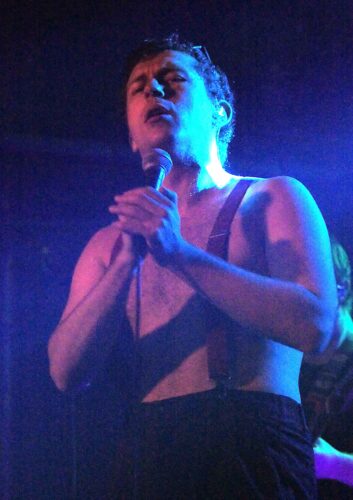
Charlie Steen of Shame at Brighton Music Hall. Photo: Paul Robicheau
It’s surprising that British post-punk rockers Shame aren’t a really big deal by now. The South London band formed in 2014 as childhood friends in their late teens, and they’re already touring on their fourth album, Cutthroat. That record and Monday’s holiday show at the Brighton Music Hall both prove the twin-guitar quintet has matured in sound and spirit while still flashing youthful spunk.
Shame guitarist Sean Coyle-Smith develops electronic loops in his spare time and Cutthroat, produced by John Congleton (St. Vincent, Angel Olsen), integrates that kind of sonic icing in some songs. But onstage Monday before just a few hundred fans celebrating MLK Day at the Allston club, Shame stuck to a no-frills attack.
Lead singer Charlie Steen served as the focal point, strutting around the stage with red suspenders over his bare chest, gazing over the crowd while coolly stoking the semblance of a mosh pit with his gruff, raspy voice. Bassist Josh Finerty bounced in kinetic contrast with teetering scissor kicks in front of drummer Charlie Forbes’ anchoring snap, flanked by Coyle-Smith and Eddie Green’s blended guitars.
The band dove early into the Gang of Four-inspired punch of its 2018 debut Songs of Praise with “Concrete” and “Tasteless,” which dismissed commodities, racism, and indifference, with closing refrain “I like you better when you’re not around.”
In turn, Shame explores ideas of corruption and cowardice – both external and internal – in new album Cutthroat, which yielded seven of the 17 songs served at the Brighton Music Hall. “You’re always doing nothing, ’cause there ain’t nothing better to do,” Steen – a more insightful lyricist than his somewhat brutish affect might suggest — railed against empty-thinking moaners and complainers.
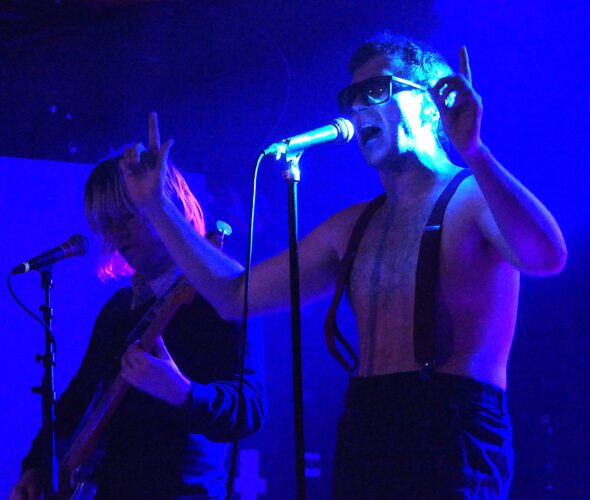
Josh Finerty and Charlie Steen of Shame at Brighton Music Hall. Photo: Paul Robicheau
Yet the new record added its own twists following a double shot of older tempo tempests “Six Pack” (“free-form British jazz,” Steen joked to the pogo-moshers) and “Alphabet,” which saw Finerty careen off the top of a low speaker cabinet, resembling a surfer in his bleach-blond hair. The bassist held down the active notes cradled within the slashing guitars in the near-country lope “Quiet Life” (about a stifling relationship) and Steen injected a few lyrics in Portuguese at the start of “Lampião,” a tune about a Brazilian bandit both hated and revered.
Steen did not deliver everything with a bark, shedding his shades to mull the slow “Adderall,” then lending whispered rumination over a choppy undertow in “Snow Day.” In Monday’s smartly paced set, that song was sandwiched by the melodic yet briskly mosh-inciting “Spartak” (the kind of tune that should catch more ears at a time when Oasis can fill stadiums) and old favorite “One Rizla,” where Steen stood before the crowd, pumping his mic stand like barbells.
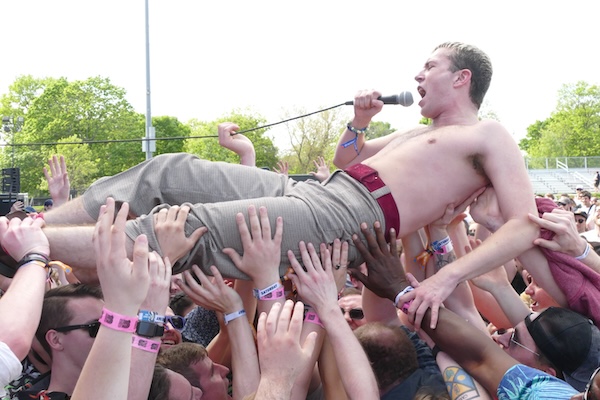
Charlie Steen of Shame at Boston Calling 2019. Photo: Paul Robicheau
His glasses came off again during closer “Cutthroat,” converting the concept of murderous conquest to a dance-beat party where you can “do what you want.” Steen got one of his suspenders unlatched during a brief crowd-surfing jaunt – something he did more of during Shame’s whippersnapper set at Boston Calling in 2019. Then the singer held his microphone over his head with both hands to sway with a sly smile, like a Chippendales dancer from the other side of the tracks.
The shadowy backlighting at the Brighton Music Hall didn’t do any favors for a band that’s not “born to die” (as one “Cutthroat” lyric boasted), but is poised to shine on bigger stages as a headliner in the U.S. as well as the UK.
Paul Robicheau served more than 20 years as contributing editor for music at the Improper Bostonian in addition to writing and photography for The Boston Globe, Rolling Stone, and many other publications. He was also the founding arts editor of Boston Metro.