
Reviews and Retrospective: Jane Ira Bloom’s “once like a spark” and “Songs in Space”
By Steve Elman
2025 turned out to be a feast year for devotees of soprano saxophonist Jane Ira Bloom. The music found on both of these releases could be thought of as exemplifying three areas Bloom has explored in depth and refined to purity.
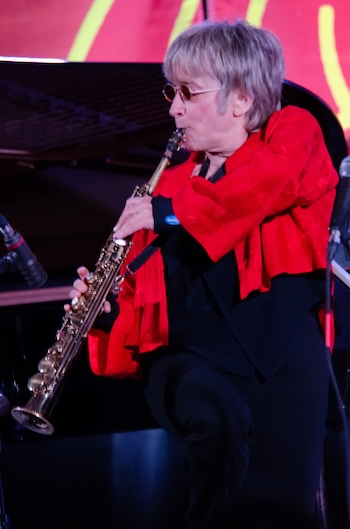
Soprano saxophonist Jane Ira Bloom. Photo: Ken Hunt)
It’s been either feast or famine for fans of saxophonist Jane Ira Bloom. In some years, we’ve had the pleasure of hearing two of her projects (or more, if we’ve been fortunate enough to hear her in person). In other years, especially during the pandemic, we’ve been deprived of her singular voice, and somehow those years have seemed a little barren.
I use the first-person-plural here because those who love Bloom’s work are a select bunch, and I think we consider ourselves a little special for appreciating her.
She has had her share of recognition, to be sure: given a Guggenheim Fellowship in music composition, named 13 times by jazz journalists as soprano saxophonist of the year, honored for soprano saxophone by the Downbeat International Critics Poll, given the Mary Lou Williams Women In Jazz Award for lifetime service to jazz, commissioned by NASA to write music for a space project, and even eponymized with an asteroid named in her honor by the International Astronomical Union. Still, she has not achieved the household-name status she deserves, so we Bloomophiles continue to cherish what she does, even as she approaches 50 years as a performing musician.
2025 turned out to be a feast year for us. In June, Bloom released Songs in Space (on her own label, Outline), and in November, a second effort appeared, once like a spark, co-led by percussionist Brian Shankar Adler (on Adler’s label, Adhyâropa). Bassist Mark Helias had his hands on both projects, performing on the first one and engineering the second.
Both are collections of profoundly intimate miniatures. In Songs in Space, Bloom gives us trio performances with Helias and drummer Bobby Previte, and a handful of duets with pianist Dominic Fallacaro. In once like a spark, Bloom duets with percussionist-composer Adler, who draws on the standard trap kit, tablas, tuned discs that recall Balinese gamelan music, and even a wooden box. Bassist Ken Filiano joins them on “Psalm,” providing a drone foundation for an improv inspired by North Indian music.
The music found on both of these releases could be thought of as exemplifying three areas Bloom has explored in depth and refined to purity.
First, Bloom the interpreter, here on display in four duets with Fallacaro (he was also heard on Bloom’s masterful collection of ballads, Sixteen Sunsets [Outline, 2013]). This aspect of Bloom’s repertoire is a special pleasure for me. She chooses other composers’ tunes with unerring sensitivity to their potential, and then realizes that potential in her performances. She also writes her own beautiful tunes in this language. There are few musicians in any genre – and I include singers – who interpret or create pieces inspired by the Great American Songbook with such eloquence.
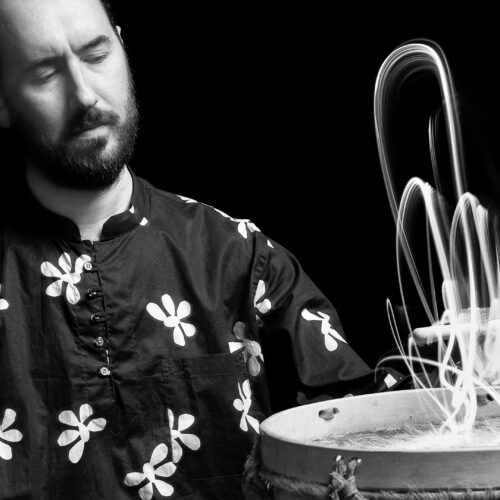
Percussionist Brian Shankar Adler, who duets with Jane Ira Bloom on once like a spark Photo: Michael Winters
The four 2025 tunes with Fallacaro are lovely additions to this aspect of her work. “My Foolish Heart” is her first recording of the great Ned Washington – Victor Young standard, and she and Fallacaro find a dark richness in it. Fallacaro adjusts the harmonies and Bloom digs into the danger lurking in the lyric: the singer warns his or her heart to beware of foolishly rushing in, but then throws caution to the wind anyway. Bloom revisits “I Could Have Danced All Night,” which appeared in a quartet version on her album Wingwalker (Outline, 2011). Fallacaro again finds darkness in the Alan Jay Lerner – Frederick Loewe tune from My Fair Lady, again Bloom enriches it, and again the darkness is justified: Eliza Doolittle sings it in a rush of euphoria, but there’s a lot of distress ahead for her before the curtain comes down. “Better Starlight” and “Cry without an Alphabet” are new Bloom compositions, and they stand with her many ballad performances as examples of her great interpretive gifts.
Second, Bloom the composer. She is a tunesmith of the first rank, and interestingly revives one of her oldies on once like a spark (“Drums Like Dancing,” first recorded on Slalom [Columbia, 1988]).
 The new material in these two releases shows her writing adeptly in a variety of forms she has made her own: the ballads above (along with “True City” and “Song from the Stars” from once like a spark), neo-boppish heads (“Space Rangers” from Songs in Space and “Be Cowboy” from once like a spark), tunes for improvising inspired by Ornette Coleman (“Riding My Planet” and “Current Events” from Songs in Space), and open forms to inspire wide-ranging improv (like “Beckett” from Songs in Space . . . see below).
Third, Bloom the unbound. Since the pandemic, she has been plumbing the possibilities of what is sometimes called free improvisation – but what Bloom does with the idea of spontaneous performance is not unstructured or undisciplined. If she or her partners craft something without prearrangement, their long experience provides sure pathways through development and resolution of their musical ideas. “Air” from once like a spark and “Polaris” from Songs in Space are spellbinding examples. In the former, Adler smooshes his brushes along the trap heads to set up a wide-open landscape of breath, and Bloom responds with her whole arsenal of effects – microtones, phase sweeps, pure notes – all bounded by rests that are as much part of the music as what is played. Space is also a prime feature of “Polaris,” where Bloom has double inspirations – bassist Mark Helias shows off his chops with precise harmonics both pizzicato and arco, and drummer Bobby Previte colors the affair with bowed harmonics from his cymbals and a delicate cushion of other sounds.
Freedom can be an important part of Bloom’s more structured pieces as well. There are prearranged ideas at the heart of compositions dedicated to writers, Bloom’s hyper-laconic “Beckett” from Songs in Space and Adler’s composition “Á Boa a Quq Aoaba” from once like a spark, which takes its palindromic inspiration from a fantastic creature in Jorge Luis Borges’s The Book of Imaginary Beings. There are themes presented in both, but both sound as free in their development as if they were pure improvisations.
I don’t think that Bloom is consciously looking back on her career in these two releases. She has always been so present in the moment of her work that her music does not indulge in self-reflection. Instead, she always seeks to make beauty tangible and to reach beyond time.
In 2021, when I interviewed her and invited her to look back on the development of her work, she characteristically responded: “It’s always been, ‘Here I am. This is it. This is what I got.’”
We are lucky to have it.
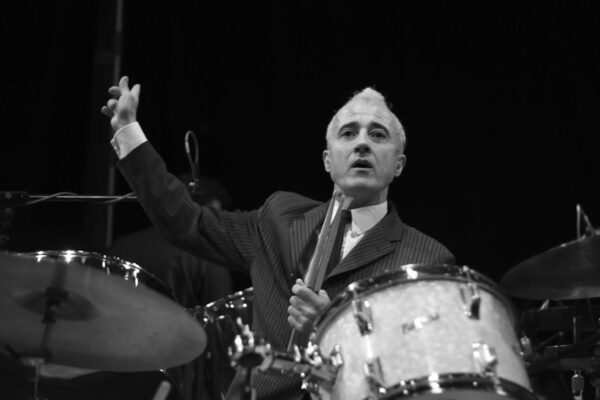
Drummer Bobby Previte. Photo: Kate Previte
More:
My 2021 interview with Jane Ira Bloom provides more perspective on the person and her work.
Also in 2021, I reviewed Bloom’s Tues Days and Some Kind of Tomorrow.
In 2016, I reviewed her Wild Lines and Early Americans.
In 2014, I reviewed her Sixteen Sunsets.
Audiophiles and equipment-heads should note that Songs in Space continues Bloom’s work in immersive audio, which is unfamiliar territory for me. For an explanation, I rely on the folks at Grammy.com:
“Today’s audio technology moves . . . into three dimensions. With immersive audio, says Guillaume Le Nost [Executive Director of Creative Technologies for L-Acoustics, based in Marcoussis, France], ‘we can place objects [that is, sound sources the listener perceives] in space . . . You can place a sound in a specific position independently from how many loudspeakers you have.’” Other sources say that listeners can perceive the experience only with special headphones or multiple speakers that are set up for immersive audio.
 Bloom’s publicist Amanda Bloom adds that on Songs in Space “Jane worked with Grammy-winning audio engineers Jim Anderson and Ulrike Schwarz . . . She has previously collaborated with them to great success – Jane and her audio team won Best Immersive Audio Album at the Grammys in 2018 [for Early Americans].”
Bloom and her engineers were also nominated in this category in 2014 for Sixteen Sunsets and in 2023 for Picturing the Invisible.
Picturing the Invisible (Outline, 2022) was inspired by the work of scientific photographer Berenice Abbott. It consisted of five duets with drummer Allison Miller, two duets with bassist Mark Helias and a trio performance with Helias and koto artist Miya Masaoka. The compositions have more perceptible song-form than the free improv duets on other of her CDs, but the feel is similar – the accompanists take a wide-open approach to their interactions with her. Bloom draws on her own love for melody – even quoting one of her own tunes on “Where the Light Gets In.”
Here is a discography of Jane Ira Bloom’s releases as a leader. Note how consistently she draws on a cadre of simpatico partners:
once like a spark (Adhyâropa, 2025) w. Brian Shankar Adler, per
Songs in Space (Outline, 2025) w. Dominic Fallacaro, p; Mark Helias, b; Bobby Previte, dm
2.3.23 (Bandcamp [digital album], 2023) w. Helias, b; Previte, dm
Picturing the Invisible (Outline, 2022) w. Helias, b; Allison Miller, per; Miya Masaoka, koto (1 track)
Tues Days (Outline, 2021) duets w Miller, per
Some Kind of Tomorrow (Outline, 2021) duets w Helias, b
Wild Lines: Improvising Emily Dickinson (Outline, 2017) w Deborah Rush, recitations; Dawn Clement, p; Helias, b; Previte, dm
Early Americans (Outline, 2016) w. Helias, b; Previte, dm
Sixteen Sunsets (Outline, 2013), w. Dominic Fallacaro, p; Cameron Brown, b; Matt Wilson, dm
Wingwalker (Outline, 2011) w Clement, p; Helias, b; Previte, dm
Mental Weather (Outline, 2008), w Clement, p; Helias, b; Wilson, dm
Like Silver, Like Song (Artistshare, 2005) w. Jamie Saft, kb; Mark Dresser, b; Previte, dm
Chasing Paint (Arabesque, 2003) w. Fred Hersch, p; Dresser, b; Previte, dm
Sometimes the Magic (Arabesque, 2001) w. Vincent Bourgeyx, p; Dresser, b; Previte, dm
The Red Quartets (Arabesque, 1999) w. Hersch, p; Dresser, b; Previte, dm
The Nearness (Arabesque, 1996) w. Kenny Wheeler, tp; Julian Priester, tb; Hersch, p; Rufus Reid, b; Previte, dm
Art & Aviation (Arabesque, 1992) w. Wheeler (and Ron Horton on 3 tracks), tp; Priester, tb; Hersch, p (2 tracks); Michael Formanek or Rufus Reid, b: Jerry Granelli, dm
Slalom (Columbia, 1988) w. Hersch, p; Kent McLagen, b; Tom Rainey, dm
Modern Drama (Columbia, 1987) w. Hersch, p; David Friedman, vib; Ratzo Harris, b; Rainey, dm; Isidro Bobadilla, per; Andy Seilgson, tu (1 track)
As One (JMT, 1984) duets w. Hersch, p
Mighty Lights (Enja, 1983) w. Hersch, p; Charlie Haden, b; Ed Blackwell, dm
Second Wind (Outline, 1980) w. Friedman, vib; Larry Karush, p; McLagen, b; Frank Bennett, dm
We Are (Outline, 1978) duets w. McLagen, b
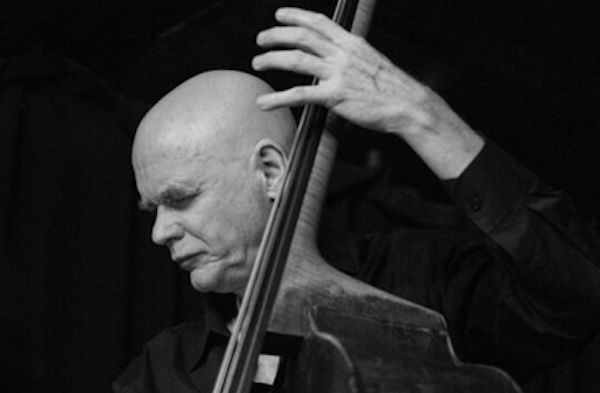
Bassist Mark Helias. Photo: Whirlwind Recordings
As a gift to you for 2026 and a pleasure for myself, I have assembled a collection of Jane Ira Bloom’s ballads into a Spotify playlist. It is part of a series of contemplative playlists I call “Atmospheres.”
This link will take you directly to the list. If you are not a Spotify subscriber, you may be required to access the site by providing your email.
Atmospheres 15 – The Bloom Ballad Book
- “I Could Have Danced All Night” (Frederick Loewe / Alan Jay Lerner) – from Songs in Space (duet w Dominic Fallacaro, piano)
- “How Are Things in Glocca Morra?” (Burton Lane / Yip Harburg) – from Sometimes the Magic (solo saxophone)
- “’Midnight Round” (Bloom) / “’Round Midnight” (Thelonious Monk/ Cootie Williams) – from The Nearness (sextet w Kenny Wheeler, tp; Julian Priester, tb; Fred Hersch, p; Rufus Reid, b; Bobby Previte, dm)
- “The Sweetest Sounds” (Richard Rodgers) – from Chasing Paint (solo)
- “My Foolish Heart” (Victor Young / Ned Washington) – from Songs in Space (duet w Dominic Fallacaro, piano)
- “Without Words” (Bloom) – from Sometimes the Magic (duet w Mark Dresser, bass)
- “Good Morning Heartache” (Irene Higginbotham / Ervin Drake/ Dan Fisher) – from Sixteen Sunsets (quartet w Dominic Fallacaro, p; Cameron Brown, b; Matt Wilson, dm)
- “Bewitched, Bothered and Bewildered” (Richard Rodgers / Lorenz Hart) – from Sometimes the Magic (solo)
- “Midnight’s Measure” (Bloom) / “In the Wee Small Hours of the Morning” (David Mann / Bob Hilliard) – from The Nearness (quartet w Fred Hersch, p; Rufus Reid, b; Bobby Previte, dm)
- “Somewhere” (Leonard Bernstein / Stephen Sondheim) – from Early Americans (solo)
- “Darn That Dream” (Jimmy Van Heusen / Eddie DeLange) – from Sixteen Sunsets (quartet w Dominic Fallacaro, p; Cameron Brown, b; Matt Wilson, dm)
- “Time After Time” (Sammy Cahn / Jule Styne) – from The Red Quartets (duet w Fred Hersch, piano)
- “I Have Dreamed” (Richard Rodgers / Oscar Hammerstein III) – from Like Silver, Like Song (duet w Mark Dresser, bass)
- “Monk’s Tale” (Bloom) / “The Nearness of You” (Hoagy Carmichael/ Ned Washington) – from The Nearness (sextet w Kenny Wheeler, tp; Julian Priester, tb; Fred Hersch, p; Rufus Reid, b; Bobby Previte, dm)
- “If I Should Lose You” (Ralph Rainger / Leo Robin) – from Slalom (quartet w Fred Hersch, p; Kent McLagen, b; Tom Rainey, dm)
- “Too Many Reasons” (Bloom) – from Sixteen Sunsets (quartet w Dominic Fallacaro, p; Cameron Brown, b; Matt Wilson, dm)
- “Chagall” (Bloom) / “How Deep Is the Ocean” (Irving Berlin) – from The Red Quartets (quartet w Fred Hersch, p; Mark Dresser, b; Bobby Previte, dm)
- “First Thoughts” (Bloom) / “This Nearly Was Mine” (Richard Rodgers / Oscar Hammerstein III) – from Mental Weather (solo)
- “Gershwin’s Skyline” (Bloom) / “I Loves You Porgy” (George Gershwin / Ira Gershwin) – from Slalom (duet w Fred Hersch, piano)
- “My Ship” (Kurt Weill / Ira Gershwin) – from Sixteen Sunsets (solo w echo effect produced by piano strings)
- “Lost in the Stars” (Kurt Weill / Maxwell Anderson) – from Art & Aviation (solo)
- “But Not For Me” (George Gershwin / Ira Gershwin) – from Sixteen Sunsets (quartet w Dominic Fallacaro, p; Cameron Brown, b; Matt Wilson, dm)
- “I Could Have Danced All Night” (Frederick Loewe / Alan Jay Lerner) – from Wingwalker (quartet w Dawn Clement, p; Mark Helias, b; Bobby Previte, dm)
Steve Elman’s more than four decades in New England public radio have included 10 years as a jazz host in the 1970s, five years as a classical host on WBUR in the 1980s, a short stint as senior producer of an arts magazine, 13 years as assistant general manager of WBUR, and fill-in classical host on 99.5 WCRB.
Tagged: Bobby Previte, Brian Shankar Adler, Dominic Fallacaro, Jane Ira Bloom