
Arts Commentary: “Merrily We Roll Along” Three Ways — A Sondheimian Trifecta
By Martin Copenhaver
Why was the original production of Merrily We Roll Along such an abysmal failure and how did it turn into a hit? Does the new film succeed in capturing the magic of the hit Broadway revival (and is that even possible)?
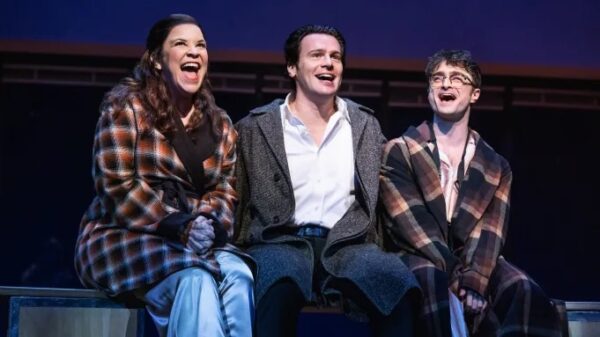
(L-R) Lindsay Mendez, Jonathan Groff, and Daniel Radcliffe in the film version of Merrily We Roll Along. Photo: Matthew Murphy
The headline for a recent New York Times article summarizes the long and loop-de-loop history of a Stephen Sondheim musical: “Merrily We Roll Along Was a Flop, Then a Hit. Now It’s a Film.” I can now claim the distinction of having seen all three versions. In 1981 I saw one of only 16 performances of the original Broadway production, which was the floppiest of flops. Then, in 2023, I saw the Tony-Award winning revival, which became the biggest of hits. Last week, I completed the Sondheimian trifecta by viewing the new film version of the 2023 production. That’s enough twists and turns to give one a case of whiplash. But it also gives one a lot to ponder, including: Why was the original production such an abysmal failure, and how did it turn into a hit? Does the film succeed in capturing the magic of the revival (and is that even possible)?
The postmortems of the 1981 production have yielded some consensus about why it was such a bust. Merrily (like the 1934 play by George S. Kaufman and Moss Hart it is based upon) covers a span of 20 years in the lives of three friends — Frank, a songwriter; Charley, a playwright and Frank’s sometime lyricist; and Mary, a novelist turned theater critic. The younger Frank is passionate about writing music and is devoted to his friends. Over time, however, Frank sells out, abandoning his creative partnership with Charley to produce movies. In the process, Frank’s relationships with Charley and Mary become curdled and fractious. The key twist is that the story is told backwards, beginning with where the friends ended up and then moving backwards in time to the origins of their friendship.
So far (mostly), so good. But then Hal Prince, who directed the original production, made the fateful decision to cast young people (the oldest was 26 years old) to play the characters. Not only were they not as believable as the older versions of their characters, they had minimal theatrical experience. Broadway audiences objected to paying big bucks to see what seemed like a college production. The unartful set depicted a gymnasium, which had the unintended consequence of emphasizing the youth of the cast. To make matters worse, the cast wore sweatshirts with bold letters on the front that identified their roles (“Best Friend,” “Ex-Wife”), as if the audience needed help to keep the characters straight (which may have been the case, but still).
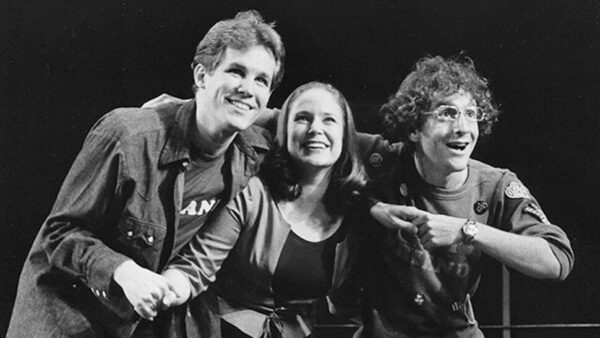
Jim Walton, Ann Morrison, and Lonny Price in a scene from the 1981 Broadway production of Merrily We Roll Along. Photo: Martha Swope
In The New York Times, critic Frank Rich, an ardent Sondheim fan, had to admit, ruefully, that the show was “a shambles.” Other reviewers agreed. In a phrase attributed to George S. Kaufman about a different play: “We got mixed reviews. They were good and rotten.” In his own dark assessment of the show, Sondheim concluded that the character of Frank was part of the problem, saying, “nobody’s interested in a selfish, venal compromiser.”
The spectacular failure of the show marinated Sondheim in bitterness, then led him into depression. He pondered whether he could continue to write music and mused aloud about creating video games, instead. The show also dealt a fatal blow to one of the most creative partnerships in Broadway history. Sondheim and Prince had collaborated on five successful shows in the ’70s (including hits like Company and Sweeney Todd), but after the debacle of Merrily, they would never work together again.
Lonny Price, who played Charley in the original Merrily, directed a wonderful documentary, Best Worst Thing That Ever Could Have Happened (2016), that traces the effect of the show’s promise and failure on its young cast.
As early as the morning after the show closed, however, the seeds of new life for Merrily were sown. That is when the cast album was recorded, which featured the inventive and, for Sondheim, unusually tuneful score, this time without the accompanying distractions of the rest of the production. The album was a showcase for the show’s potential, like an audition tape sent into the world.
Sure enough, many revisions and revivals followed, including three major Off-Broadway productions, and many more stagings in regional theaters. A 2012 West End production included Maria Friedman in the cast, who fell in love with the musical and became its tireless advocate. She went on to direct Merrily in a 2022 Off-Broadway production that made its way to Broadway in 2023, then onto the screen this month.
The revised versions included many changes, some of which have helped the show immensely. For instance, the original production began and ended at a graduation ceremony. Frank is the featured speaker at both — as a time-worn and dissolute cynic at the opening of the show and as an idealistic student in the show’s final scene. In both scenes the students sing a mawkish anthem, “The Hills of Tomorrow.” It is intended to be the kind of hymn to youthful idealism one might expect at a graduation, but it does not have the dramatic power to serve as the beginning and, particularly, the ending of the show.
By contrast, the 2023 revival (Arts Fuse review) and the attendant film versions begin with Frank alone on stage. He looks haggard and pensive, but then, when he is surrounded by show-biz professionals descending on him at a party, he insists he has never been happier. The revival ends with Frank, singing of his youthful optimism about the future and his role in it, with Charley and Mary, in “Our Time.” It is the stirring denouement of the show. But then, in a silent coda, Frank is once again alone on stage and staring into the distance. He looks reflective, verklempt. Is he reflecting on his future or, in a final loop-de-loop, is he reflecting on his past from the perspective of the future? Whatever your interpretation, it is a gripping moment — a vast improvement over the original beginning and ending of the show.
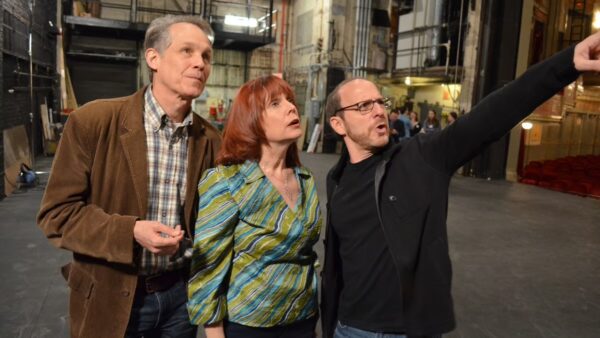
Jim Walton, Ann Morrison, and Lonny Price in a scene from the Best Worst Thing That Ever Could Have Happened. Photo: NYFF
Not all of the revisions in the revival are as successful. The revival includes a larger role for Gussie, Frank’s conniving paramour who later becomes his wife. Gussie’s character is insufferable, and on top of that she is given three songs that were not in the original, none of them very good. They are trunk songs that should have stayed in the trunk. It is as if Sondheim refused to award the character with songs worth singing. If Sondheim is right — that we are not interested in “a selfish, venal compromiser” — then we are even less interested in having two. And so, apparently, was Sondheim.
Beyond changes to the script, the stage revival and film both benefit from the superb cast of leads. Daniel Radcliffe, best known for his work in the Harry Potter series, convincingly embodies the neurotic and high-strung Charley. In particular, his rendering of the song, “Franklin Shepherd, Inc.” is a tour de force. Lindsay Mendez, in the role of Mary, also is excellent, whether she is delivering boozy zingers or sharing the longings of her lovesick heart.
Jonathan Groff brings a fierce intensity to the role of Frank. Although his portrayal reveals the character’s flaws, as a member of the audience I never quite give up on this Frank, and, for me, that is something new. He is more than Sondheim’s description of a “selfish, venal compromiser.” Groff’s Frank seems more like a lost soul than someone who is rotten to the core.
The chemistry among the three leads is palpable, which makes it all the more poignant when the chemistry turns acidic.
Other reasons the 2023 revival has been cheered by audiences have less to do with the production itself and are more attributable to other factors. True to the old maxim, death has done marvels for Sondheim’s reputation. Before his death in 2021, he was already lionized, but after his death, he has been more like canonized. Clearly, Merrily has benefited from his ascension.
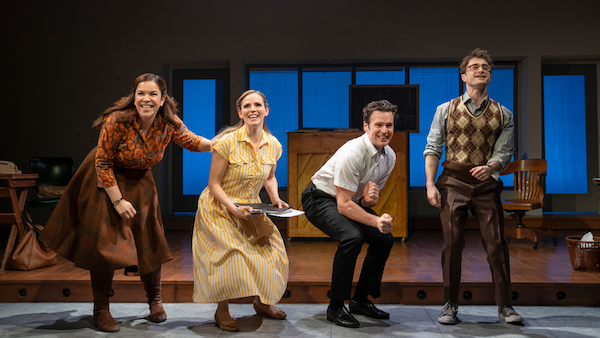
A scene from the 2023 Broadway production of Merrily We Roll Along. Photo: Joan Marcus
Then, too, one of the major themes of Merrily is a yearning for an earlier, more innocent time, full of promise not yet tarnished by disillusionment. That theme spoke to audiences of the 1934 play, staged in the midst of the Great Depression, but it could not resonate as powerfully in 1981, in the era of Ronald Reagan’s cheery “Morning in America” bromides. Now, at the time of this revival, anxiety and uncertainty are themselves being revived. It can feel like a dark night in America, so it is understandable that audiences are eager to embrace a more carefree period. Nostalgia may be a yearning for a time that never was, but that does not prevent us from wanting to go there.
Director Maria Friedman has done an admirable job in bringing Merrily from stage to screen. Other Sondheim shows have film versions. They are in roughly two categories: the films that are written and directed for the screen (Sweeney Todd, Into the Woods) and those that are simply the original stage versions filmed (Sunday in the Park with George). This Merrily is somewhere in between. It is a film version of the revival as seen on stage, but it includes cuts and close-ups that are techniques associated with film. This was achieved by filming three performances before live audiences, augmented by scenes shot without an audience. There are scenes when the close-ups are a bit overwhelming (like being stuck at a party with a “close talker”) but, for the most part, it works. It is more than a mere filming of the show, but it does not stray from the original.
The film version is a reminder, however, of the challenges that come with putting a musical on the screen. Musical performances, as far back as the choruses of classical Greek drama, have been at home on a stage. Film more naturally traffics in the literal. For instance, there is a reason why documentaries are shown on screens, rather than stages. Conversely, watching performers break into song on a stage does not require as much suspension of disbelief as experiencing the very same performance on film. Of course, Friedman cannot be faulted for being unable to transcend the limits of the medium. In this film she has come very close to capturing Sondheim’s lightning in a bottle.
The long journey of Merrily We Roll Long is not over. Director Richard Linklater has already started filming a new version. So, stay tuned. For a very long time. Linklater has been interested in exploring the challenge of tracing the relationships among major characters over 20 years by filming over a period of 20 years. So, Sondheim fans, mark your calendars. You only have to wait until 2040.
Martin B. Copenhaver lives in Woodstock, Vermont, and Cambridge, Massachusetts. He is the author of nine books, but he is particularly proud of his Bolognese sauce, which was once written up in a national magazine.
Tagged: Ann Morrison, Daniel Radcliffe, Jim Walton, Jonathan Groff, Lindsay Mendez, Lonny Price, Maria Friedman, Merrily We Roll Along