
Theater Reviews: Broadway’s Big Revivals — “Ragtime” Reclaims Its Strength, “Chess” Can’t Find Its Footing
By Christopher Caggiano
Returning musicals take another shot at success — with very different outcomes.
So far this season, two major musicals have returned to Broadway in search of redemption. Ragtime and Chess both had rocky original runs, both built devoted followings anyway, and both are now back to give things another go. Ragtime, for all its narrative excess, once again proves how far a glorious score can carry a show. Chess, despite its powerhouse songs and legendary concept album, still can’t find a book sturdy enough to hold everything together.
RAGTIME
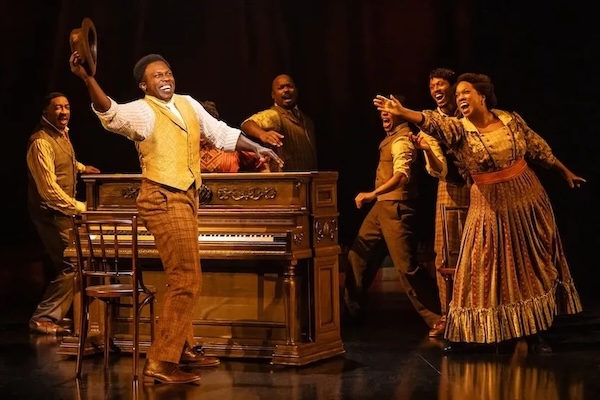
Joshua Henry and cast in Ragtime. Photo: Matthew Murphy
The original production of Ragtime arrived on Broadway in 1998 with enormous expectations, a massive cast, and –as it turned out — enough production bloat to collapse under its own weight. It ran for two years but closed at a loss, its fate tied in part to that of producer/felon Garth Drabinski and the Livent scandals that ensued.
A brief 2009 revival had its merits, but ultimately failed to land, closing after two months. But the tide for Ragtime finally began to turn with the 2024 Encores staging, a production so warmly received that Lincoln Center seized the chance to bring it to Broadway for the 2025-26 season.
Ragtime follows three families in early-20th-century America whose lives intersect during a period of social upheaval — an upper-middle-class white family (generically named Mother, Father, and Young Boy) in New Rochelle, a Black pianist (Coalhouse Walker) and the mother of his child (Sarah), and a Jewish immigrant (Tateh) and his daughter escaping persecution and fighting poverty. Ragtime traces the era’s tensions around race, class, immigration, and identity.
The show still has its excesses, but the score remains one of the great achievements in modern musical theater. Flaherty’s music is lush, supple, and idiomatic. Ahrens’s lyrics are packed with wit and character detail. The opening number alone is a masterclass in how to launch a sprawling story. In fact, nobody crafts an opening sequence quite as effectively as Ahrens and Flaherty. That mastery carries through the rest of the score as well: even when the plot wanders or certain connections feel loose, the score pulls everything back into focus with emotional coherence and sweep.
The show is full of ambitious musicalized scenes rather than mere songs. One of the strongest examples is “New Music,” which never fails to give me chills. Coalhouse Walker arrives at Mother’s house, having tracked Sarah down, hoping for a chance to make things right. He sits at the piano and pours out his heart the only way he can — through music. Sarah listens from a distance, resolute at first, then slowly gives in as the sound draws her toward him.
It’s one of the score’s most thrilling passages. The only (minor) drawback is the end of the song, which feels a bit too much like a finale ultimo. As Gerard Alessandrini once noted in Forbidden Broadway, too many Ragtime numbers finish “with a reeeeeeallly long nooooooote.”
“Our Children” works in a quieter register, all warmth and gentle ache. And subtext. Talk about your subtext. Mother and Tateh open up to each other through their children, but we can sense that there’s more going on between them than just parental pride. And the modulation near the end of the number is a killer. Modulations are overused in music, both for the stage and in pop songs (looking at you, Barry Manilow), but this particular key change, combined with a delicate ritardando, makes the moment magical, and Brandon Uranowitz and Caissie Levy play it here with clarity and grace.
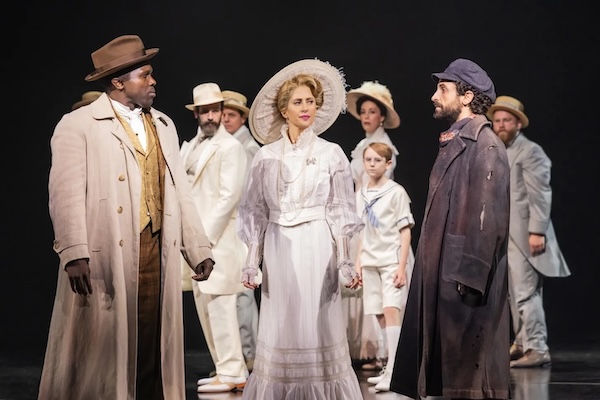
Joshua Henry, Caissie Levy, and Brandon Uranowitz in Ragtime. Photo: Matthew Murphy
Some of Ragtime’s numbers still feel superfluous. “What a Game” brings a welcome levity to the second act — Father takes his son to a baseball game rather than confront the escalating crisis with Coalhouse — but the number doesn’t deepen the story. It’s amusing, and it relieves some tension, but dramatically it’s spinning its wheels. Similarly, “Atlantic City” feels mostly unnecessary and goes on much longer than it needs to. The side business with Houdini and Evelyn Nesbit piles on extra movement and spectacle without adding much insight, and the show would lose little if most of it were trimmed.
The number “He Wanted to Say” continues to be one of the show’s oddest choices: Younger Brother is finally ready to declare his purpose by offering his savvy with explosives as a service to Coalhouse’s desperate cause. Yet the song hands the actual articulation of that purpose to Emma Goldman, who comments outside the scene. The device doesn’t build urgency; it sidesteps it, and the button — when Younger Brother says “I know how to blow stuff up” — still lands with an awkward laugh, undercutting a moment that’s meant to shift the ground beneath the characters.
The show’s underlying issues in the book also remain. McNally leans a bit too heavily on narration, and there are patches of expository dialogue that feel more functional than dramatic. And some story beats remain hard to justify. Sarah’s devastation in the opening scenes has always required a performer who can ground it in emotional truth. Nichelle Lewis’s Sarah approaches “Your Daddy’s Son” with the kind of vocal showboating that works against the moment. The song only lands when the lyrics are clear. Lewis’s performative excesses during the line “I buried my heart in the ground / When I buried you in the ground” rob the audience of fully understanding Sarah’s motivation.
What keeps Ragtime soaring, despite all this, is the combination of score and performance. Brandon Uranowitz delivers a sharply etched Tateh, warm and grounded. Tabitha Lawing brings an infectious lightness as his daughter. Caissie Levy gives Mother a cool, steely resolve, with a “Back to Before” that favors emotional shading over belting. And Joshua Henry’s Coalhouse is a force — vocally authoritative, emotionally centered, and dramatically commanding. Perhaps this will be the year that Mr. Henry finally wins a well-deserved Tony.
CHESS
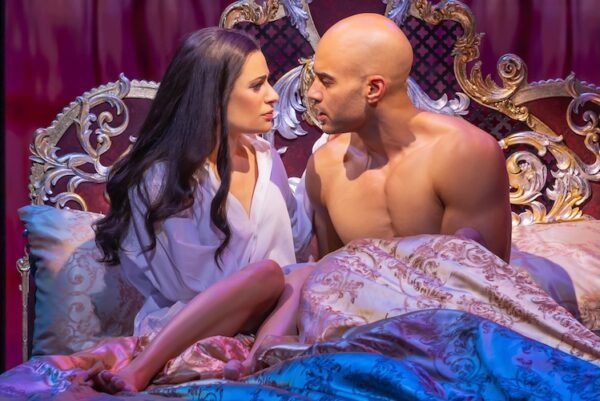
Lea Michele (Florence Vassy) and Nicholas Christopher (Anatoly Sergievksy) in Chess.
Photo: Matthew Murphy
Allow me to be blunt. Director Michael Mayer’s new Chess is crass, loud, and garish, a production almost entirely devoid of subtlety. The songs and two male leads provide the only real value here but, unlike Ragtime, the score alone can’t hold the evening together. The problems with Chess have always come down to the book, and this version shows once again that no one has yet found a way to give the songs their due.
Chess involves a Cold War chess championship that also becomes a political battleground. An American grandmaster (Freddie), his second-turned-lover (Florence), and a disciplined Soviet challenger (Anatoly) are drawn into a web of geopolitical manipulation, personal rivalry, and emotional fallout.
Chess began as a concept album in the ’80s, with a compelling but odd admixture of songs with wildly varying tones. Lots of “bangers,” as the kids say, but even then it was hard to imagine a show that could thematically contain all of those disparate styles.
As soon as I saw the song “Merano” listed in the program for the current Broadway version, I knew trouble was ahead. The song opened the show on the concept album and in the London version of the show, and it sets precisely the wrong tone for what follows. This production even doubles down by staging the song with inscrutable hand choreography (by Lorin Lotarro) that feels different for the sake of it, while having nothing to do with the characters or the story.
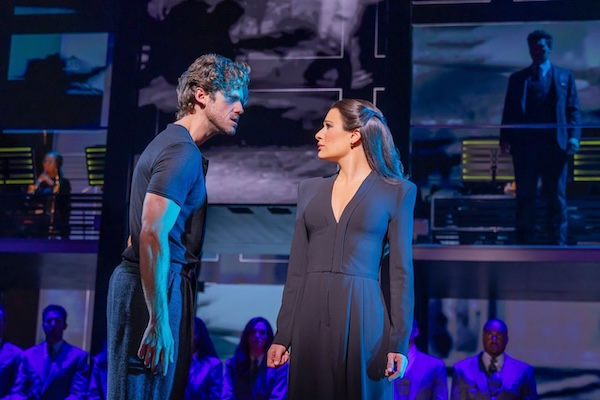
Aaron Tveit (Freddie Trumper) and Lea Michele (Florence Vass) in Chess.
Photo: Matthew Murphy
Danny Strong’s new book is a flat-out disaster — pandering, meandering, and dramatically inert. Strong’s inexperience with musical theater is evident in the way songs pop up with little to no motivation. The most glaring example is “Someone Else’s Story,” a song written for the original Broadway outing that seems intended to give Florence a big Act Two solo. Lea Michele simply walks downstage and sings it as if she were on American Idol. There’s no setup, no emotional prerogative, no reason for the moment to happen beyond the fact that the song is cool and they wanted to use it.
The revival’s problems deepen as the book reaches for borrowed gravitas. At one point, Strong incorporates real Cold War history, specifically the 1983 NATO exercise known as Able Archer, which some Soviet generals feared might be a cover for an actual Western attack. Reading about the production beforehand, I got the sense Strong was rather proud of himself for discovering this little-known moment that supposedly could have brought the world to the brink. Well, historical accuracy doesn’t make your book good, Mr. Strong. Perhaps you should’ve been the dramaturg rather than the librettist.
Strong has inflated the role of the Arbiter (a smarmy Bryce Pinkham) into a sardonic narrator, a clumsy device that crushes whatever seriousness the story attempts to muster. The Arbiter cracks anachronistic jokes about Joe Biden and RFK Jr., and even points out which characters don’t have their own song, part of an ongoing meta-theatricality that comes off jokey and shallow. The tone becomes so flippant that the audience laughs at moments that are supposed to carry weight.
The problems compound in Act Two, where the show should tighten, but it disperses instead. There’s no accumulating tension, no sense of stakes deepening as the match progresses. Each complication is brushed aside, and every solo is staged like a concert turn. “Pity the Child,” which Aaron Tveit sings beautifully, is sabotaged by its setup. Instead of moving cleanly from “No Deal” into the number, as occurs on the concept album, the show inserts a pointless mini-reprise of “Nobody’s Side” that kills the momentum. Tveit begins the song curled into a fetal position, which tells you everything about the production’s tendency toward the literal and overdetermined.
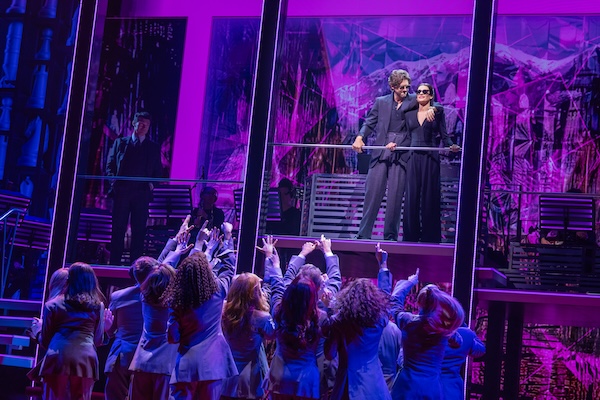
Aaron Tveit (Freddie Trumper), Lea Michele (Florence Vassy) and the cast of Chess. Photo: Matthew Murphy
Both Tveit and Nicholas Christopher do far better work than the surrounding production deserves. Christopher is undercut by the pointless choreography behind him in “Where I Want to Be,” but he knocks the Act One closer, “Anthem,” out of the park. Lea Michele, by contrast, never quite locates a person inside Florence. The vocals are fine — clean, competent, occasionally bright — but the performance feels calculated rather than lived. She hits the marks without giving the role any inner life, and the result is a character who seems to be presenting emotions rather than experiencing them.
And then there’s the ending: the supposedly emotional revelation about Florence’s father, presumed dead since the Soviet crackdown on the 1956 Hungarian uprising. The moment appears abruptly, flickers for about five seconds, and disappears without any space to land. It’s emblematic of the entire evening: ideas introduced without preparation, dispatched without consequence. The original Broadway production may have been dark and gloomy, but at least it was coherent. This one swings so far in the opposite direction that it becomes ridiculous, impossible to take seriously.
After at least six major rewrites — London, Broadway, this version, and several regional reconceptions floating around online — Chess still hasn’t found a way to make its story work.
Christopher Caggiano is a freelance writer and editor living in Stamford, CT. He has written about theater for a variety of outlets, including TheaterMania.com, American Theatre, and Dramatics magazine. He also taught musical-theater history for 16 years and is working on numerous book projects based on his research.