
Children’s Book Reviews: The Natural World and Beyond
By Cyrisse Jaffee
Three beautiful new picture books for kids about nature, color, and gardening will inspire, inform, and delight.
This Is Orange: A Field Trip Through Color by Rachel Poliquin. Illustrated by Julie Morstad. Candlewick Press, 2025
Dawn by Marc Martin. Candlewick Press, 2025
My Pollinator Garden: How I Plant for Bees, Butterflies, Beetles, and More by Jordan Zwetchkenbaum. Illustrated by Kate Cosgrove. Holiday House, 2025
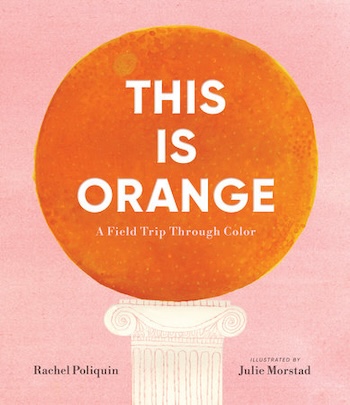 An oversized picture book just about the color orange? Yes! In this clever, wonderfully informative book, enhanced by splendid, eye-catching illustrations, orange takes center stage. The opening lines — “We must begin with the orange. So very orange. So delicious round and sweet.” — are deceptively simple. This is Orange is chock full of fascinating facts about the color, the etymology of the word, and how it’s been used in art and history.
The narrative begins, understandably, with different types of oranges (navel, mandarin, blood), along with other fruits (kumquats). Then it explores the history of the word, from Tamil (India) to Old Persian, to Arabic, Italian, French, and finally English. (There was no word in English for orange when Chaucer wrote The Canterbury Tales in the 14th century.) The earliest use of the word in English may have been in the early 16th century, when the mother of Margaret Tudor, Queen of Scotland, bought her “slevys of orenge colour,” as shown in the book in a 1502 portrait. (No mention is made of the difficulty of finding a rhyme in English for orange.)
There is such an abundance of cool information in the book that it’s hard not to share it all. Orange is used in clothing (Buddhist monks wear robes dyed by turmeric; astronauts wear orange space suits), during religious festivals, on flags, and in art (such as Mark Rothko’s Orange and Yellow, and a famous gate installation by Christo and Jeanne-Claude). In nature, orange is used to attract a mate by creatures such as the Guianan cock-of-the rock and male mallard ducks.
This effortlessly comprehensive discourse on orange will impress adults and offer children the kind of specialized knowledge they love. (A tiny quibble: the cute orange cat, who is shown on several of the pages, isn’t directly mentioned.). The last page asks kids to notice orange in their world — and no doubt they will!
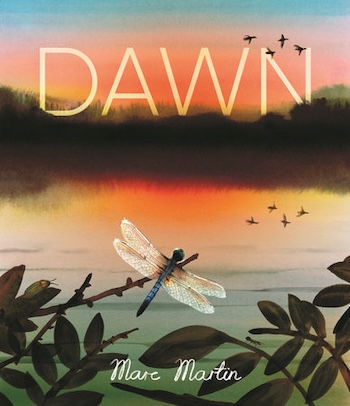 Dawn, by Marc Martin, is another stunning picture book about a single topic that teems with images and information. In gorgeous, full-color illustrations, with very little text, the various components that make up this special time of day are captured in nature. From a spider’s web sparkling with dew to a dandelion spreading its seeds in the breeze; to insects climbing, buzzing, and emerging; to birds flying in formation and frogs splashing in the water; no details are overlooked.
The use of scientific observation is subtly demonstrated here, as is the portrayal of natural habitats and animal behaviors. The terrific variety of words will introduce kids to new and diverse vocabulary. This is a great choice for reading aloud with one or more preschoolers, although the combinations of carefully chosen words and close-up illustrations are so evocative that you almost want to read it in a whisper.
The information in My Pollinator Garden, by Jordan Zwetchkenbaum, is a lot more straightforward in its mission to inform, but still makes for an entertaining read. A little African-American girl (with big glasses and a braid) explains that her garden is not only pretty and smells good, it “attract(s) certain animals so they will take pollen from one plant to another of the same kind. Then the plants can make seeds. And new plants can grow.”
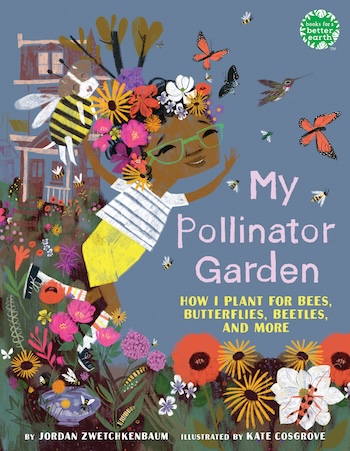 Bees of all kinds are featured, from the “pure green sweat bee” to the “orange-tipped wood digger bee” to the “southeastern blueberry bee” and more. The text explains what kind of flower each bee needs and how they get the pollen. For instance, some species can push flower petals apart, others shake flowers. Wasps, flies, beetles, butterflies, moths, and even bats all play their part.
The deep, rich illustrations by Kate Cosgrove, filled with detail, add energy and appeal to the text, which may inspire kids to start identifying (or even planting) pollinators that they see. In an Author’s Note, Zwetchkenbaum explains that “Most of the pollinators and plants in this book are found in the Northeastern United States,” but there are a few nods to the Southwest. Additional information on how to plant for pollinators, care for your pollinator garden, as well as a glossary and bibliography, is also provided. This is an excellent addition to any school or public library. It would also be useful for local nurseries, nature centers, botanical gardens, communal gardens, Girl Scouts, and 4-H Clubs, not to mention home use.
Cyrisse Jaffee is a former children’s and YA librarian, children’s book editor, and a creator of educational materials for WGBH. She holds a master’s degree in Library Science from Simmons College and lives in Newton, MA.
Tagged: "Dawn", "My Pollinator Garden: How I Plant for Bees Butterflies Beetles and More", "This is Orange: A Field Trip Through Color", Jordan Zwetchkenbaum, Marc Martin