
Woodstock Film Festival, Dispatch #1: Troublesome Women
By Peg Aloi
A trio of superb films that feature fierce women.
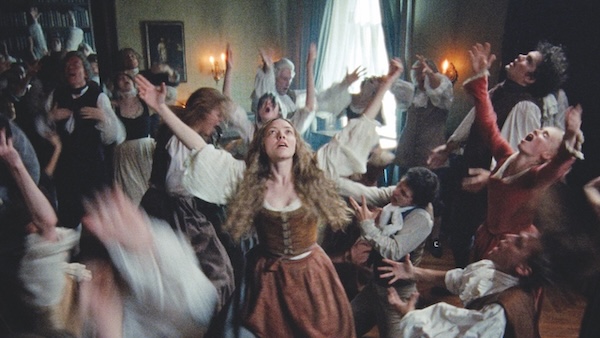
The Testament of Ann Lee, starring Amanda Seyfried. Photo: WFF
For my opening night screening of the Woodstock Film Festival, now in its 26th year, I chose to see The Testament of Ann Lee. This gorgeous biopic, directed by Mona Fastvold, who co-wrote the screenplay with Brady Corbet (they also co-wrote 2024’s The Brutalist), tells the fascinating story of Ann Lee, who founded the Shakers in the 18th century. Thomasin McKenzie (Leave No Trace) plays Mary, a devotee who narrates the story, which is an intriguing blend of authentic period realism and stylized musical set pieces containing songs and choreography.
Born to a large family in Manchester, England, Ann (Amanda Seyfried) and her devoted brother (The Starling Girl’s Lewis Pullman) formed a new religious movement, based on Ann’s vivid religious visions. The Shakers admired order, practiced ecstatic dancing, and forbade sexual congress. They took a perilous journey by sea to settle in the New World, suffering persecution from locals (Ann, a rebellious woman leading a new religious movement, was inevitably accused of witchcraft). Yet the pair still amassed followers and eventually built settlements in Niskayuna, New York, and Hancock, Massachusetts (where some of the austere, handsome buildings they erected still stand). Ann’s husband (the perfectly cast Christopher Abbott) eventually left her, unwilling to follow the sect’s strict rules. Despite the fact that many families with young children joined them, the Shakers eventually died out.
This film is utterly compelling to watch — beautifully filmed by William Rexer (Millers in Marriage). The musical segments are artful and entrancing, though may not please or make sense to all viewers. The entire production is seamlessly crafted, an outstanding achievement given its relatively small budget. The cast is outstanding, especially Seyfried, in a career-defining performance that is gutsy, intricate, and transcendent.
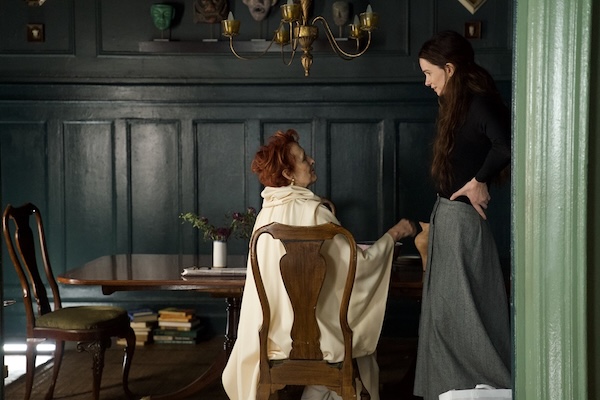
Park Avenue, starring Fiona Shaw and Katherine Waterson. Photo: WFF
Next I saw Park Avenue, a Manhattan-set drama starring two of my favorite actresses, Fiona Shaw and Katherine Waterston. The film was preceded by a funny and well-acted short, Eloise and the Dress, by Rachael Sonnenberg, which explored family drama around an imminent wedding. It was a fitting preamble to Gaby Dellal’s drama about a wealthy, celebrated Manhattan writer, Kit DeMille (Shaw) and her estranged daughter Charlotte (Waterston), who shows up at her mother’s posh Park Avenue apartment unannounced after leaving her husband on their ranch in Colorado. Kit has scheduled a high-profile book launch, and Charlotte pretends that’s why she’s in town. Mother and daughter are tense yet intimate together, both accusing the other of being habitually dishonest. Kit’s casual cruelty to Charlotte seems bound up with sad secrets having to do with Charlotte’s father’s untimely death. Dealing with a serious illness that she tries to hide from everyone — except for her devoted doorman and friend Anders (a terrific Chaske Spencer) — Kit tries to keep up appearances. She hangs out with her friends and building board members (including great cameos by Phylicia Rashad and Didi Conn), dons colorful, eccentric outfits, and downs whiskey sours in her favorite bar at every opportunity.
Meanwhile Charlotte cavorts in dungarees, which she pairs with exquisite blouses borrowed from her mother’s closet. She is also plotting her uncertain future as she tries to weather her mother’s stinging insults. There are some characters in the story whose connections to Kit and Charlotte could have used some embellishment, in particular Charlotte’s seemingly abusive husband, her teenage daughter (attending private school near NYC), and Kit’s eccentric old friend, played by Timothy Hutton. But, despite these gaps, the film is a rich and satisfying viewing experience, thanks to its dynamic visuals (the sets and costumes are a joy) and powerful performances. Waterston is a gifted, versatile actress (Inherent Vice, The World to Come); she plays Charlotte’s raw vulnerability and simmering resentment with fine precision. Fiona Shaw is ever a marvel, bringing a delightful array of eccentric mannerisms to Kit, along with mercurial but tightly controlled emotions. This is a woman who curates every moment she can, until she can’t anymore. Why should we care about these privileged characters, given that our government is ripping away the means most people need to survive? The very rich are not like you and me, as F. Scott Fitzgerald said. But, in this portrait of Kit, we see a fortunate woman whose life is not immune to tragedy and grief, who cannot escape the ravages of age or the unforgiving injuries of time.
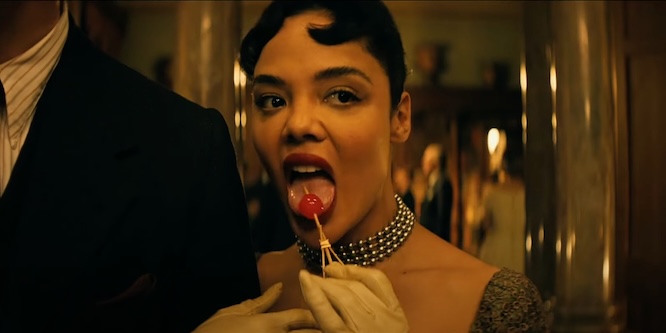
Tessa Thompson in Hedda. Photo: WFF
Next I saw Nia DaCosta’s Hedda, an intriguing adaptation of Henrik Ibsen’s celebrated 1891 drama Hedda Gabler. The film is opulently stylish, supported by an excellent cast, including an award-worthy performance from Tessa Thompson in the title role. Set in the late ’20s, the film mostly takes place during a decadent Great Gatsby–worthy party given at the newly-purchased home of Hedda and her husband (Tom Bateman). A brief prologue creates a sense of foreboding: we know before the party begins that it will end in tragedy. The script envisions Ibsen’s notoriously enigmatic anti-heroine as a socially ambitious Black woman who is hellbent on creating a whirlwind of deceit and chaos around her; she is ambivalent about her recent life choices choices, and draws on her seductive wiles to manipulate friends and lovers.
The dialogue is sharp, the visuals alluring, the tone and pacing are engaging. A compelling air of suspense is maintained as events unfold. The entire cast is terrific, especially Nina Hoss and Imogen Poots as women caught in Hedda’s web. The film’s period stylings seem to overpower the occasional subtle flashes of anachronistic cultural relevance. It would have been nice to have seen this idea taken a bit further. It will be interesting to see how audiences and critics (particularly Ibsen lovers) respond to this ambitious film.
Peg Aloi is a former film critic for the Boston Phoenix and member of the Boston Society of Film Critics, the Critics Choice Awards, and the Alliance for Women Film Journalists. She taught film studies in Boston for over a decade. She has written on film, TV, and culture for web publications like Time, Vice, Polygon, Bustle, Dread Central, Mic, Orlando Weekly, Refinery29, and Bloody Disgusting. Her blog “The Witching Hour” can be found on substack.
Tagged: "Hedda", "Park Avenue", "The Testament of Ann Lee", Amanda Seyfried, Ann Lee, Fiona Shaw, Gaby Dellal, Katherine Waterston, Mona Fastvold, Nia DaCosta, Tessa Thompson
There is actually a remaining (though very small) Shaker community in Sabbathday Lake, Maine!