
Book Review: John Guare’s Funhouse Mirror: The Playwright Joins the Library of America
By Robert Israel
A generous serving of what theater critic John Lahr calls playwright John Guare’s “funhouse-mirror reflection of American life’s caprice and chaos in the twentieth and twenty-first centuries.”
Plays by John Guare, 832 pages, Library of America, $32
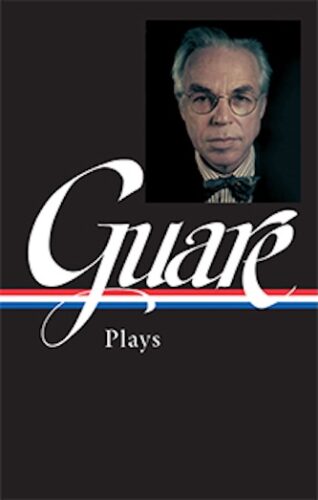 When I interviewed playwright John Guare in Provincetown in the fall of 2007, I wanted to know what had become of his play A New Me.
“You remember it?” Guare asked.
How could I forget it? A New Me was featured at the Boston debut of the (now defunct) American Premier Stage. Trinity Rep trucked the show from Providence to Suffolk University’s C. Walsh Theatre on Beacon Hill with a cast of three who performed one scene, all fifteen minutes of it. If memory serves, the snippet involved a ditsy housewife, played by actress Melanie Jones, chatting about her life, while a jock, (the actor’s name escapes me), dressed in tighty-whities and tennis shoes, jabbed her with acupuncture needles. Squirming while being poked and groped, Ms. Jones prattled on about whether her dinner guests, due to arrive at any moment, might notice “fanny prints on my Lucite chairs.” The audience howled with glee.
“Well, the truth is,” Guare told me in Ptown, “I lost it. I mean A New Me is a lost play. I have no idea what happened to it.”
Suffice to say, A New Me, the play that got away, is not among the selections in the Library of America volume that offers a generous serving of what former New Yorker theater critic John Lahr, in his introduction, calls Guare’s “funhouse-mirror reflection of American life’s caprice and chaos in the twentieth and twenty-first centuries.”
Guare, at age 87, remains a unique, quirky, urbane, and entertaining writer. He is showing no signs of slowing down. He has been lauded by his peers and critics alike as the eminence gris of the American theater. Edited by playwright Tony Kushner, et. al., the book is a welcome cornucopia of his work for the stage. It also includes Atlantic City, a screenplay that was nominated in 1980 for five Academy Awards. The film starred Burt Lancaster and Susan Sarandon and was directed by French auteur Louis Malle.
But his journey hasn’t always been stellar. Take his much-maligned two-act comedy Bosoms and Neglect for example: originally staged in 1979, critics unanimously loathed it.
“When Bosoms and Neglect opened in New York, it lasted four performances,” Guare told me. “They wanted to run me out of town. My advice to playwrights: always have another play in the works.” (A revised version was staged by Trinity Rep the following year at Boston’s Charles Playhouse — it received glowing reviews).
Bosoms and Neglect tells a wicked and devastating story of misfits struggling to find moorings in our crazed, neurotic society. The prologue packs a wallop. We meet the elderly Henny, who is blind. She confesses to her son, Scooper, that for months she’s been ministering to a festering, gaping wound in her breast by covering it with Kotex pads. Guare’s language crackles with comedic and horrific tension. As we advance to the first act, we hear Scooper and fellow therapy patient Deirdre kvetch that they are being ranked by their shrink according to their mental disorders and thus subjected to an unfair hierarchical fee scale. The first act climaxes as Deirdre, in flagrante delicto with Scooper, assaults him with a pen knife and, as she stabs him, they lob rejoinders about Freudian analysis. (No more spoilers: Get the book. Read the script.)

Playwright John Guare. Photo: courtesy of the artist
The House of Blue Leaves, one of Guare’s early successes, is included. Guare has called the drama “autobiographical in the sense that everything in the play happened in one way or another over a period of years, and some of it happened in dreams, and some of it could have happened, and some it, luckily, never happened.” Also included is Guare’s Six Degrees of Separation, a 1990 play that was adapted into a film in 1993. It explores the premise that we are all connected to other people by a chain of no more than six acquaintances. Based on a true story, it dramatizes the escapades of David Hampton, a con man who managed to convince people he was the son of actor Sidney Poitier. The film version, also nominated for Academy Awards, introduced a young Will Smith, then known as a rapper, in the role of the con man.
When one joins the Library of America’s roster of luminaries, the presumption is that legions of new readers – and in Guare’s case theatergoers — follow. But playwrights write to be produced, and lately, that hasn’t been the case for Guare or his contemporaries, Lanford Wilson, Sam Shepard, Marsha Norman, Charles Fuller, and others. The fact is, there have been too few revivals of these important American playwrights at many of our nation’s repertory companies. Based on the abundant offerings in this book, Guare has more than earned that honor; he’s cranked out more than enough in his 50-year writing career for those companies to choose from.
Time will tell if this book spurs a sea change. Meantime, there’s always the chance Guare might give us a finished version of A New Me – when and if he finds the lost script.
Robert Israel, an Arts Fuse contributor since 2013, can be reached at risrael_97@yahoo.com.
Tagged: "Bosoms and Neglect", "House of Blue Leaves", John-Guare
Robert,
Several decades ago, I met the late John Wulp on Nantucket. Around the time that I met him, Wulp had founded the Nantucket Stage Company in 1973 where he developed a number of pre and off-Broadway productions including the Tony-award winning Dracula with scenic and costume design by Edward Gorey. He was a loyal friend of John Guare and personally produced a number of his plays including Guare’s Bosoms and Neglect. I attended the opening night of that show in NYC. This play was autobiographical in regard to Guare’s mother, her avoidance of dealing with her illness and his difficult relationship with her. Certainly a strange play, yet a decade or so later, I realized my own mother had suffered from the same breast cancer affliction and avoided dealing with it as well. She ultimately passed away from it.
It was an odd story by Guare with mixed reviews, but sadly, Bosoms and Neglect resonated with me personally. The affable playwright will probably be best remembered for the films Atlantic City and Six Degrees of Separation — not his plays.
My John Guare story. In the late ’70s, he and other playwrights were part of an evening on the American theater hosted by Boston’s critics — or at least the event included many local reviewers. Elliot Norton’s belief that critics can serve as “play doctors” when a Broadway production is in preview was brought up as an example of critical support. Norton’s request, in print, that Neil Simon bring back the Pigeon sisters in act two of The Odd Couple was pointed out as a famous example. Simon followed Norton’s advice, changing the comedy before it went to New York.
At a reception after the talk, I mentioned the play doctor idea to Guare who, with a mischievous smile, said — we let critics think that. They give us better reviews.”