
Opera Review: Sound, Charcoal, and Memory: The Many Layers of William Kentridge’s “Sibyl”
By Debra Cash
Scribble, smudge, repeat: the passage of time and the emergence and dissipation of information conveys the difficult work of experiencing coherence and retaining memory.
William Kentridge’s Sibyl, with music composed and conceived by Nhlanhla Mahlangu and Kyle Shepherd. Edited and composited by Zana Marovic; costume design by Greta Goiris, set design by Sabine Theunissen, lighting design by Urs Schonebaum with Elena Gui, cinematography by Dusko Marovic. The October 9 performance was dedicated to the memory of philanthropist Agnes Gund. At Powerhouse International: A New Arts Festival, Brooklyn, New York, October 8-11.
Ambiguity has a bad name in the arts right now, a time when the gaslighting political environment seems to require reinforcement of clear stances and definitions, and algorithms shuttle attention into narrower and narrower imaginative spaces.
But that doesn’t make ambiguity automatically suspect. There are ways to take a stand — moral, political, ecological, aesthetic — that remain capacious doors to exploration, to surprise, and to wonder.
The work of South African artist William Kentridge is Exhibit A. This Johannesburg-born and -raised visual artist and theater-maker has never created didactic work, although he came to humane, anticolonialist politics early, from the cradle. His father was a leading anti-apartheid lawyer of the ’60s and ’70s who defended the family of activist Steve Biko, murdered in police custody. His mother co-founded the South African Legal Resources Centre. Kentridge’s oeuvre — drawings, films, works of puppetry and theater — during the apartheid era foregrounded the mutual incomprehensibility between the Black and white communities (both Afrikaners and the more contingently positioned Jewish population to which Kentridge’s family belongs), who inhabited the same industry- and war-ravaged landscapes but had completely different experiences of personal and collective agency, comfort, and possibility.
Sibyl had an unsettling journey to The Powerhouse in Gowanus this month. The venue is a smashing (if hard to find from the street!) converted former power plant turned “art factory” designed by Herzog and de Meuron, which features maker spaces, print and ceramic studios, and a comfortable, flexible theater space.
Kentridge came to the lectern to introduce the October 9 performance. He shared that his 2019 chamber opera (Waiting for the Sibyl) had been commissioned by the Teatro dell’Opera di Roma as a companion piece to the 50th-anniversary revival of a rare 1968 “ballet” by American sculptor Alexander Calder. Calder’s Work in Progress featured turning mobiles occupying and shaping a stage busy with dancers and bicyclists.
Kentridge — and global producers — wanted to tour it, but as the mobiles sat in storage through the decades, Calder’s stage elements had morphed from being “props” to being “masterworks.” They were impossible to insure. Nor would Calder’s estate allow Kentridge to reproduce them for theatrical use. Ever resourceful (if, as reports had it right, a bit peeved), Kentridge substituted the work with a 22-minute film he had been working on at the same time, and offered it as the overture to create an evening-length touring program.
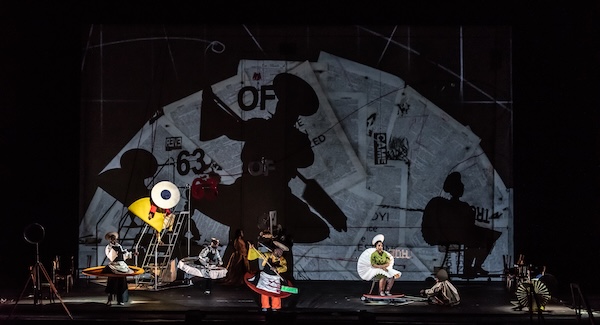
A scene from Waiting for the Sibyl. Photo: Stella Olivier
That film, The Moment Has Gone, will be delightfully familiar in its structure to anyone who sat through Kentridge’s 2012 Norton Lectures at Harvard (Daniel Bosch’s series for The Arts Fuse may have been the only publication on earth that covered every single session as significant art events in their own right. They were.). Kentridge, in his unassuming uniform of white button-down shirt and dark pants, draws with a stick of charcoal, while an identical Kentridge consults and complains from behind a camera on a tripod. We get reacquainted with Felix Teitlebaum, the artist’s illustrated alter ego, contemplating the artist’s work in a gallery, blue tears flooding his charcoal-and-white self.
Images are scrawled, smudged, erased, and brought together in animated sequences. A barefoot figure sits in the dirt pounding a mallet; Kentridge’s hands sort through what seem like page proofs; a sculpture slides off its pedestal. The trenches left by denuded mines become shelters and then graves. The Moment Has Gone is a meditation on the shifting interdependence of seeing and making and seeing again; the historic landscape and the private studio and the public exhibition; paired attention and neglect.
The film featured live accompaniment by South African jazz musician Kyle Shepherd. (Boston audiences heard his work for the moving puppet play of displacement, The Life and Times of Michael K, presented by Arts Emerson this past winter.) Shepherd creates a tremolo at a piano downstage while an ensemble of male singers performing the close harmonies of the South African isicathamiya style familiar from the singing of Ladysmith Black Mambazo offer pure, almost reverent tones. The music seems to rise up from the shifting illustrations of Johannesburg in the projections behind them.
Kentridge’s mini-opera Waiting for the Sibyl riffs on the Roman myth of the Cumaean oracle who wrote her answers to petitioners’ questions about their fates on oak leaves. Those leaves, left outside her cave, might make accurate prophecies, but the wind shuffles the leaves, and so, her predictions. This former priestess of Apollo also carries her own curse: eternal aging, which makes her an old woman who cannot die.
This myth is a perfect progenitor to Kentridge’s restless range of literary markings and aborted communication strategies. In Waiting for the Sibyl, the theatrical images include pages from antique ledgers; newspapers effaced with dark marks; typewriters emerging — miraculous — from random squiggles, and then dissolving again into something resembling a plate of fettuccine; a document that might be misunderstood as a telephone; papers scattering to escape proscribed sequence; oak leaf shapes cut as if by a nearly-blind Matisse; and slogans and text fragments flashing into view and then disappearing.
Scribble, smudge, repeat: the passage of time and the emergence and dissipation of information convey the difficult work of experiencing coherence and retaining memory.
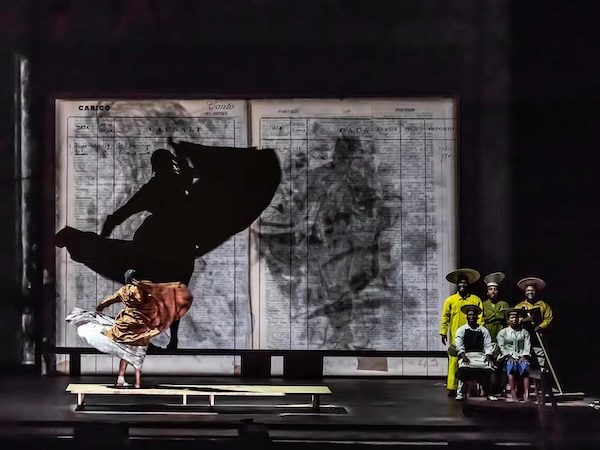
A scene from Waiting for the Sibyl. Photo: Stella Olivier
Waiting for the Sibyl is a series of cluttered, busy tableaux. A dancer, swathed in a caftan, her braids swaying, pulses intensely from atop a low platform; the silhouette shadow she casts on those ledgers is dark and more precise than her movements while, as if on a facing page, a charcoal animated version of her dancing forms and dissolves. Across the ledger paper an aphorism appears: “OLD GODS HAVE RETIRED.”
Over the course of the next 45 minutes or so, the performers’ figures’ proportions are augmented with Calderesque red disk tutus and sharp-edged hats that transform them into constructivist puppets. A fan on a stand blows papers across the space; a megaphone is relocated by an impassive worker in overalls; wooden chairs run away from a tired man and collapse as if rebelling against their use. Constant visual reshuffling keeps the vignettes fresh. It’s playful, manic, and somehow poignant, which is a tribute to the nine-member South Africa-based cast that performs with complete clarity of intention.
Waiting for the Sibyl has no written score but apparently was composed by Nhlanhla Mahlangu based on oral transmission. The tender close South African harmonies are front and center. At times, there is a striding syncopation between Shepherd’s piano and the company’s swooping treble chants. At others, the performers engage in sequences of panting breath.
Kentridge’s libretto is also a collage, a series of jottings he has kept in his private notebooks over the years. It draws from poetry translated from Finnish, Hebrew, Spanish, Greek, Polish, Russian, and German, as well as renderings of African proverbs and a few, well, oracular assertions. “The radio is faithful to megahertz,” the singers repeat. “Starve the algorithm.”
These sounds and Kentridge’s visual imaginings arise from the same ambiguous landscape, one that rests uneasily between the analog and the digital, the past and the unseeable future. They are the work of a free, and freewheeling, South Africa, freeing itself from any outsiders’ expectations.
Debra Cash is a founding Contributing Writer of the Arts Fuse and a member of its Board.
Loved your inspired review of Kentridge work.
Wonderful review, Debra. Kentridge is all slip, slide, smudge…..with an underlying spine which I feel is intuitive verbal.
I know he is an artist of multiple works mixing gallery images with film with slide images with drawn or videod images
on outdoor surfaces. I don’t know as much about his work as you do, but my sense is that he sees a thought or idea as
verbal and unpacks words with various kinds of imagery that has stock characters to which he refers in different places
and circumstances. His humanism is balanced by his awareness of the capitalistic, racist societies in which he lives and thrives. There is guilt in his living situation and atonement in his imagery of White greed and cruelty positioned against Black endurance. For me, his caravan structures, seeing people walking endlessly and forever, are both the hamster cage of the human condition and the onward push forward of humanity to whatever is better. Despite his very British appearance, he is Jewish at the core of his values.