
Poetry Review: “On the Slaughter” — Brilliant, Personal Translations of the National Poet of Israel
By Joann Green Breuer
If there ever was anyone to handle Hayim Nahman Bialik’s broad, impressive, and impressionistic craft with acute passion, it is scholar and poet Peter Cole.
On the Slaughter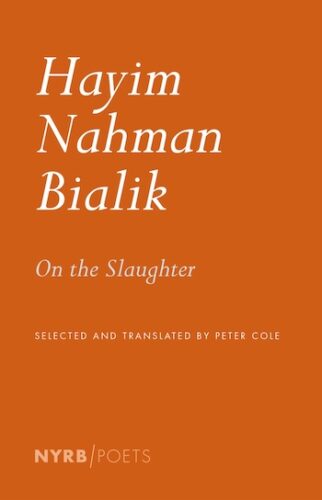 by Hayim Nahman Bialik. Translated, from the Hebrew, annotated, and with an introduction by Peter Cole. New York Review Books, 152 pages, $20
Born in a tiny village of “forty or so” huts, Radi, Ukraine, where his family eked out a living with a failing timber business, Bialik was orphaned at age seven. He was then sent to live with his pious grandparents, who enrolled him in the Volovshin Yeshiva at the age of 17. Around that time, Bialik began to write poetry; he soon left the yeshiva without informing his grandparents. Throughout his life, he continued to educate himself about Jewish texts written in a number of languages: Russian, German, Yiddish, and Hebrew. He also delved into the music of past Andalusian Hebrew.
Established Jewish writers, including Sholem Aleichem, Medele Moche Seforim, and Y.L. Gordon, lauded and supported him. At age 20, Bialik married Manya Averbuch. They lived in Odessa, his beloved adopted home, for 20 years until antisemitism in the Soviet Union forced his evacuation to Germany, where he lived for three years. In 1924 he fled to the British Mandate Palestine. After 20 years in Palestine, illness forced him to seek medical care in Vienna, where he died of a blood clot, an unfortunate side effect of treatment for kidney stones. At his funeral 100,000 came to mourn — half of the territory’s Jewish population.
Bialik’s mother tongue was Yiddish, in which he wrote about 20 poems. He translated these into Hebrew, and soon transitioned into writing in a language that, for millennia, had been almost entirely confined to written rabbinical commentary on ancient texts. Bialik’s popular poems and prose works were, among many other factors, responsible for the revival of spoken Hebrew as a vehicle for secular pride and delight. Jews then spoke a variety of vernacular languages because they had been scattered about the world, stealing vocabulary from wherever they wandered and settled: Yiddish, Ladino, Arabic, English, Polish, Russian, German, and more. In their newfound country, having escaped pogroms and worse, Jews were being inspired by reading, hearing, and grappling with Bialik’s dramatic imagery and moral conundrums in Hebrew. Quickly, Jews began to acquire a national language, arguably the only instance of a “dead” language regaining street life.
Eminent translator and annotator Peter Cole chose an epigraph that hints at the historical and contemporary complexity of Bialik’s poetry. It comes from the Arabist and critic Edward Said, who points out that the poet’s writings are deeply focused on both the suffering and dreams of Jews. Bialik’s vision is broad: “Texts that are inertly of their time stay there: those which brush up unstintingly against historical constraints are the ones we keep with us, generation after generation.” This is a reference to the fact that the fame of Bialik’s verse arose despite — or perhaps because of — its vision of the horrific Kishinev pogrom and its bloody aftermath.
The 35 Hebrew poems in this volume are grouped chronologically. (Bialik occasionally noted the exact year of composition.) This editorial decision is preferable to grouping poems thematically, the latter being open to argument. This is not a bilingual edition, which means readers must trust that Cole has captured both the basic sense and the import of the poems. Cole has impressive credentials, for sure. He is a MacArthur grantee, a resident of both the US and Israel, and a published, prize-winning poet. Still, I always like to look at the original lines, even if I cannot understand the language. Line length, sonority, and meter are crucial in conveying the nuances of poetic feeling and the bent of meanings. In particular, there’s a Jewish duality at the center of Bialik’s worldview (ha-shniyut b’yisrael): in the poet’s universe, opposites stand together, clash, and cohabit (fable and law, city and farm, hope and despair, retribution and acceptance), just as they do in the Hebrew Testament, the Talmud, and their commentaries. Also, what works in Hebrew’s root-built semantics is not always easily referenced in other languages. Bialik’s words and world are woven within the “fabric of Hebrew literature.”
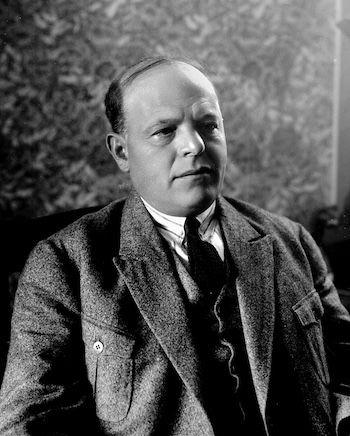
Poet Hayim Nahman Bialik in 1923. Photo: Wikimedia
Translations are inevitably controversial, a choice as ethical as it is literary. Because language grows, should we use terms that echo older speech patterns the poet used? Or should we draw on contemporary argot? Do we use English meters to suggest Hebrew’s? Or do we try to find equivalent rhyming patterns? For me, the best approach is to make a poet’s work accessible — and to trust the translator as much as reasonably possible. One must also be aware that what you are reading is a hybrid, at its most powerful (usually) when a poet is translating another poet, as is the case with Bialik and Cole. In this instance, we are particularly fortunate that Cole is both a poet and a scholar. His study of medieval Middle Eastern literature has been deep and, dare I say, loving. If there was ever anyone to handle Bialik’s craft with acute passion, it is Cole. And those who want to learn about Bialik’s references will value the extensive endnotes which the translator has assembled. Each poem is annotated at the close of the book, not at the bottom of each poem’s page; thus, one can respond to the poem without distraction and refer to the context when ready to seek analysis over emotion.
For an example of Cole’s translation strategy, look at the opening word of Bialik’s famous poem, from which this volume gets its title: On the Slaughter. Written in 1903, it is an early, but cogent, reflection on the massacre in the “backwater” town of Kishinev. The far longer “City of Slaughter,” which appears later in this volume, comes across as more of a screed registering compassion and horror at the mass murder of Jews, the utter mayhem that ran rampant for several days as the holidays of Passover/Easter came to a close. Bialik, in his role as reporter and historian, interviewed a number of the survivors. His report emerged, not as a newspaper or encyclopedia document, but as verse. At the time, Bialik had already published a book of his poems, and had been recognized as a poet to watch, but “City of Slaughter” and “On the Slaughter” became his most famous works, assuring his legacy. The poems eschew sentimentality or self-pity, rejecting what had become the standard despairing responses to the trauma of pogroms. Bialik supplied a call of affirmation, suggesting Jewish defiance, rather than offering consolation. That call has been drawn on in both wise and ill-advised ways, notably in today’s Gaza assault.
Cole translates the opening word of On the Slaughter as “Skies.” Previous translators have begun the poem with the word “God,” or “Heavens.” A first word can serve as a lens through which an entire poem can be read. Despite the many references in the poem to the Hebrew Bible — Psalms, Ecclesiastes, and others — Cole has chosen a secular reading of the Hebrew word. The implication of Cole’s choice: that the despair in all that follows will be focused on the real world, on real Jews. The reader is not situated in a mystical dream. The second line contains a cry to “God,” and its first word is “if.” Think of that. Bialik studied in yeshiva and knew his religious mantras, but Cole’s word choices are decidedly secular. Later in the poem, Cole makes the language more immediately personal than other translators.
Not:
You, Executioner. Here’s my neck – go/to it. Slaughter me! Behead me like a
dog yours is the almighty arm and the axe/ and the whole world is my scaffold.
But:
Executioner, here’s my neck: slaughter!
Take off my head like a dog’s– you’ve got the ax
and the arm and the world to me is a butcher’s block.
The conversational tone here, along with its rhythm, feel both contemporary and timeless. It is a remarkable achievement.
In the explosive agony of the far longer “City of Slaughter,” Bialik calls on the “son of man” to stand, to flee, to weep. Initially, the poem had been censored by a Jewish editor who had converted to Christianity. It took about three months before the unexpurgated version was published. The Jewish relationship between God and man has always stirred heated debate. The dialogue continues, and the poem lives, used as both excuse for retribution and argument against it. “Cursed be he who cries – Revenge!” says the poet. But neither the poem nor the pain ends there. Art, notably when situated within a nationalistic ideology, has its consequences.
The early middle years of Bialik’s writing, often from Odessa, include a number of poems that turn to nature’s lights — stars and sun — with sighs and urgings. In his later middle years, when Bialik was moving from Odessa to Warsaw and back to Odessa, he wrote this line in “And If the Angel Asks”: “Where, my son, is your soul — ?” He weeps for a lost love, although he and Manya were never apart. It is another kind of love for which Bialik weeps.
I cite one more poem from this period of Bialik’s work to illustrate Cole’s sensibility and skill. I almost hate to quote another translation, because it belies the immediacy and intimacy of Cole’s rendering. But evidence matters.
This opening:
Summer is dying in the purple and gold and russet
of the falling leaves of the wood,
and the sunset clouds are dying
in their own blood
In Cole’s disarming voice becomes:
Summer dies into choice
gold and amber, and the purple–
of autumn gardens and twilight clouds
wallow in their blood
Instead of this closing:
have you patched your coat for winter?
stocked potatoes against its coming?
Coles hears:
Have you checked your shoes? Patched your jacket? Go, get the potatoes ready.
In this period of verses there remains “a cruel smile” as in “And When the Days Grow Long”:
the man in his dream, within the folds of his longing
whimpering
as the cat claws at his roof and wails.
Then the hunger comes,
swelling and gnawing like no other,
hunger for neither bread nor vision, but — for the Messiah!
Yet the sounds at the final verse are of either, or both, of a donkey braying or the “blast of the horn” announcing “Is the Messiah coming?” Here is Jewish duality at its most incorrigible.
Not all of Bialik’s poetry deals with murder, destruction, and loss. He wrote a number of children’s verses which he termed “natural voices for the young.” Early In his career, 1890/91, he wrote “To the Bird,” ostensibly not for children, which closes with the lines:
The tears have vanished and summers too;
but no end comes to my grieving.
You’re back, little bird, hello, hello–
now lift your voice and sing.
By 1922, he is speaking to the child, not to the bird:
And in each egg–
Shshsh!!! You’ll wake them–
the tiniest chick
lies sleeping…
Bialik sleeps, but his opus is awake and moves us. The ironies of his artistry resonate. This yeshiva dropout infuses his work with startling biblical imagery and confounding Talmudic argument; this diaspora Jew became the “National Poet of Israel”; and this childless man became the inspirational, challenging father of innumerable Hebrew poets.
Joann Green Breuer is artistic associate of the Vineyard Playhouse.
Wonderful review. Thanks for this clear-eyed look into a great Jewish poet. Your remarks on translation are invaluable.
Roberta Silman