
Book Reviews: Four Books on the Climate Crisis — Is it Really the End of the World?
By Ed Meek
How bad is the future going to be? Depends on who you read.
The Long Heat, Climate Politics When It’s Too Late by Wim Carton and Andreas Malm. Verso Books, 429 pp., $39.95.
Overshoot: How the World Surrendered to Climate Breakdown by Wim Carton and Andreas Malm. Verso Books, 1182 pp., $18.82.
What if We Get it Right? Visions of Climate Futures by Ayana Elizabeth Johnson. Random House, 471 pp., $19.31.
Not the End of the World: How We Can Be the First Generation to Build a Sustainable Planet by Hannah Ritchie. Little Brown Spark, 299 pp., $30.00.
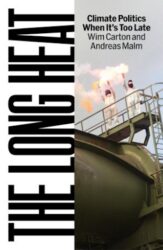 The Long Heat Is a follow-up to Overshoot, a breakthrough book that claims the tipping point for fighting climate change has passed. The theory of Overshoot is that humans have sped past the ability of the earth to accommodate us. There are too many of us using too many resources unsustainably. As a result, we’re increasing — rather than decreasing — global warming, and destabilizing our weather patterns. We’re warming the oceans, melting the ice, killing coral reefs, fishing out the oceans and filling them with plastic. There are prolonged droughts and floods from downpours. Hurricanes are getting stronger. We’ve already passed the 1.5 c limit of the Paris Accords (briefly last year). Carton and Malm insist that we are getting close to a tipping point, at which conditions will become much worse.
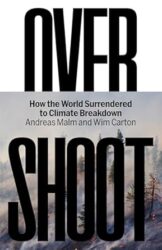 In Overshoot, the authors argue that changes in the affordability and efficiency of green energy don’t matter because big oil will not leave their assets stranded. If they did, it would trigger a worldwide recession. In addition, fossil fuels create what appears to be a never-ending market — big oil is not about to give up on that profitable arrangement. The consumer burns fossil fuel and must buy more. Once solar panels are installed, oil is no longer a nonstop moneymaker. Once energy comes from the sun and the wind and water, its good for us and the planet. But that’s not so good for business.
The Long Heat accepts this endgame and asks, what should we do now? The authors raise three options: carbon sequestration, geo-engineering, and mitigation. They argue that sequestration is a scam perpetrated by big oil and capitalists. Geo-engineering is a crap shoot as likely to destroy us as save us (the strategy is debunked by Elizabeth Kolbert in Under a White Sky). Although mitigation is the only rational choice among the three, Carton and Malm argue that we won’t be able to do enough to deal with climate change. The only answer is to leave the oil in the ground. But they conclude that this will only happen when oil loses its value, which is to say, not anytime soon.
In Race for Tomorrow, Simon Mundy traveled the globe and spoke with CEOs of fossil fuel companies who expressed awareness of climate change and the coming end of coal and oil. Meanwhile, they all said, there’s a lot of money to be made.
If you consider fossil fuels as a short-term business opportunity and leave the long-term consequences out, you can see why a businessman like Trump would be in favor of them. Although he claims that climate change is a hoax, his interest in Greenland indicates he sees opportunity in a changing climate. Meanwhile, his trade deals often include selling American gas. His undercutting of support for electric vehicles and green energy has more to do with profits for big oil than exposing hoaxes. It’s all about the money. Since a majority of American voters elected Trump, they apparently, so far, support this love of fossil fuels.
If this vision is too bleak for you, you might turn to Ayana Elizabeth Johnson’s What If We Get it Right?, in which she interviews people who are obsessed with fighting climate change in their own, effective ways: she wants to restore the ocean, Brian Donohue is out to create a million small sustainable farms, the author’s mom, a community farmer who provides fresh food for her old urban neighborhood, wants us all to join farm collectives that cultivate seeds. Bill McKibben tells us to divest from fossil fuels and never stop protesting. Johnson dots her text with hearts and includes poets: “I’d gamble on humanity a hundred times over” (Pakistani Climate justice advocate Ayisha Siddiqa). Maybe gambling is not Siddiqua’s strength. She would “follow love into extinction.” Wait, isn’t that the wrong message? In any case, although Johnson’s heart is in the right place, this is not a very serious or realistic book.
 For a positive but nuanced perspective, read Not the End of the World by Hannah Ritchie, deputy Editor of The World in Data. Ritchie tells us that to be sustainable means living in a world that provides for us in the present while, at the same time, leaves behind a planet that enables those who follow us to thrive. Historically, humans have not been good at the first measure. It is only recently that we have been able to feed the world and create healthy outcomes for most of us (at least in the developed world), with much lower rates of child mortality, poverty, and extended life spans. We are now doing pretty well at sustainability. It’s the second part of sustainability, protecting the future, that we find so challenging because of our over-reliance on fossil fuels. Nonetheless, Ritchie insists we are capable of dealing with climate change when we choose to do so. Because of these factors, Ritchie claims this is the best time ever to be alive. This is similar to Steven Pinker’s point of view in Enlightenment Now in which he touts the advances humanity has made.
Ritchie takes on a number of challenges presented by sustainability to advance her argument that dealing with problems like pollution is nothing new. Although millions still die from pollution, we have succeeded in creating much healthier cities. Take London and Beijing, for example. When coal was king, homeowners used it to heat their houses and industry relied on it, resulting in filthy air. London is now a beautiful and relatively clean city. Beijing was known for its pollution until the 2008 Olympics — embarrassment and demands by residents forced China to clean it up. Ritchie also tells us that growth and lower emissions are not incompatible. Farming with high yields because of the green revolution means we are able to feed the world’s growing population. The problem: the increasing demand for beef and pork and lamb forces us to use more and more land and food to feed livestock. In the future, we are going to have to replace this costly and inefficient system, Ritchie says, with artificial meat and sustainable fishing practices. As for the cooperation we will need to accomplish that, she points to how the world dealt with the hole in the ozone layer. We can work together to solve the problem of climate change — if we are willing to unite to do what is necessary.
Ed Meek is the author of High Tide (poems) and Luck (short stories).
Tagged: "Not the End of the World: How We Can Be the First Generation to Build a Sustainable Planet", "Overshoot", "The Long Heat", "What if We Get it Right? Visions of Climate Futures", Andreas Malm, Ayana Elizabeth Johnson, Climate Change, Climate Crisis, global warming
This is a thoughtful roundup of perspectives on the climate crisis. 🌍
I appreciate how you contrasted the urgent warnings of Carton and Malm with the more hopeful approaches of Hannah Ritchie.
It’s a good reminder that while the challenges are real and daunting, there are actionable paths forward — from sustainable farming to clean energy solutions — that can make a difference. 🌱