
Jazz Concert Reviews: Mary Halvorson’s Amaryllis and the Mehmet Ali Sanlıkol Quintet at the Regattabar
By Jon Garelick
Gigs by superb bands led by Mary Halvorson and Mehmet Ali Sanlıkol at the Regattabar.
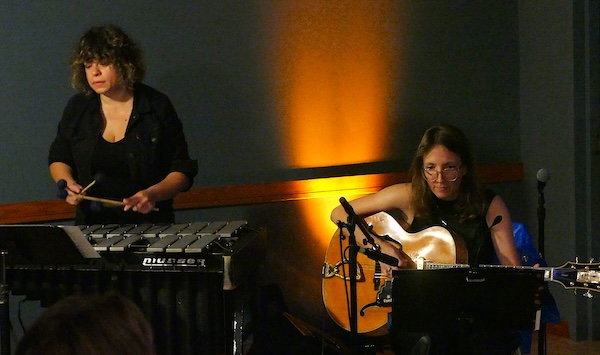
Mary Halvorson (right) with Patricia Brennan at Regattabar. Photo: Paul Robicheau
It took a while to load in the sold-out crowd for the Mary Halvorson band’s first set at the Regattabar on Thursday night, so the 7:30 show didn’t start until 7:52. But from there, Halvorson and her sextet proceeded with focused efficiency: no patter, no announcements between songs. After all, they had to clear the house, and take a breather, before the 9:30 second set.
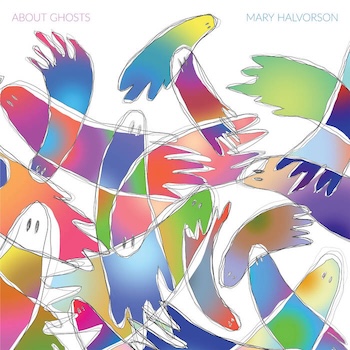
That focus and efficiency could also describe the music itself, coming off one of Halvorson’s best releases, this year’s About Ghosts (Nonesuch) — certainly at this point, on the cusp of the third quarter, one of the best jazz albums I’ve heard by anyone this year.
It features the band, Amaryllis, that she’s been working with over her previous three albums — Amaryllis, Belladonna, and Cloudward.
Over the course of these albums Halvorson’s writing has sharpened for small band. Always beguiling — as rhythmically and harmonically knotty and form-bending as her guitar playing — the band’s music on About Ghosts seems to have a new sleekness and groove — a new efficiency, if you will. When you think of Mary Halvorson’s music, you don’t think of a blowing session — there are great solos, sure, but everything serves the piece, which can turn and bend at any moment. The result is as intoxicatingly rich as the scent of a lily. But it is demanding music: relentless dissonances, broken rhythms, wayward forms. And sometimes it can be too much. Maybe that’s why her Code Girl band (with the impressive vocalist Amirtha Kidambi) never caught on for me. Background and foreground were blurred, my attention confused. Maybe “too much information,” as composers sometimes say.
At the Regattabar, the ensemble was in perfect balance, and it confirmed that this is as close as Halvorson’s music has come to progressive hard-bop — grooving and tuneful, with solo features, but always with the composition itself as the thing, even as elements shifted this way and that, our attention always clearly directed.
This was deeply organized music: long-lined melodies over contrasting rhythmic figures, multiple cued entrances and exits for soloists, unison figures for horns or rhythm, and always attractive melodies or rhythmic motives that served as core material for improvisation and gave structure to the whole.
 It probably helps that Amaryllis is a star-laden ensemble: aside from Halvorson, trumpeter Adam O’Farrill has been a rising star for the past few years. He’s now the trumpeter in keyboardist Hiromi’s very different band, Sonicworld. And his For These Streets (Out of Your Head) is another of this year’s best jazz albums thus far. Meanwhile, vibist Patricia Brennan was the breakout star of 2024; her Breaking Stretch (Pyroclastic) was an across-the-board critics poll winner. Trombonist Jacob Garchik is another comer gaining more attention for his own bands, drummer Tomas Fujiwara has been Halvorson’s drummer of choice for a couple of decades, and Nick Dunston is an admired bassist of startling originality and power.
Seeing the band live helped reinforce the adage that we hear live music with our eyes. Or was it the favorable sound mix that made Brennan’s contributions, for example, feel so essential? Set against the wall to the seated Halvorson’s right, she comped with harmonies or single-note figures and made the vibrato of the vibraphone a real breathing presence.
Occasionally Brennan’s pedal/mallet work conjured a celeste, or Halvorson would chime it with a bit of heavy reverb or her own signature bends and slides to create a backdrop curtain of shimmery sound. As a “chording” instrument, Brennan’s vibes were a good fit with Halvorson’s guitar and gave the music a space and texture that might have been crowded by piano.
The band played three tunes from About Ghosts, five new pieces, and an encore of “Amaryllis,” the one “oldie,” each with its own distinctive character. Occasionally there were cinematic effects, like the dissonant Bernard Hermann-like intervals in the melody of “Florid Waning” or Halvorson’s looping effects on “Nacre Sky” (both new). Another new one, “Verdant Glitters,” had an appealing Afro-Latin cadence, and “Eventidal” (from About Ghosts), with Fujiwara’s delicate brush work, suggested the Modern Jazz Quartet in its textures and dynamic balance.
And yes, there was some shredding. Brennan took a couple of bravura solos, as did O’Farrill, Garchik, and Fujiwara. But thankfully, in a departure from old-school blowing, there was no need for everyone to solo on every tune. “Whatever the piece required” seemed to be the rule of the day. (Fujiwara appeared to be playing the phrases of the tune in his “Amaryllis” solo.) Dunston had one extraordinary outing, on “Verdant Glitters,” establishing the seven-note vamp that would anchor the piece before elaborating with flurries of alternating single-note phrases in the upper and lower registers, accenting with a powerful series of double-stops, like a drum. And the otherwise reserved Halvorson, supporting and leading with sharp commentary, took a flying passage of eighth-note swing on “Nacre Sky.”
Inviting the audience to stick around for the second set (where the band would be joined by saxophonists Walter Smith III and Logan Richardson for some of the About Ghosts octet numbers), Halvorson said, “I can pretty much promise not to repeat any tunes.”
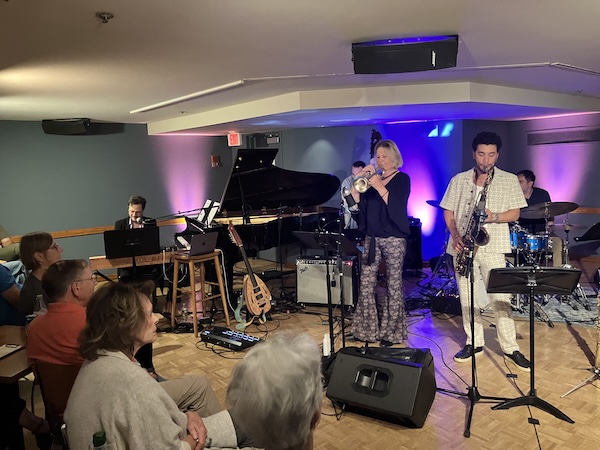
The Mehmet Ali Sanlíkol Quintet at the Regattabar. Photo: Jon Garelick
The pianist and composer Mehmet Ali Sanlıkol came to Boston from Turkish Cyprus in 1993 to establish his identity as a jazz musician at Berklee and leave behind any remnant of his Turkish heritage, including Turkish music. “I wanted to be a jazz cat!” he told me around the time of the release of his big band album Whatsnext?, in 2014. But in the intervening years, acquiring degrees from Berklee and New England Conservatory (where he earned a PhD), he’s become something of a Turkish-American polymath, writing a provocative fusion of jazz and Turkish folk and classical traditions as well as founding the Turkish traditional music organization DÜNYA.
If you’d dropped into the middle of any one of the tune’s Sanlıkol played in his quintet’s set at the Regattabar on Friday night, however, you might not have made the Turkish connection — this was forthright, vital, American jazz. The open harmonies and “exotic” scales of the Turkish makams that Sanlıkol deployed were of a piece with the modal jazz that’s been common currency in jazz for the past 50 years. In fact, if the set’s opening number, “A Children’s Song,” had a certain Coltrane-like cast, it was no accident. Sanlıkol has said that Coltrane’s approach to “My Favorite Things” was key to his arrangement of a piece by the Turkish composer Muammer Sun. But those familiar outlines were informed by Sanlıkol’s very personal approach to deploying, as he has written, “varying degrees of Turkish musical characteristics in a jazz context.”
The band at the Regattabar included musicians from his latest album, 7 Shades of Melancholia (Arts Fuse review) — bassist James Heazlewood-Dale, drummer George Lernis, and trumpeter Ingrid Jensen, plus the saxophonist Edmar Colón. The rhythmic core of Heazlewood-Dale and Lernis were key to pieces taking flight, especially Lernis’s unrestrained accents and cues, propelling one chorus to the next. “A Children’s Song” began gently, with Sanlıkol singing in unison with his piano melody, but soon took off with keyboard runs and upward propulsion, before being joined by Colón’s earthy tenor.
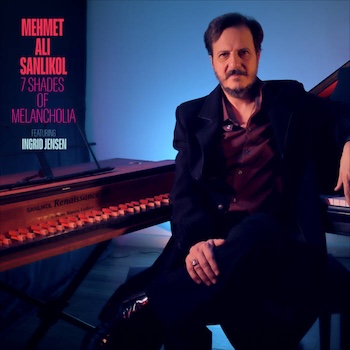 The Turkish tinge (to paraphrase Jelly Roll Morton on Latin influences) could be heard in Sanlıkol’s vocals — sometimes wordless, sometimes in Turkish — and in his Renaissance 17, a patented digital keyboard of his own invention that allows him to play microtonal scales. Sometimes the synthy sound of the instrument led to familiar jazz-rock rhythms and sometimes it competed in the mix with Colón’s tenor. When he sang wordlessly in unison with it in his uptempo “Hüseuyni Jam,” he conjured Milton Nascimento with Wayne Shorter.
Jensen — a guest on the album — was a tonic all night. Her warm tone and insightful phrasing gave special color to the beautiful melody of Sanlıkol’s “One Melancholic Montuno.” And she was a key component in what might have been the most “Turkish” song of the night, “Esrar,” adapted from a text by the Turkish Bektashi dervish Neyzen Tevfik, in which her use of mutes and her interplay with Colón underscored the tune’s haunting minor-keyed mood. And here Sanlıkol’s playing of the melody line on the double-reed duduk was a revelation — not only Turkish but musically apt.
For the closer and encore, “Segah Shuffle” and “Talk About a Turkish Blues,” Sanlıkol turned to an electric oud, another instrument of his own design, and rocked out, with horn backing. To these ears, the oud was indistinguishable from electric rock guitar, but one imagines that the 11-string instrument gave Sanlıkol more options than a 6-string Les Paul.
So some pieces sounded more explicitly Turkish than others (I especially like when Sanlıkol takes off with odd-metered Levantine dance rhythms, as on his album Turkish Hipster). But in each, he sounded resolutely himself — which is pretty much the point, whether you’re a jazz musician or any other kind of improviser.
Jon Garelick can be reached at garelickjon@gmail.com.
Tagged: "7 Shades of Melancholia", "About Ghosts", Adam O’Farrill, Edmar Colón, George Lernis, Ingrid Jensen, James Heazlewood-Dale, Mary Halvorson, Mehmet Ali Sanlikol, Nick Dunston, Patricia Brennan, The Mehmet Ali Sanlíkol Quintet