
Classical Album Review: “Shostakovich Discoveries” — Music That Fell Through the Cracks
By Jonathan Blumhofer
This collection of ten items by the Soviet-era great manages to be more than a parade of mere curiosities.
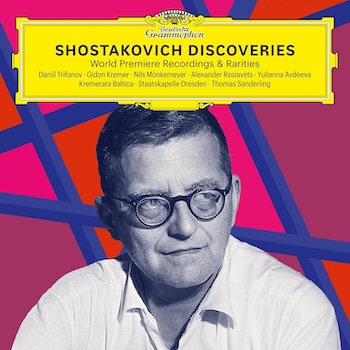 That we don’t know every note Dmitri Shostakovich wrote, even fifty years after his death, is hardly surprising. The man was compulsively prolific and had to weave his creative way through unimaginably complex political and personal labyrinths. That some music fell through the cracks (or was intentionally squirreled away in desk drawers) is to be expected.
Almost by definition, then, what makes up this “missing” fare is haphazard: sometimes offerings are substantial, oftentimes they’re short and occasionally they’re experimental. It’s welcome to note, however, that Shostakovich Discoveries, Deutsche Grammophon’s new collection of ten items by the Soviet-era great, manages to supply a bit more than a parade of mere curiosities.
Yes, there are a couple of those: In the Forest, a dreamy, Debussy-meets-Delibes effort from around 1919, is one. So are the Prelude & Fugue in C#-minor (a recently unearthed and newly completed sketch discarded from Shostakovich’s massive Op. 87 set) and Murzilika, a mysteriously wry number that lasts barely half a minute. Even so, they’re smartly played by pianists Daniel Ciobanu (the first) and Yulianna Avdeeva (the rest).
But brevity can also yield touching dividends. The 5 Pieces for Two Violins and Pianos, sweetly rendered by violinists Gidon Kremer and Madara Petersone with pianist Georgijs Osokins, showcases the populist side of Shostakovich, the one at home writing film scores and mimicking jazz. The Impromptu for Viola and Piano, which just turned up in 2017, offers, in the hands of violist Nils Mönkemeyer and keyboardist Rostislav Krimer, a beguiling play of soulful melancholy and wistful playfulness. It’s a truly welcome discovery.
So are the 3 Fugues for Piano Shostakovich penned in the early-‘30s as he was writing his Symphony No. 4. Daniil Trifonov navigates them with snapping authority, especially the jaunty middle installment. The same pianist does well, too, in the Scherzo, Shostakovich’s “Opus 1,” that sounds, in this reading, a bit like precociously clangorous Tchaikovsky.
For heavy-duty acerbity, look no further than the “Three Fragments” from Shostakovich’s satiric 1928 opera The Nose. Inexplicably cut before its premiere, these are demonstrations of the composer at his most harmonically and ironically aggressive. There’s a brashness to his writing here—all of it boldly rendered by Thomas Sanderling and the Staatskapelle Dresden—that was effectively squashed by Stalin’s cultural police just a few years later.
Yet the world of anticipations that emerges from these pages, from the crunchingly dissonant organ solos and goofily ironic woodwind turns of the outer pair to the unsettling phantasmagoria of the central section, is notable—especially as we listen to it with the benefit of hindsight and knowledge of where Shostakovich’s career was headed: anticipations of the Fourth Symphony and Lady Macbeth are readily apparent. But so are hints of the later symphonies and quartets.
Those connections become abundantly clear in Yelabuga Nail, an aptly bleak setting of Yevgeny Yevtushenko’s meditation on the suicide of poet Marina Tsvetaeva. Just discovered in 2023, this is a major addition to the Shostakovich catalogue and the world premiere recording from bass Alexander Roslavets and pianist Andrei Korobeinikov boasts a fitting sense of ceremony.
The Anti-Formalist Rayok, on the other hand, features Shostakovich at his most bitterly sarcastic. Setting excerpts from the Communist Party conference speeches that resulted in (and followed) the notorious Zhdanov Decree, the music is often antic and cartoonish—a quality that lends a welcome bit of context to similar-sounding episodes in the composer’s symphonies, quartets, and concerti.
Yet the Rayok’s also unnervingly timely: the banality of the libretto overlaps more than a little bit (in tone and worldview, if not exactly syntax) with our current political moment. That ensures that this performance—in which bass Alexei Mochalov, percussionist Andrei Pushkarev, and Kremerata Baltica don’t stint on whimsy or cheek—speaks with a vigor that ought to unsettle even the most complacent among us.
Jonathan Blumhofer is a composer and violist who has been active in the greater Boston area since 2004. His music has received numerous awards and been performed by various ensembles, including the American Composers Orchestra, Kiev Philharmonic, Camerata Chicago, Xanthos Ensemble, and Juventas New Music Group. Since receiving his doctorate from Boston University in 2010, Jon has taught at Clark University, Worcester Polytechnic Institute, and online for the University of Phoenix, in addition to writing music criticism for the Worcester Telegram & Gazette.
Tagged: "Shostakovich Discoveries", Andrei Pushkarev, Daniel Ciobanu, Daniil Trifonov, Deutsche Grammophon, Dmitri Shostakovich, Georgijs Osokins, Gidon Kremer, Kremerata Baltica, Madara Petersone