
Opera Album Review: Aleksandra Kurzak Channels a Great Singer of the Past
By Ralph P. Locke
World-renowned soprano Aleksandra Kurzak’s homage to the great French soprano Cornélie Falcon is largely one to cherish.
Aleksandra Kurzak, soprano.
Morphing Chamber Orch/ Bassem Akiki.
Aparte 353—67 minutes.
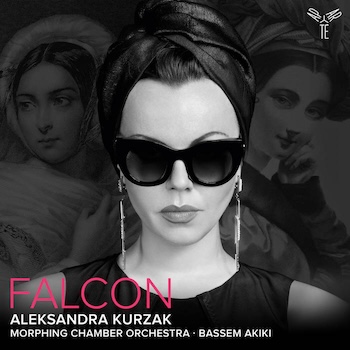 This aria album has a big hot-pink title: FALCON. And it juxtaposes a photo of Aleksandra Kurzak, a leading soprano at the Met and other major opera houses around the world, with two portraits of Cornélie Falcon (1812-1897). Kurzak even sports a head-wrap that we see in one of the Falcon portraits. Yes, we have here another album in which a prominent singer channels a great singer of the past. I have reviewed, and often admired, such efforts (for example, one in which Lawrence Brownlee and Michael Spyres sing two-tenor duets by Rossini); this one, too, is welcome and well done, though (as I’ll explain) less than ideal.
In the opera world, a “Falcon soprano” is an established category: it refers to a singer with a light, flexible top and a rich bottom extending into mezzo territory, with enough dramatic vitality to convey a wide range of emotions.
Kurzak was soon to turn 47 when she made this recording in Vienna in 2023. Falcon famously lost her voice at 23, during a performance of Niedermeyer’s Stradella, and she stopped singing entirely at 28. Some critics suggested that she had begun her operatic career too young, others that there was a spot in her middle range that she had never mastered.
Fortunately, Kurzak shows no such weaknesses in her vocal technique. Each aria here is beautifully rendered. Still, a few of the most famous numbers feel somewhat generic rather than individually interpreted — perhaps because Kurzak hadn’t yet performed the roles on stage. I also do not always hear her pay close attention to the words she’s singing. Musical and vocal aspects are splendidly managed, but tempos are quite steady, with few changes to respond to the text. Kurzak’s French is not at all native-sounding: in the repeated phrase “le bonheur,” the “le” has a very open (Italianate?) e, sounding more like “leh” or even the English word “lay.”
The album contains some pieces from a generation or two before Falcon, namely Donna Anna’s “Non mi dir” from Don Giovanni, Julia’s famous solo from Spontini’s 1809 La vestale, and Beethoven’s concert aria “Ah, perfido!” Particularly interesting, of course, are the excerpts from works that were created during Falcon’s career (some of them designed for her), notably Meyerbeer’s Les huguenots, Halévy’s La juive, and Niedermeyer’s aforementioned Stradella. The Niedermeyer aria is so engaging and dramatically effective that I now hope someone will record the whole work. (Véronique Gens recorded the same Stradella aria on her Visions CD.) Although Falcon also “created” (as one says in the opera world) the title role in Louise Bertin’s remarkable Esméralda, that work is, unfortunately, not represented here.
Among other numbers that are heard are Berlioz’s atmospheric song with orchestra “Le jeune pâtre Breton” (which Falcon sang on a concert that included the premiere of Berlioz’s symphony-with-viola Harold in Italy) and Agathe’s grand aria from Weber’s Der Freischütz. My favorite is the countess’s aria from Rossini’s Le comte Ory, which Kurzak tosses off with touches of comical self-importance. You can watch her enjoyment (and be startled by her coloratura and brilliant high notes) in a YouTube video of the entire aria made during the recording session:
The orchestra, under Lebanese-Polish conductor Bassem Akiki, is smallish but highly responsive. Unlike other aria recitals, the orchestra here is not recorded too quietly. As a result, many colorful details come through, such as the skittering strings in the Spontini (which I suspect inspired a moment in the “Ride to the Abyss” in Berlioz’s The Damnation of Faust). But the acoustic is rather dry, with little room resonance: in Richard Bonynge’s famous complete recording of Les huguenots, the long passage in Valentine’s aria accompanied only by winds blooms more touchingly. (The fine singer there is the then-youngish Martina Arroyo.)
Akiki, who is also a composer, is best known for conducting complex new works, which perhaps inclines him toward maintaining precision — being faithful to the written notes. I wish that here he had shaped tempos more (that is, gone beyond the notes of the score) to encourage the singer to shift moods from phrase to phrase, lean into a word, or emphasize a leap or motive. Instead, he seems to be taking his cue almost entirely from her. What I have in mind is beautifully illustrated by Krassimira Stoyanova’s recording of this same aria from Les huguenots on her album I palpiti d’amor (on the Orfeo label, also available on streaming channels), flexibly conducted by the experienced Austrian opera conductor Friedrich Haider.
In short, Kurzak’s disc is largely one to cherish. (All of its tracks are also available for free on YouTube.) But, if it had been done with even more nuance and moment-to-moment specificity, it would have celebrated more fully the memory of one of the most vivid and influential opera singers of the nineteenth century.
Ralph P. Locke is emeritus professor of musicology at the University of Rochester’s Eastman School of Music and Senior Editor of the Eastman Studies in Music book series (University of Rochester Press), which has published over 200 titles over the past thirty years. Six of his articles have won the ASCAP-Deems Taylor Award for excellence in writing about music. His most recent two books are Musical Exoticism: Images and Reflections and Music and the Exotic from the Renaissance to Mozart (both Cambridge University Press). Both are now available in paperback; the second, also as an e-book. Locke also contributes to American Record Guide and to the online arts-magazines New York Arts, Opera Today, The Boston Musical Intelligencer, and Classical Voice North America (the journal of the Music Critics Association of North America). His articles have appeared in major scholarly journals, in Oxford Music Online (Grove Dictionary), and in the program books of major opera houses, e.g., Santa Fe (New Mexico), Wexford (Ireland), Glyndebourne, Covent Garden, and the Bavarian State Opera (Munich). The present review first appeared in American Record Guide and is included here, lightly revised, by kind permission.
Tagged: Aleksandra Kurzak, Aparte, Bassem Akiki, Cornélie Falcon