
Album Review: MonoNeon — Forging His Own Psychedelic Path
By Brooks Geiken
MonoNeon is the most important musician to emerge from Memphis in recent memory.
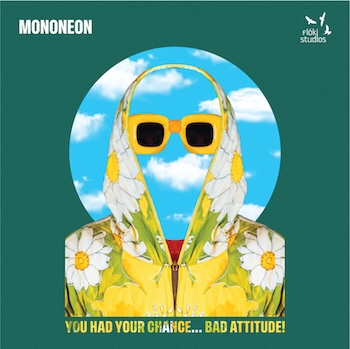
Thanks to Leah Concialdi, I have been introduced to the wonderful and bizarre world of MonoNeon. Mono, as his father, bassist Dywane Thomas (The Bar-Kays, Denise LaSalle etc.), refers to him, is a third generation musician who hails from Memphis, Tennessee. Mono’s grandfather, Charles Thomas, was a revered teacher and pianist; he taught several generations of Memphis pianists, including Phineas Newborn, James Williams, and Mulgrew Miller. Thus MonoNeon has been around outstanding musicians his entire life. He took the lessons he learned as a child and went on to forge his own psychedelic path.
First, one issue to put out of the way. Mono’s look is seriously provocative. He performs in knitted head pieces, bright iridescent colors, and a ski mask. The neon sock that hangs at the end of his bass is … distinctive. To top it all off, his own signature bass sports its own in-your-face color scheme.
Forget about all that visual stimulation — the cat can play his own Fender model five string bass and sing.
On his latest album, You Had Your Chance…Bad Attitude!, Mono displays a talent for inventing sprightly melodies, clever, insightful lyrics, and superior bass playing. On the opening track, “Bad Attitude,” Mono insists that he will not give up his integrity as a musician to make it in Hollywood. Another playfully satiric number: his funk song “Beyoncé,” where a guy trying to get closer to his girlfriend lets her listen to Beyoncé’s music — if she really wants to.
One tune, “City Life,” is a mixed bag. Some of the lyrics are enjoyable, “Jimi’s [Hendrix] smilin’ down on me. I can hear him in my mind. That “voodoo” sounds so sweet,” and “Every day is a deja vu.” Unfortunately, at the end of the song he overamplifies his vocals and there’s feedback via an electric guitar solo — the heavy metal overtones smack of overindulgence.
Thankfully, other tracks supply beauty and simplicity, ranging from the silly to the serene. The middle three, “I Wish You Well,” “Mama I Really Love You,” and “All U Need Is Love,” proffer a laid-back slow jam vibe. The first is a break up song that contains the unexpected line, “I hope I never see your face again.” “Mama I Really Love You” contains an inspired guitar break by renowned blues musician Christone “Kingfish” Ingram, who was recently featured at the end of Ryan Coogler’s Sinners. The use of a baritone voice on “All U Need Is Love” makes for a fine contrasting complement to Mono’s lovey-dovey lyrics.
The final two tunes, “You’re The One That I Like” and “I Know I’m Gonna See You Soon,” fall into the category of bouncy love song. Both tracks feature horns and inspired background vocals.
On YouTube one can find several excellent Mono videos. In one performance, Mono duets with his Grandma Liz on a touching song called “Still Got That Sparkle.” Grandma Liz suffers from dementia: one line in the tune goes, “we just need a song and a dance to bring back memories.” When Grandma Liz sings “Jesus What a Wonderful Child,” with Mono on bass, the experience is transcendent, lovely singing with stunning accompaniment. In another video, an improvisation titled “Flamen-Day-Glo,” Mono jams with two Spanish musicians, Jorge Pardo on flute and Ximo Tebar on the guitar. Mono appears to be comfortable in any musical situation and brings his considerable knowledge and chops wherever he goes.
Not since Prince, with whom Mono was briefly associated, have I heard such a talented and prolific pop musician. His songs can be humorous at times (“Beyoncé,” “I Wish You Well,” and “I Know I’m Gonna Miss You”) or thoughtful (“Bad Attitude” and “All U Need Is Love”). Mono’s bass playing is nothing short of sensational throughout the entire album. My feeling is that Robert Gordon needs to add another chapter to his seminal book It Came From Memphis. MonoNeon is the most important musician to emerge from Memphis in recent memory.
On the strength of Mono’s most recent album I went to see him at Yoshi’s in Oakland, California, on June 23. While waiting for the band to hit the stage, I noticed that the venue’s PA system was playing music composed by Frank Zappa. Mono has been heavily influenced by Zappa, along with the eccentric Brazilian musician Hermeto Pascoal. In that way, my introduction to Mono was preceded by hearing music by one of his inspirations.
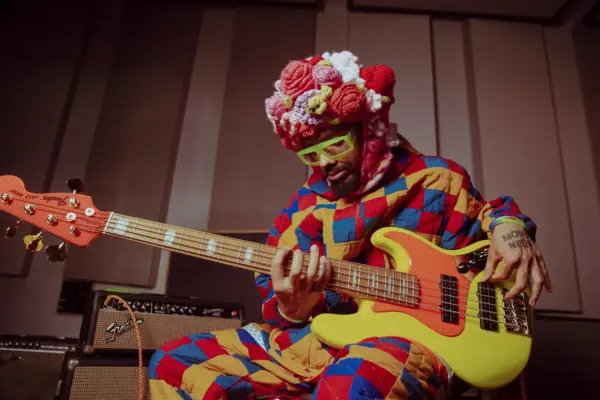
MonoNeon in action. Photo: Courtesy of the artist
Mono and the band dove into their nine-song set without informing listeners of what song they were playing. Electric keyboardist Dominique Xavier Taplin, electric guitarist Peter Knudsen, and drummer Jackie Whitmill jumped into the anarchistic spirit of every tune — jamming was on their minds. When Mono waved a hand above his head it was a signal for the band to change the direction of the music. Another tune inevitably began.
After about 30 minutes of this treatment, I began to tire. The tunes were often repetitive; on top of that, the band didn’t play anything off the new album. The show came off as just another stop on a big tour; there was a rushed feeling to the performance. Mono also spent part of the show with his back to the audience, which only increased the cold-shoulder atmosphere of alienation. It seemed as though MonoNeon was simply going through the motions.
Mono rolled out material from days gone by, including “Jelly Roll,” “Basquiat and Skittles,” and“Hot Cheetos” (which contains the lines, “Let’s go to your favorite ghetto. Go to the corner store and get some hot Cheetos”), “Stereo,” “Tell Me That This Love Ain’t Real,” and “Invisible.” The latter song was particularly revealing. At one point, Mono says that he would like to be invisible. But, as a performer, he has begun a high-profile life on the road, playing in front of people night after night.
In a recent interview, Mono said, perhaps in jest, that he wanted to be a superstar. He will gain the proper recognition, but to do that he has to promote his new music by playing it for as many audiences as possible. Judging by his many videos, Mono has plenty of music he could play in concert. Taplin, Knudsen, and Whitmill should learn Mono’s songs; then the band’s leader should pick and choose the tunes that fit the moment. Also, Mono should make sure to always include some new material in his shows.
MonoNeon is a tremendously inventive bass player and a delightful lyricist. The band I heard in Oakland was skilled and supported his music very well. But, here’s some advice for Mono when performing live: present the full range of your music, throw in a gospel number, and play some tracks from your latest recording.
Brooks Geiken is a retired Spanish teacher with a lifelong interest in music, specifically Afro-Cuban, Brazilian, and Black American music. His wife thinks he should write a book titled “The White Dude’s Guide to Afro-Cuban and Jazz Music.” Brooks lives in the San Francisco Bay Area.