
Film Review: “Highest 2 Lowest” Is Somewhere in Between
By Peter Keough
The times are out of joint for Spike Lee.
Highest 2 Lowest. Directed by Spike Lee. At the Coolidge Corner, Kendall Square, West Newton, Alamo Drafthouse, and the suburbs. It begins streaming on September 5 on AppleTV
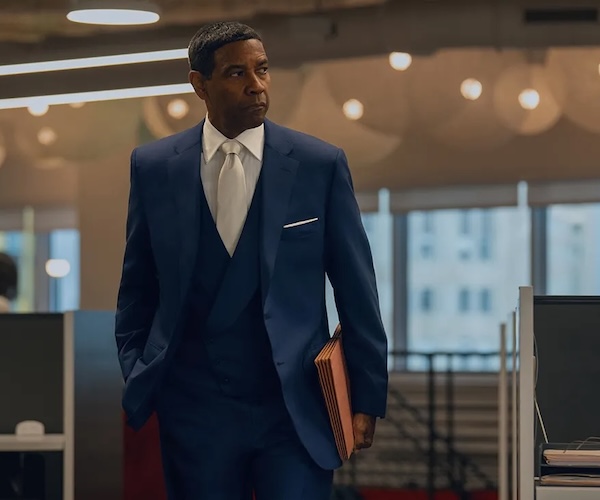
Denzel Washington in Highest to Lowest.
A remake of Akira Kurosawa’s High and Low (1963), itself an adaptation of the 1959 Ed McBain crime novel King’s Ransom, Spike Lee’s new film, as the title might suggest, indulges in his best and worst tendencies.
On the plus side, the film boasts some of his most dynamic, subtle, and surprising action sequences. It engages with the inequities and corruption of American society and culture — in particular, the gulf between haves and have-nots, the disparity between “high” and “low” art, the soulless excrescences of commercialized pop, and the mindless excesses of the plutocracy. It boasts a freewheeling mix of tones, styles, and allusions. And perhaps, most importantly in this perniciously anti-DEI era, it celebrates Black achievement and talent, past, present, and to come.
The negative side, ironically, involves some of those pluses taken to extremes and verging at times on bathos, kitsch, and corn.
That would include the performance of the film’s star, Denzel Washington, now in his fifth collaboration with Lee, a slate of films that includes the previous and superior crime thriller Inside Man (2006). In this outing he unevenly portrays the film’s Lear-like protagonist, David King, whom Lee has shrewdly made a music mogul, updating Kurosawa’s equally shrewd choice of a stylish shoe manufacturer played by Toshiro Mifune. As King, Washington tours the highlights of his repertoire, ranging from anguished family man to cocky action hero, but these showy bits never quite gel into a compelling, integrated characterization.
First seen on the balcony of his chi-chi digs in a Manhattan high-rise (which serves more as decoration than the metaphor of the mansion in High and Low), he’s gabbing on the phone about a business deal. He’s delighted with the prospects, dancing about as the song “Oh, What a Beautiful Mornin’” from the ultra white-bread musical Oklahoma! (1955) surges on the soundtrack. “It’s a beautiful day!” exclaims King at the end of the call.
Lee has his share of arresting opening sequences, but this is one of his more perplexing. Is he being ironic, or suggesting that King’s taste, once apparently legendary, has grown as unhip as the Rodgers and Hammerstein classic? If so, the film’s score by frequent collaborator Howard Drossin echoes for a while that dowdy vibe — it’s a distractingly bombastic accompaniment to the narrative. Such a tone-deafness would seem inexplicable from a director whose strong point has always been his musical choices. It is especially puzzling in a film about the music industry.
But the stodginess of the score might serve to echo the inertia of the early going (not unlike Kurosawa’s version). Here Lee tediously details King’s plan to thwart an attempt to squeeze him out of his company Stackin’ Hits. (The longueurs of this exposition had me idly wondering if the name was an allusion to Stax Records, and whether the rival company Stray Dog nodded to Kurosawa’s 1949 noir.) However, before these unexciting machinations can play out, King receives shocking news: His teenage, mildly fractious son Trey (Aubrey Joseph), has just been kidnapped and ransomed for over $17 million, roughly what King has set aside for his buyout. In fact, it is just about all the money he owns. Of course he’ll pay it, but when it turns out that the kidnapper had mistakenly snatched not Trey but the son of King’s friend and chauffeur Paul Christopher (Jeffrey Wright), doing the right thing becomes a murkier prospect.
Or does it? As King quickly realizes, not to pay the ransom would be a PR disaster. Paying it, on the other hand, might actually pay off. As did Kurosawa, Lee shrewdly recognizes that with a prominent cultural and business figure like King the conflicts of an individual conscience don’t matter as much as the public image. That’s what sells records and shoes and now, 60 years after the print and broadcasting era of High and Low, that process has gone viral with social media, a phenomenon that Lee satirizes with acidic glee.
Meanwhile, the police (more bumptious and less surefooted in this version) have a kidnapper to catch, and those scenes are the film’s high point, with a French Connection-style police chase interrupted by a Boston-hating Yankee Stadium crowd and a Puerto Rican Day festival featuring a smashing performance by the late bandleader Eddie Palmieri’s Salsa Orchestra.
But, while in Kurosawa’s film the villain is a bitter, impoverished young man, a misguided but idealistic revolutionary of sorts enraged by the disparities of class and wealth, in Lee’s version he’s an aspiring rapper called Yung Felon (multi-hyphenate artist A$AP Rocky) whose song “Trunks” ironically provides a key clue in the investigation. Felon is depicted as a sellout eager to make money at the expense of his music, in contrast to King’s troubled but unwavering dedication to the art. In fact, Felon’s irreverence and rage are refreshing and, despite a near-parodic music video, his music possesses fire, soul, and originality.
As for King’s taste, it is demonstrated in a scene in which he auditions Sula (singer-songwriter Aiyana-Lee), a young artist who performs what proves to be the title song. The lyrics include:
“But now I’m stronger
without you, I’m feeling much lighter
think you’re older so you’re right
I know I’m young, but I wasn’t born last night”
Her powerful, gospel-like rendition starts out with only an eloquent, subtle piano accompaniment. But then, seemingly from Lee’s sound mixing studio, there surges an orchestral arrangement complete with soaring chorus — we’re back in the cornfields of “Oh, What a Beautiful Mornin.’”
Peter Keough writes about film and other topics and has contributed to numerous publications. He was the film editor of the Boston Phoenix from 1989 to its demise in 2013 and has edited three books on film, most recently For Kids of All Ages: The National Society of Film Critics on Children’s Movies (Rowman & Littlefield, 2019).
Tagged: "High and Low", "Highest 2 Lowest", Aiyana-Lee, Akira Kurosawa, Denzel Washington, Jeffrey Wright