
Dance Commentary: The Phoenix Rises — A Reimagined Doris Duke Theatre at Jacob’s Pillow
By Debra Cash
Jacob’s Pillow’s new Doris Duke Theatre is a complete triumph. It is, in artistic director Pamela Tatge’s words, “nothing like we had in mind but exactly what we thought.”
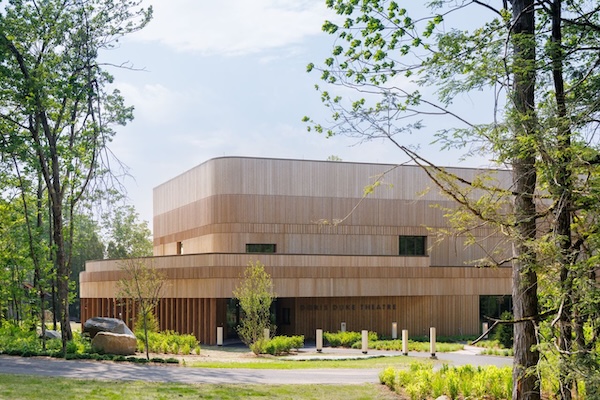
Doris Duke Theatre on the Jacob’s Pillow Campus. Photo: Iwan Baan, courtesy of Jacob’s Pillow
A phoenix rising from the ashes.
The metaphor was on everyone’s lips the evening of July 9, but in this case, the cliché was literal.
In November 2020, in the depths of the Covid pandemic, Jacob’s Pillow’s beloved Doris Duke Theatre — an intimate black box space that had hosted the dance festival’s most experimental and inspiring work over the previous 30 years, burned to the ground. Miraculously, no one was hurt and the other, adjacent wooden buildings on the bucolic campus were saved, thanks to volunteer firefighters from Becket and five other surrounding Berkshire towns who rallied to the alarm.
Shock was followed by creative acts of mourning: a poignant embodiment of disbelieving grief, rock is broken, by the legendary Japanese-American dancer Eiko Otake in an 8-minute video directed by Liz Sargent, and Yve Laris Cohen’s Studio/Theater production at the Museum of Modern Art, shaped by the charred, bent rebar that was cranked down around them as Pillow-related performers shared personal stories. Audience members, seated across from one another at the edges of the performance space, nodded in their acknowledgment of this great loss.
Yet, even as the dance field reeled, the leadership of Jacob’s Pillow was committed to rebuilding. The replacement version of the Doris Duke Theatre would embody all the virtues of the original, and would be better. This, they felt, was an opportunity to erect a theater that would carry the entire dance field 50 years into the future. The guidelines of the architectural competition that followed were based on extensive interviews from Pillow-related folks. What had they most valued in the Duke, as performers, technical production personnel, audience members? How could it be improved? (In full disclosure, during my tenure as executive director of Boston Dance Alliance, I helped Pillow project manager Katy Dammers convene a Zoom with New England dancers with disabilities. I also shared materials we had created on disability assets and needs, many of which were implemented on the Pillow’s campus, aside from the Duke design initiative.)
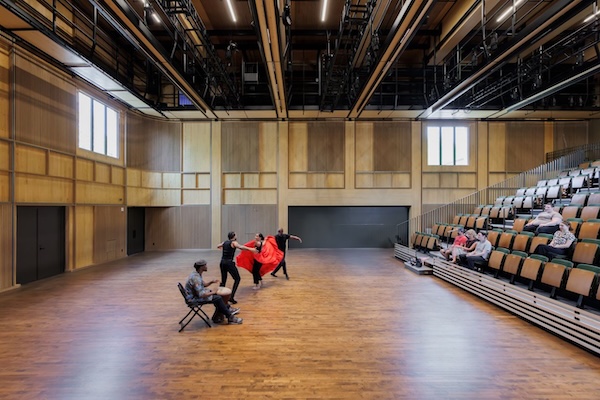
Doris Duke Theatre on the Jacob’s Pillow Campus. Photo: Iwan Baan, courtesy of Jacob’s Pillow
Pillow executive and artistic Director Pamela Tatge assembled what she — and just about everyone else — describe as a dream team: the Dutch architectural firm of Mecanoo led by the brilliant Francine Houben, who had been visiting the Berkshires to go camping since the ’70s; New York-based architect of record Marvel; distinguished Indigenous artist Jeffrey Gibson to instill the design, which stands on traditional land of Muh-he-con-ne-ok/Mohican people, with native images and ideas that would honor the land and its original inhabitants; technical and acoustic consultants Charcoalblue; and Berkshires construction team Allegrone Construction who, Tatge noted with pride at the opening ceremonies, raised the new theater on time and on budget.
And could the timing have been more auspicious? The official ribbon cutting on July 9, it turns out, was the anniversary of the day in 1942 when Jacob’s Pillow’s founder, Ted Shawn, opened the first theater in America designed specifically for dance.
Let me add my voice to the cheers.
Jacob’s Pillow’s new Doris Duke Theatre is a complete triumph.
It is, in Tatge’s words, “nothing like we had in mind but exactly what we thought.”
The new Duke sits lightly on the original site, its two-part, curved shape quietly referencing “turtle island” with a broad lozenge topped with a green roof — danceable as well as sustainable — and a set-back box guiding the eye between the renovated back of the Shawn Theatre, its neighboring Perles Family Studio, and the venerable Ruth St. Denis studio. The site feels more cohesive, vertical striations in the wood creating a feeling of stability and safety while seven horizontal bands of slightly varied wood tones and heights refer to the buildings’ promise to serve dance “seven generations” into the future. (At the ribbon cutting the crowd was assured that all this wood — brought in from Canada before tariffs went into effect — has a three-hour fire retardant rating and that the building’s construction adhered to “every safety code known to mankind.”) It was also designed for four-seasons use, which will enable the Pillow to expand its creative residencies, which, in a time of shrinking resources, will be a boon to artists.
Newly rerouted and repaved paths make wheelchair access easier. (All of the accessibility elements of the site and building are as crucial as they are understated, including the Pillow’s first elevator, which makes access to the highly instrumented technical booth available to production and video professionals who use wheelchairs.) An indigenous garden planted with medicinal herbs and flowers, with a firepit for communal gatherings designed by Nipmuc cultural steward Andre StrongBearHeart Gaines Jr, snuggles up to the veranda’s glass doors, which can open up for air, light, or performers’ entrances and exits. You want to run your hand against all of these surfaces: it’s like stepping into the best version of a bespoke piece of mid-century modern Scandinavian furniture.
The theater space itself is, visually, a cousin to the original Duke, so much so that a friend who had close Pillow connections gasped and put her hand to her heart when she first encountered it. While, at 20,000 square feet, it is twice the size of the original footprint, it retains its intimacy. The Duke’s familiar sequence of comfortable seats rise from the stage level on retractable risers, ensuring unobstructed sightlines. (Set up in a traditional format on July 9 for 220, the theater can be reconfigured to accommodate up to 400 people.)
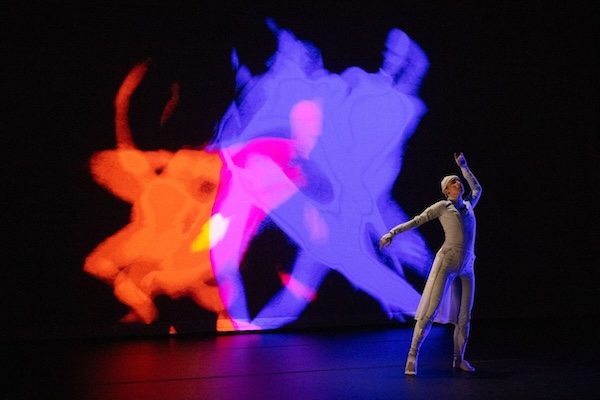
Elaini Lalousis in Alexander Whitley’s Otmo Live: Interstice at the dress rehearsal for the Doris Duke opening program at Jacob’s Pillow Dance Festival 2025. Photo: Jamie Kraus
The Duke has prioritized building up a technology infrastructure for both live performance and expanding its online presence. Digital technology at the Pillow is hardly new: a curated series of Pillow historical video clips have been available online since 2011, but digital connections became imperative during Covid when no one could attend dance performances in person. The Duke’s $5 million investment in tech ranges from spatial audio, infrared performer tracking, immersive projections, and support for AI and robotics integration. According to the Pillow’s website, the setup “serves as a living lab for artists, integrating cutting-edge technologies such as artificial intelligence, extended reality, and robotics into live performances.” I’ll be writing separately for the Arts Fuse about the summer-long exhibit Dancing the Algorithm in the Duke’s corridors and some of the performances that incorporate robotic elements.
Suffice it to say that this is a building whose arc spans the earliest days of Ted Shawn’s dreams and a future we cannot yet envision.
Debra Cash, a founding Contributing writer for the Arts Fuse and a member of its Board, has been a Scholar in Residence at Jacob’s Pillow.
Debra, this is the second elevator (fourth if we count the lifts).
Thanks for that correction!
Having had a tour before the opening, they do refer to the elevator as the “first”.
Thank you for the lovely article…for including the link to the Eiko film. I hadn’t had a chance to see it before, and this was the perfect opportunity, to both celebrate the new and witness the destruction the fire created.