
Classical Album Reviews: “hommages” & Tchaikovsky Orchestral Works, vol. 3
By Jonathan Blumhofer
On hommages, United Strings of Europe is technically secure, rhythmically precise, richly colored, and ever attuned to matters of nuance and spirit. Tchaikovsky’s output could be uneven, and this installment of Alpesh Chauhan’s continuing traversal of the Russian icon’s orchestral music with the BBC Scottish Symphony Orchestra is proof.
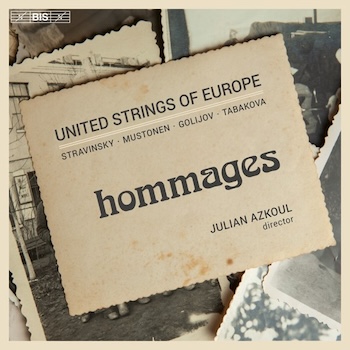
There’s much to admire in the playing of the United Strings of Europe (USE) on their new album, hommages. It’s technically secure, rhythmically precise, richly colored, and ever attuned to matters of nuance and spirit.
But there’s even more to love in the repertoire they assay here with artistic director Julian Azkoul. Dobrinka Tabakova, Osvaldo Golijov, Igor Stravinsky, and Olli Mustonen—yes, the pianist—are not a lineup one expects to encounter every day. But here they’re a thoroughly compatible team.
Tabakova’s Organum Light cites Einstein in its program note—and you can, in fact, divine the music’s allusions to small particles combining to craft a greater whole. Yet the larger work is a fascinating musical argument in its own right, with meditative, chant-like episodes framing a series of amorphous, floating gestures in the middle.
Golijov’s Last Round offers the expected fervency and sultriness, as well as a sharply delineated spatial aspect with two quartets tossing back and forth sinewy tango rhythms. While this Astor Piazzolla tribute’s denouement is rightly gorgeous, that moment is almost overshadowed by the enticing sultriness of the combative, opening “Movido, urgente.”
Stravinksy’s Apollon musagète, heard in Azkoul’s new arrangement for nonet, hardly suffers from reduced numbers. In fact, if one didn’t know better, one might think this was the composer’s original edition, given the charm, delicacy, and acerbity the USE brings to the effort. Only in the concluding “Apothéose” does the ensemble’s tone veer into thinness—and then not for long.
After the Stravinsky, comes the Mustonen. Pianists who also compose have of course been, historically, a dime a dozen. But the phenomenon seems to be particularly vibrant these days.
Mustonen’s Nonetto II dates from 2000 and offers no shortage of appeal. Its emotional anchor is an Adagio of peculiar devotion, intensity, and beauty—think of a cross between Beethoven’s “heilger Dankgesang” and Derek Bermel’s “Gliding over Algiers” and you’ve got the picture—that the USE delivers with pristine focus. Their cellists manage much the same in the disc’s chaser, Mustonen’s short, noble tribute to Pablo Casals titled Apotheosis.
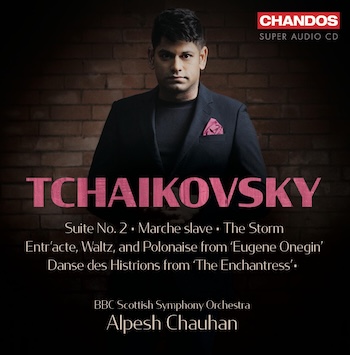 With a composer like Tchaikovsky, it can be easy to forget both how prolific he was and how uneven his output could be. There’s no escaping either, though, in this third installment of Alpesh Chauhan’s continuing traversal of the Russian icon’s orchestral music with the BBC Scottish Symphony Orchestra for Chandos.
The most puzzling item on offer is the Orchestral Suite No. 2, whose five movements can’t seem to decide whether they want to give free rein to the composer’s imagination or self-consciously imitate older kinds of music. The central part of the opening “Jeu de sons,” for instance, is given over to a stodgy fugue. The finale purports to be a “Danse baroque”—though to its credit exhibits little of the latter characteristic.
As such, the 40-minute undertaking is hardly Tchaikovsky’s most compelling effort. Nevertheless, Chauhan leads a performance here that’s very well done and brimming with color, especially in the enchanting “Rêves d’enfant” and during the wacky, wheezing refrains for four optional accordions during the Scherzo (there’s nothing elective about the assemblage in this reading).
That last sonority hints at what Stravinsky would do in Petrushka thirty years later. In a similar vein, The Storm, Tchaikovsky’s first major orchestral work, suggests, at times, what’s to come in his own Francesca da Rimini, Hamlet, and Romeo & Juliet. Chauhan and his forces don’t quite overcome the then-student composer’s structural choppiness and, while their rendition is a shade blunt, it’s also a picture of vigor and bluster.
The pairing’s biting take on Marche slave is likewise rewarding, as is their rendition of the “Danse des Histrions” from The Enchantress. Their readings of the Entr’acte, Waltz, and Polonaise from Eugene Onegin are similarly well done, even as the bright, strutting tone of the last gradually takes on something of an insistent quality.
Jonathan Blumhofer is a composer and violist who has been active in the greater Boston area since 2004. His music has received numerous awards and been performed by various ensembles, including the American Composers Orchestra, Kiev Philharmonic, Camerata Chicago, Xanthos Ensemble, and Juventas New Music Group. Since receiving his doctorate from Boston University in 2010, Jon has taught at Clark University, Worcester Polytechnic Institute, and online for the University of Phoenix, in addition to writing music criticism for the Worcester Telegram & Gazette.
I am really grateful that our album ‘Hommages’ (BIS-2739) was recently selected for review in your publication. For the benefit of your readers, I just wanted to clarify one factual point in Jonathan Blumhofer’s review. My arrangement of Stravinsky’s ‘Apollon musagète’ is for string sextet (2 violins, viola, 2 cellos and bass) not for string nonet as is stated in the review. I appreciate that the varying instrumentation on the album is a potential source of confusion. The liner notes can be found here: https://eclassical.textalk.se/shop/17115/art25/5157725-a6b0d1-BIS-2739_booklet.pdf
Many thanks for your attention to this point. Congratulations on producing such an engaging and comprehensive online publication. Long may it continue.
All very best wishes,
Julian