
Classical Album Review: A Glorious Offering of Unrecorded and Other Rarely Performed Bizet Works
By Ralph P. Locke
The new “Portrait” package contains five hours of music by Bizet that is mostly unknown to music lovers and performers alike. Plus one of his best operas, a one-act written just before Carmen: 1872’s Djamileh, which is set in a harem.
Portrait: Georges Bizet: hardcover book plus 4 CDs. Bru Zane 1059. Total time: 305 minutes.
The ever-amazing scholars and publishers at the Center for French Romantic Music (located in the Palazzetto Bru Zane, Venice, Italy) have now released vol. 6 in their “Portrait” series of multi-disc volumes, each devoted to surveying works in several genres by a single composer, and each accompanied by a small hardback book (in upright format, with 2 or more CDs tucked into the front and back covers). I have previously praised two earlier anthologies in the “Portrait” series: vol. 3 (Marie Jaëll) and vol. 4 (Félicien David).
Bizet, of course, is in another category altogether, being justly renowned for his final opera, Carmen, and—in the concert hall—his early Symphony in C and, among other orchestral works, incidental music written for Alphonse Daudet’s play L’Arlésienne. (A complete performance of the L’Arlésienne music includes chorus as well, plus passages for the orchestra to play under onstage action and spoken dialogue.) Likewise heard often is his opera The Pearl Fishers (from 1863, when he was a mere 24 years old), and a miraculous set of pieces for piano four-hands (Jeux d’enfants).
The new “Portrait” package brings us five hours of music by Bizet that is mostly unknown to music lovers and indeed to performers as well. The longest work here is Djamileh, an enchanting one-act opera that reached the stage scarcely three years before the first performance of Carmen and the composer’s subsequent death, when he was only 36. The work had few performances during his lifetime, but later won much praise from Gustav Mahler (who conducted it in Hamburg and Vienna) and Richard Strauss. The best of the previous recordings, no doubt, is the one featuring the silver-toned Slovakian-born soprano Lucia Popp (conducted by Lamberto Gardelli).
This new one easily matches it in many respects, not least because the singers are all native (or at least highly accomplished) French speakers. This allows them to expertly handle the spoken dialogue, which is rendered complete here. (The dialogues are given track numbers, so are easy to skip if one prefers.) I was particularly drawn in by the slender-toned but artful tenor Sahy Ratia, who was born in Madagascar and relocated to France early in his career. Some moments in the work suddenly make more sense to me, now that I know certain of these spoken interchanges. The orchestral accompaniment has surely never been handled with more finesse than shown here by Les Siècles (a period-instrument group) under the alert and flexible leadership of François-Xavier Roth. A solo-trombone countermelody in the prelude, for example, is managed with great elegance and subtlety.
Two objections: Djamileh’s “Lamento” is taken far too slowly, milking the Tristan-like harmonies (which I don’t inherently mind) but putting Isabelle Druet’s otherwise fine voice under unnecessary stress; and Philippe-Nicolas Martin, though excellent in spoken dialogue, cannot produce a fully steady tone in his short but crucial couplets (“Il faut pour éteindre ma fièvre”). Jean-Philippe Lafont meets this challenge with almost casual ease in the Gardelli recording.
(For true opera buffs, I should mention that other recordings of Djamileh, inevitably, offer their own insights: one with Marie-Ange Todorovitch, Jean-Luc Maurette, and the renowned baritone François le Roux; another, made in Poland, with the rich-toned American mezzo Jennifer Feinstein; and a Soviet-era one sung in Russian. And there are currently no fewer than three very effective video versions on YouTube, in, respectively, French, English, and—my favorite, because of the very effective interaction between the singers—Hungarian.)
This four-CD “Portrait” set also allows us to hear two dramatic cantatas (more or less: operatic scenes) that Bizet wrote for the Prix de Rome competitions: one, Le Retour de Virginie, possibly as early as 1853 (this recording is the work’s world premiere), the other, Clovis et Clotilde, in 1857. (Another Prix de Rome cantata survives: David, 1856. It has been performed recently in Paris, but no recording exists yet.)

Sahy Ratia, tenor (from Madagascar), who takes the lead male role in Djamileh. Photo: courtesy of the artist
The 1857 Clovis et Clotilde finally won Bizet the prize, with the result that he got to spend the next few years in Italy steeping himself in Italian opera and the treasures of Italian art museums (as reported in letters that he wrote to his family and that have been wonderfully translated, with commentary, in a book by Hugh Macdonald). Both of these cantatas are well worth hearing, showing how completely and successfully this teenaged composer had mastered a wide range of styles and manners typical of the music of the era: they often lack a personal stamp but could easily be taken for previously unknown excerpts from works of, say, Meyerbeer or Gounod. (I mean this comparison appreciatively, not dismissively: the latter two were, as widely agreed, among the most skillful composers of their era!)
More importantly, the cantatas help us understand how The Pearl Fishers, though written only a few years later (something we tend to forget, perhaps assuming that it closely preceded Carmen), is as vivid as it is. Bizet was born, it seems, to bring fascinating characters and their dramatic interactions to life on the concert or operatic stage. (A live Clovis performance from 1988, featuring no less than Monserrat Caballé, is on YouTube.)
In addition, we are treated to a handful of piano works, including the extended and somewhat well-known Variations chromatiques (1868), whose harmonic explorations I find a gratifying challenge a century and a half later. Also, there are fifteen songs (including one perennial favorite in exotic manner: “Adieux de la hôtesse arabe”), an intriguing if oddly shaped Overture in A minor (almost a mini-symphony, apparently composed during the period 1855-57), and four widely varying choral pieces with orchestra. Notable among these choral tableaux is a delightful one in siciliano rhythm (“La Golfe de Baïa”) and another, “La mort s’avance,” that is a highly creative “meditation” (Bizet’s own word, in the subtitle) on two Chopin etudes.

Soprano Mélissa Petit. Photo: courtesy of the artist
As a gesture to the immense amount of work Bizet did—across his career, in order to bring in some cash—transcribing for piano (or piano and voice) works by other composers, we get to hear, in Bizet’s colorful transcriptions for piano solo (that is: without singers), six highly diverse choruses from Faust, Mireille, and other Gounod operas.
The biggest surprise, for me, was a nearly half-hour-long work called Vasco de Gama. (Bizet uses “de” rather than “da,” thus giving the name a French twist, much the way that, in French, Michelangelo is called Michel-Ange and Mozart is pronounced Mo-ZARRR.)
This work is an “ode-symphonie,” a genre that was inaugurated in 1844 by Félicien David with his instantly beloved Le Désert. The term “ode-symphonie,” invented by David himself, and quickly accepted by critics and fellow composers, refers to a highly descriptive concert work (no costumes, sets, or onstage motion) for voices, orchestra, and narrator, although the spoken narration in Bizet’s work is very brief.
Vasco de Gama was written when Bizet was only 21 and still in Rome at the Villa Medici. The work portrays the beginning of the famous Portuguese explorer’s momentous trip around the African continent. In the course of six movements, the mariners cast off; a storm kicks up, personified by the god Adamastor; the storm eventually calms down; and the crew members express excitement when they sight land (“Asia!” they all shout) and prepare to get off the ship in order to conquer the “heathen.” Bizet intended to complete the work with two further sections but gave up the attempt; he brought the completed Part 1 to performance in 1863, and it eventually appeared in print five years after his death, but no performances followed until the present performers took up the honorable (and pleasant) task.
One movement in Vasco de Gama will be familiar to many lovers of song: the bolero sung by the ship’s mate Léonard (a role written for, and sung here by, a mezzo-soprano), beginning with the words “La marguerite a fermé sa corolle.” You may know it better by the title under which it was published separately, without a part for chorus: “Ouvre ton coeur.” Bizet also inserted it (with some altered words) into his important opera Ivan IV, a work that never reached performance in his lifetime but that now exists in an eminently practical edition by the aforementioned Hugh Macdonald. The song, of course, also seems to announce, fifteen years in advance, the style that Bizet would explore so fascinatingly in Carmen. Indeed, no doubt because the song was unpublished, he felt free to reuse the vocalist’s final scalar ascent almost note-for-note at the end of Carmen’s seductive Act 1 “Séguedille.”
Other movements in this work are matched to music no less vivid, and, as so often with Bizet (even at age 21), they are superbly orchestrated. I found particularly stirring the prayer that Vasco and the other sailors (his brother Alvaro, the young Léonard, and male chorus) sing, begging God’s protection during a sea storm. This movement could easily have found a place in one of Bizet’s operas, and I was thrilled to get to know it, and in such a confident and communicative performance.

Cyrille Dubois, tenor, who sings exquisitely in one of Bizet’s cantatas and a set of songs. Photo: courtesy of the artist
Speaking of which: the performers on this 4-CD set (in addition to the three who take the leading roles in Djamileh, already mentioned) include some of France and Belgium’s most distinguished, with a smattering from elsewhere, such as (among the singers) Karina Gauvin (who is French-Canadian and masterful as ever), Mélissa Petit (new to me and utterly entrancing!), Cyrille Dubois (a light tenor perfectly cast in exquisite music here), baritone Thomas Dolié, and pianists Célia Oneto Bensaid, Anthony Romaniuk, Florian Caroubi, and, in the Gounod choruses and two solo pieces, Nathanaël Gouin.
Tenor Reinoud van Mechelen, a sensitive artist heard in eight songs, sounds vocally less secure than he does on recordings of Baroque operas. Sometimes he doesn’t land squarely on a note; other times his vibrato threatens to become a wobble, especially in La Nuit (where it is exacerbated by an unnecessarily slow tempo).
The fine orchestras and conductors include, besides Roth and his marvelous band, ones from Lyon (conducted by Ben Glassberg) and Metz (David Reiland), plus a period-instrument ensemble called Le Concert de la Loge (Julien Chauvin). The last of these ensembles originally went by the name of Le Concert de la Loge Olympique, an allusion to an important concert series in eighteenth-century Paris (which was led for some years by the renowned Afro-Caribbean violinist, composer, and fencer Joseph Boulogne, Chevalier de Saint-Georges). But the organizers eventually agreed to remove the adjective “Olympique” from the group’s name, at the request of the French Olympic committee.
(In truth, I can’t imagine any serious confusion resulting from the phrase “Concert de la Loge Olympique”; did somebody fear that the public might jump to the erroneous conclusion that concerts of eighteenth-century, using period instruments of all things, were being organized, inappropriately, by the Olympic committee?)
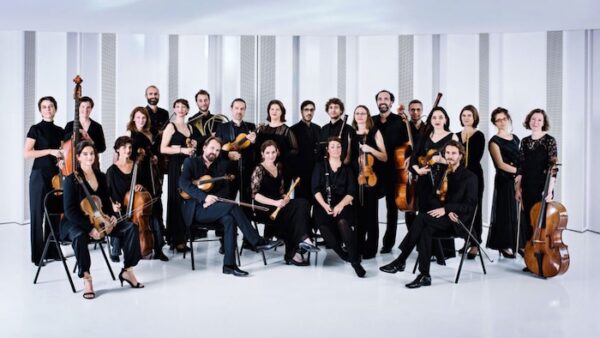
Le Concert de la Loge (formerly Le Concert de la Loge olympique) and conductor Julien
Chauvin.
In each orchestra, we are treated to some marvelous instrumental soloists, whether a glittering harp or a marvelously flitting flute. In various of the works, the Flemish Radio Choir sings magnificently, as does the chorus of Lille Opera.
The book includes informative essays and all the sung texts in French, all in good English translations. I’d have liked the texts for the six Gounod choruses that we hear as piano solos. This would have helped me “hear” what was being sung about—and, as I caught on to the melody, would have allowed me to start singing along.
The only other thing that is missing is specific discussion of certain of the pieces heard. For that, I strongly recommend Hugh Macdonald’s irreplaceable 2014 Bizet, in Oxford University Press’s renowned “The Master Musicians” series. (Macdonald also prepared most of the scores and parts for this project. Many of them are available for purchase or rental from his publishing firm Fishergate, from the Center for French Romantic Music, or, in the case of Djamileh, from Bärenreiter.) Macdonald’s superb thematic catalogue of the works of Bizet is available online, open-access, and gives yet further details. And, if your French is up to it, I strongly recommend dipping into Hervé Lacombe’s marvelously rich 864-page book published by Fayard in 2000: Georges Bizet: Naissance d’une identité créatrice.
In short, this 4-CD “Bizet Portrait” is a gift to the music-loving world, and I recommend it for anybody who is already drawn—quite understandably!—to French music (or to opera, or to song, piano music, choral music…)!
Ralph P. Locke is emeritus professor of musicology at the University of Rochester’s Eastman School of Music and Senior Editor of the Eastman Studies in Music book series (University of Rochester Press), which has published over 200 titles over the past thirty years. Six of his articles have won the ASCAP-Deems Taylor Award for excellence in writing about music. His most recent two books are Musical Exoticism: Images and Reflections and Music and the Exotic from the Renaissance to Mozart (both Cambridge University Press). Both are now available in paperback; the second, also as an e-book. Locke also contributes to American Record Guide and to the online arts-magazines New York Arts, Opera Today, The Boston Musical Intelligencer, and Classical Voice North America (the journal of the Music Critics Association of North America). His articles have appeared in major scholarly journals, in Oxford Music Online (Grove Dictionary), and in the program books of major opera houses, e.g., Santa Fe (New Mexico), Wexford (Ireland), Glyndebourne, Covent Garden, and the Bavarian State Opera (Munich). The present review first appeared in Classical Voice North America and is included here, lightly revised, by kind permission
Tagged: "Portrait: Georges Bizet", Center for French Romantic Music, Cyrille Dubois, Le Concert de la Loge, Les Siècles, Mélissa Petit., Palazzetto Bru Zane