
Jazz Album Reviews: Thelonious Monk and Bill Evans — Two Indispensable Recordings
By Michael Ullman
Happily, these clean, bright Craft reissues make some invaluable music glisten.
Bill Evans Quintet, Interplay (Riverside, Craft LP)
Thelonious Monk, Thelonious Himself (Riverside, Craft LP)
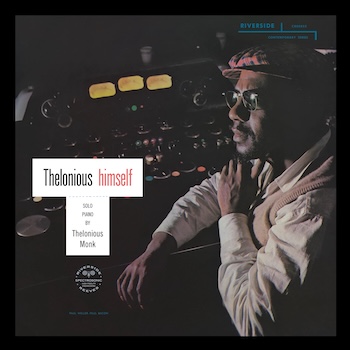 Thelonious Monk’s Thelonious Himself was recorded in April 1957, and Bill Evans’s quintet album Interplay was recorded five years later. Both pianists were at the top of their respective games, and both recordings are, to my ears, indispensable. Happily, these clean, bright Craft reissues make the music glisten.
No one ever sounded more like “himself” than Monk. His solo performances are still startling. He introduces “April in Paris” with what sounds like a series of stutters. It’s as if he doesn’t want to let go of each phrase: he pauses at the end of a line, letting it resonate through his pedal. He never lets up, playing forcefully, distinctly, even aggressively, inserting scale passages — in this case mostly ascending — as if to provide contrast. Nearly every pause is followed by a thumping chord. He comes off as thoughtful and, occasionally, as on the bridge to “Ghost of a Chance,” he even borders on the romantic. He also sounds to be on the verge of stride piano in the left hand, supplying moments of swing. I had a friend who seemed outraged at Monk’s ballads. Listening to the pianist’s dissonant chords along with his distinctive timing, the guy proclaimed, “That’s ugly.” Monk had him covered — he wrote a piece called “Ugly Beauty.”
Monk is one of the great blues players. Thelonious Himself contains one of his most substantial blues performances, a nine and a half minute track which he called simply “Functional.” You shouldn’t be without it. The session also contains Monk’s solo version of his most famous composition, “‘Round Midnight.” He begins out of tempo as he plays what must be one of the most famous introductions in jazz. The other original is “Monk’s Mood,” which he begins solo. He plays a full chorus, and then Monk springs a surprise: he brings in bassist Wilbur Ware and, as a second soloist, John Coltrane to form a drumless trio. Coltrane is restrained in the presence of his mentor.
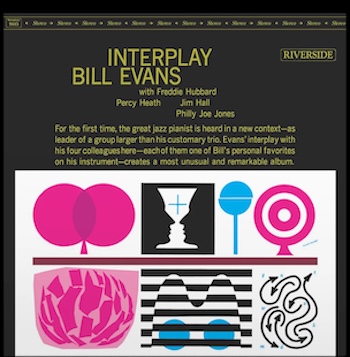 In 1962, when Interplay was recorded, Bill Evans had recently recorded his most celebrated trio albums with Scott LaFaro and Paul Motian. Evans was a revered sideman. The pianist played on Miles Davis’s Kind of Blue, Oliver Nelson’s Blues and the Abstract Truth, and elsewhere. Before this album Evans had already made a duet recording with Jim Hall and various sessions with Cannonball Adderley. His ballad playing was exquisite. In fact, his sound was so refined that Evans got a reputation for being as soft-spoken in his music as he was in his life. This quintet album may have been meant to dispel that bland image.
This is a band of all stars: Freddie Hubbard, Jim Hall, Percy Heath, and Philly Joe Jones. Evans takes care not to dominate. Everyone solos, as is fitting on an album dedicated to interplay. “I’ll Never Smile Again” is taken uptempo. The track begins with Jones on his hi-hat: the snap and vigor of his playing allows him to take on an equal status as partner throughout. Hubbard plays the melody muted and then Jim Hall takes the first solo. It’s as delightful and inventive a turn as this fan of the guitarist expected. Hubbard gets the second shot. Jones announces Evans’s solo with a splash on his cymbals. The pianist plays forcefully and with a fluency that can also be surprising because of its harmonic substitutions. The band exchanges fours to finish.
Evans plays the intro to “When You Wish Upon a Star,” taken adagio, and then lets Hall take over, accompanied by some frolicking commentary by Hubbard. Evans enters delicately. In the solo, the pianist’s right hand plays single notes that sound as if they are coming from a different instrument, given the dark chords hit by his left hand. The only original on the set is the title cut, “Interplay.” Again, I am drawn to the superb solo by Hall and his interactions with Jones. Evans manages to make his blues playing lyrical, whether he’s playing a single repeated note or moving through his gentle wanderings. A fine album, excellently reproduced.
For over 30 years, Michael Ullman has written a bimonthly jazz column for Fanfare Magazine, for which he also reviews classical music. He has emeritus status at Tufts University, where for 45 years he taught in the English and Music Departments, specializing in modernist writers and nonfiction writing in English, and jazz and blues history in music. He studied classical clarinet. The author or co-author of two books on jazz, he has written on jazz and classical music for the Atlantic Monthly, New Republic, High Fidelity, Stereophile, Boston Phoenix, Boston Globe, and other venues. He plays piano badly.
Tagged: "Thelonious Himself", Bill Evans, Freddie Hubbard, Interplay, Jim Hall, Percy Heath, Philly Joe Jone