
Concert Review: Boston Modern Orchestra Project — Music for the Now
By Aaron Keebaugh
Happily, the composers on this compelling BMOP program were not cowed by tradition.
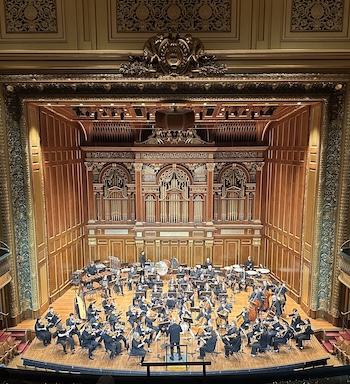
Gil Rose and the Boston Modern Orchestra Project in action at Symphony Hall. Photo: eeWee Productions.
It’s fair to admit that the symphonic canon brings with it quite a bit of baggage. For anyone who has ever tried their hand at composition, historical figures loom heavy and large. And if you’re prone to self-effacement — as I am — a trip to Symphony Hall provides a chastening cure to outsized creative ambitions. Beethoven’s name, emblazoned atop the proscenium arch in Boston’s Symphony Hall, says it plainly enough — pipsqueak, don’t even think about it.
But those with nerve, like Han Lash, break through centuries of intimidating pressure to take their place in a masterly musical tradition. Zero Turning Radius, the composer’s new concerto for orchestra — premiered by Gil Rose and the Boston Modern Orchestra Project — uses an ingenious strategy. Lash appears to aim at the mundane, but, when played with verve, as BMOP did splendidly, the music takes a slow path to sublimity.
According to the composer, the five movements depict the thrill of using a particular type of lawnmower. The lines churn, skitter, and dance — passages change directions on a dime. Instrumental sections collide with seismic force. Lash calls for an oversized percussion section to interject syncopations that push the stinging harmonies into overdrive. Through it all, Lash eschews providing a sense of momentum or long-range, built-up tension. The music invites listeners to fixate on the immediate moment — music for the now.
That said, there are lyrical moments that fill the cracks in Lash’s cut-and-slash musical mosaic. Sweeping passages rise out of the Stravinskyan morass in the second movement, marching striking passages momentarily out of the shadows. The BMOP French horns soared in the opening of the third movement as Rose lovingly traced the curves of each phrase. In the piece’s concluding movements, a brass chorale emerges, supplying passages that roar like the eponymous mower on a bender. It’s music that has been shaped to keep listeners on their toes — Rose and the orchestra performed it with the assurance of Fred Astaire.
They also treated Jeremy Gill’s Four Legends from the Silmarillion with just as much verve and abandon. This cycle of tone poems is a narrative-based rarity today: the music thoughtfully conveys the characters and drama set out in J.R.R. Tolkien’s beloved creation myth. Running an hour in length, the four pieces were mesmerizing, a vivid play of color and sonic light.
In “Ainulindalë,” flute calls and rustling strings conjured up a mysterious scene, conveying images of beings slowly coming to life. Each character in Tolkien’s birth of the world was treated as a variation on a theme. The music for Ulmo rolled like lapping waves; the passages depicting Aulë coursed with noble grandeur. Melkor, the Lucifer-like being who later transforms himself into the demonic Morgoth, was expressed through growling basses and shrieking woodwinds. The music never stopped accumulating fury, finally erupting in full-on cries that reflected the fires of creative destruction.
“Narsilion” opens whimsically, the music distant and otherworldly. Rose shed light on the vibrant colors generated by every passing bar. “Tinúviel” took listeners along on Beren and Luthien’s journey to Morgoth’s lair. Unresolved dissonances underpinned a horrific scene; angular lines suggested that Tolkien’s upstart world contained more than a little chaos.
Gill’s strengths as a composer lie in how he moves with seamless ease from scene to scene. “Eärendil” involved a parallel story: the titular character’s wedding to Elwing along with the fall of the Elvish city of Gondolin. The music danced quietly and seductively on the road to war and oblivion. Still, in the final moments, a faint glimmer of woodwinds suggested forlorn notes of hope. Listening to Four Legends is to experience a musical vision of Tolkien’s storytelling brilliance. This was not a cuddly world that guaranteed serenity; Gill’s music takes you into the abyss and then spits you back out. Rose and the orchestra were adept guides, relaying the journey’s power with boldness and clarity.
Christopher Theofanidis’s The dream, strange and moving made for a fitting curtain raiser. Like Lash’s concerto, this score sputters forward in fits and starts, suggesting the fragmentation of surrealism. Rarely do lines emerge in long-breathed shapes. The wild and vibrant colors recalled Berlioz, stripped of its lyricism but spotlighting its colors. Rose and the orchestra painted a vivid picture of this dreamscape with almost fevered intensity.
The composers on this BMOP program, happily, were not cowed by tradition. Their works exude the power of earnest conviction; they speak clearly and confidently. And, in an age when the orchestral medium may feel increasingly irrelevant, this strategy points to a way forward. Tradition need not hamper the creative impulse. Ignore the stereotypical demand to wrestle with profundity. Instead, make music that invites reflection, thoughtful consideration, even musings on the everyday. That, at its best, can be more than enough.
Aaron Keebaugh has been a classical music critic in Boston since 2012. His work has been featured in the Musical Times, Corymbus, Boston Classical Review, Early Music America, and BBC Radio 3. A musicologist, he teaches at North Shore Community College in both Danvers and Lynn.
Tagged: "Four Legends from the Silmarillion", "The dream, "Zero Turning Radius", Boston Modern Orchestra Project, Christopher Theofanidis, Gil Rose and the Boston Modern Orchestra Project, Gil-Rose, Jeremy Gill