
Musician Profile / Interview: Composer Carlos Simon at a Career Turning Point
By Steve Elman
Getting to know the Composer Chair of the Boston Symphony Orchestra, the first composer of color to have a comprehensive long-term relationship with the BSO.
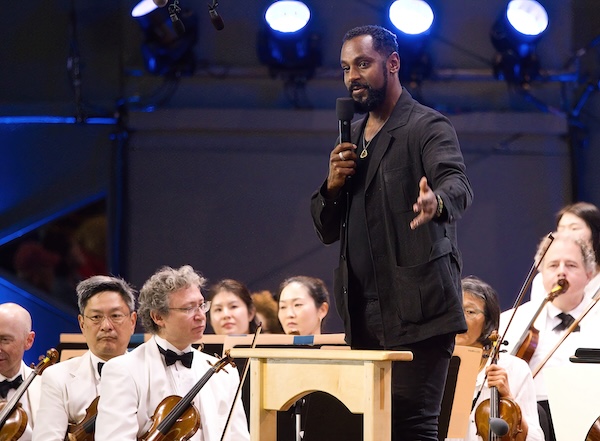
Carlos Simon onstage at the Shed at Tanglewood, introducing his Fate Now Conquers on August 18, 2024. Photo: Hillary Scott, courtesy of the BSO
In the wake of the Boston Symphony Orchestra’s evening devoted to the music of John Coltrane on March 22, I spoke with composer Carlos Simon, who curated Coltrane: Legacy for Orchestra as part of his role with the BSO as Composer Chair. This profile draws on that conversation.
Simon’s background is rich with influences from the Black American experience. When we spoke, he confirmed the statement in his Wikipedia biography that he is the son of a preacher (Bishop Carlos O. Simon Sr.) and (as Wiki puts it) that he “grew up in a household where he was forbidden to listen to anything other than gospel music.” When he was able to make his own choices, he broadened his hearing to a wide range of music, but gospel has remained close to his heart.
Simon’s status as a contemporary composer to watch has grown with each passing year. His early music jobs included providing arrangements, keyboards, and musical direction for singers Angie Stone and Jennifer Holliday, but he soon moved to formal classical composition. Since 2006, he has received commissions for some 20 film scores and has written more than 70 orchestral, chamber, vocal, and electronic works. In 2019, he became a professor at Georgetown University.
He achieved a new level of prestige in 2021 when he was named Composer-in-Residence at the Kennedy Center for the Performing Arts, which resulted in a close relationship with the National Symphony; that relationship led to premiere performances at the Kennedy Center and a CD of his orchestral pieces (Four Symphonic Works [National Symphony, 2024]), played by the NSO, led by music director Gianandrea Noseda. (Art Fuse review)
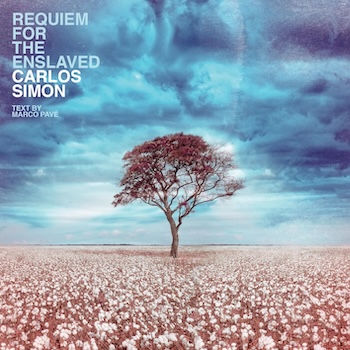
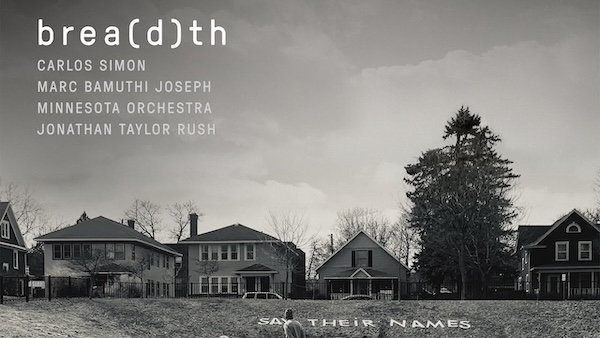
His body of compositions includes an opera (Night Trip, 2020), a dramatic oratorio inspired by Paul Robeson (Here I Stand, 2024), a series of powerful and pointed chamber and orchestral works (notably Requiem for the Enslaved [released on Decca CD, 2022]) and brea(d)th [released by Decca in digital form, 2023]), a flute concerto (Movements), a trombone concerto (Troubled Water), settings of gospel music, Christmas songs, and biblical texts, and much more. He has received commissions from the Sphinx Organization, the National Symphony, the San Diego Symphony, the Los Angeles Philharmonic, and the BSO itself.

Simon’s Composer Chair position with the BSO was announced in January 2024. It represents yet another step up in an impressive career. But even before he assumed this formal position, Simon had established a relationship of growing warmth with Boston’s orchestra. During the Covid lockdown, the BSO programmed two of his works for online listening. His Motherboxx Connection (2021) went on to receive live performances at Tanglewood and at Symphony Hall in 2022. The BSO commissioned his Four Black American Dances (2023), which premiered under Andris Nelsons’s direction, in February 2023. Nelsons and the BSO took that piece on tour in Europe and repeated it for a concert in the following season in October 2023.
As Composer Chair, his role in the season just concluded and in the next two seasons is analogous in some ways to the role Thomas Adès has played as Artistic Partner with the BSO since 2016. Adès has composed new works, assisted in constructing programs, played piano, conducted, and been an abiding presence at Tanglewood. Simon will not be conducting the BSO (yet), but he has a full plate nonetheless.
He is slated to compose new works for the orchestra and its related chamber ensembles, to teach at Tanglewood, and to “curate” some programs, a role that includes shaping the performances by choosing repertoire and deciding how pieces will relate one to another. In addition, the orchestra will perform more of his works, including a double concerto for violin and cello written for the National Symphony (planned for the 2026-27 season).
The first ventures in Simon’s role as the BSO’s Composer Chair were at Tanglewood last summer. An expanded version of his Warmth from Other Suns for string orchestra was premiered by members of the BSO in July 2024. Two months later, in September, the full orchestra played a new commissioned work, Festive Fanfare and Overture (2024), celebrating Andris Nelsons’s 10th anniversary as BSO music director. Shortly thereafter, his Wake Up! Concerto for Orchestra (2023) was played in three subscription concerts. To cap that September, he also curated a Boston Symphony Chamber Players concert.
Simon will be busy at Tanglewood this summer. On July 10, the Boston Symphony Chamber Players will reprise some pieces from that September 2024 concert, including three of Simon’s chamber works. On July 27, one of his songs, Behold, the Queen, commissioned by the BSO, will be part of a Tanglewood Learning Institute program called “African Queens,” presented by soprano Karen Slack with pianist Kevin Miller.
Finally, on August 24 in the Shed (at 2:30 p.m.), he will see the premiere of a new work commissioned by the BSO and written for the Tanglewood Festival Chorus, Words and Prayers of My Father, conducted by the TFC’s director, James Burton. This is a very personal piece, setting inspirational texts written by four members of his family who served as ministers of the gospel, including his father, Carlos O. Simon Sr. It receives a significant spotlight as the lead work in one of the most popular concerts of the Tanglewood season, where the BSO plays Beethoven’s 9th Symphony.
In the BSO’s 2025-26 season, Simon will have two world premieres and the second performance of a major new work.
The stellar pianist Seong-Jin Cho (who stunned a Celebrity Series audience in Jordan Hall on February 2 this year by playing all of Ravel’s solo piano works in a single program — without a score to help his memory) will join the Boston Symphony Chamber Players on January 18, 2026, again in Jordan Hall, for the first of Simon’s premieres, as yet untitled.
 The second premiere, also as yet untitled, will be part of a program on February 1 (at 3 p.m.) at Thomas Tull Concert Hall at MIT called “American Road Trip” with master violinist Augustin Hadelich and pianist Orion Weiss.
In between those two chamber concerts, the BSO will perform Simon’s Good News Mass, with two vocal soloists and a large choral ensemble, on January 29 and 31. This is a featured work within the orchestra’s “E Pluribus Unum: From Many One” series, designed (as the BSO’s website says) to explore the “history, music, and ideals” of the United States, “one composer, one piece, one story at a time … [including] voices that have woven the rich tapestry of American music: from Copland, Barber, and Bernstein to modern trailblazers John Williams, Tania León, and Composer Chair Carlos Simon.”
Good News Mass is an ambitious work, including orchestra, a tenor soloist (Zebulon Ellis), a spoken word soloist (Marc Bamuthi Joseph, who is contributing his own text), a 40+-member choir called The Crossing, gospel choruses, and Simon himself playing organ, all conducted by Artistic Partner Thomas Wilkins, who has been a spark plug for the BSO’s concerts featuring composers and performers of color since before the pandemic. The work also includes a visual element — video by Melina Matsoukas, a two-time Grammy-winning music video director.
When we spoke, Simon continued:
Carlos Simon: Last year [that is, in the 2024-25 season] was sort of a ramping up [in my role as Composer Chair], getting the orchestra to know who I am, with my Festive Overture and Wake Up!, which is a pretty new piece. This [next] season is important to me. My Good News Mass is … the largest piece I’ve written so far.
The Arts Fuse: Will this build on past works, like Requiem for the Enslaved, and brea(d)th?
Simon: Yes. And the BSO is a great place to highlight this work. I’m trying to bring together the different worlds of gospel and classical. It was previously played by the Los Angeles Philharmonic, directed by Gustavo Dudamel — it was a co-commission with them.
AF: Will the Boston performance of Good News Mass be different from the one in L.A., or is this a “finished” work?
Simon: It’s a finished work. If there are any changes, they’ll be minor.
AF: Do you have a previous relationship with Thomas Wilkins?
Simon: Yes — he’s conducted other pieces [of mine with other orchestras]. I have a lot of respect for him.
AF: The Composer Chair role seems a bit like the Thomas Adès relationship, without the conducting.
Simon: It is — and I’m going to play, too. I’ll be the organist in Good News Mass.
AF: Your composing shows a remarkable gift of melody, and it’s not something that every composer has. Of course, it’s hard to quantify where that might come from, but did gospel play a role in building your sense of what makes a beautiful melody?
Simon: Gospel, yes, but a lot of things contributed [to my aesthetic] — the American songbook, R&B, film music, [jazz] — a lot of things [I’ve appreciated over the years].
AF: Can you describe your compositional process?
Simon: [The wellspring is] mainly improvisation. I start at the keyboard, in a free flow of ideas, based on the concept I’m writing for. I refine the process, [developing the best ideas, and finally] orchestrate, based on the forces I have to work with.
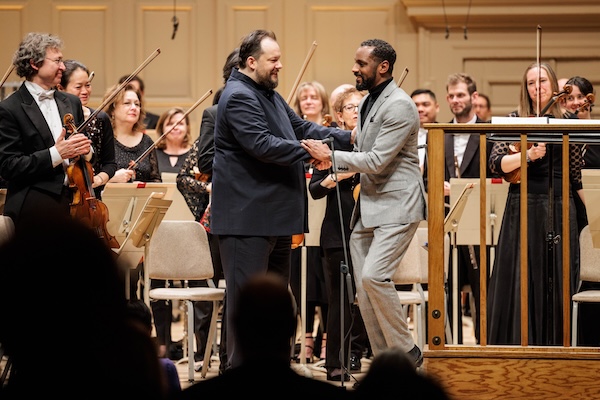
BSO music director Andris Nelsons and Carlos Simon on stage at Symphony Hall, following the BSO’s performance of Four Black American Dances, February 9, 2023. Photo: Aram Boghosian, courtesy of the BSO
Simon has an abiding passion for social justice which is reflected in many of his works, including the two I mentioned when we spoke. In addition to those, he has written pieces in a wide range of media that honor and memorialize Black Americans in many fields, including Romare Bearden, George Floyd, Herbie Hancock, Terrence Hayes, Bessie Smith, Howard Thurman, and Bill Traylor. But even when his purpose is protest, his work consistently avoids stridency or despair. When there is justifiable anger, especially in texts provided by his spoken-word collaborators Marc Bamuthi Joseph and Marco Pavé, Simon ultimately brings his pieces to places of hope.
He has been eloquent about this element of his music. In a 2021 interview conducted by National Symphony Principal Pops Conductor Steven Reineke, Simon discussed his Elegy: A Cry From the Grave, which was (in Simon’s words) “dedicated to those who have been murdered wrongfully by an oppressive power; namely Trayvon Martin, Eric Garner and Michael Brown.” In the interview, he continued:
When I wrote this piece in 2015, as a Black man, I had so many emotions. I was fearful. I was frustrated, angry even. And I went to music, the only thing that I knew could help…. I wanted … to deal with my emotions through the music. And here we are, 2021, with the same things that are happening…. There’s a sense of melancholy [in Elegy], it’s somber and solemn, but there are tendrils of hope. There’s some change that needs to happen, I believe, and I’m hopeful for that…. I’ve built all these emotions into the piece, [concluding with] hope for the better.
Good News Mass is likely to resonate in a similar way.
Simon’s new role is a sign that the BSO expects to build a special relationship with the composer, and it is worth noting that no other composer of color has held such a favored position in the BSO’s history.
So far, Simon’s Composer-in-Residence relationship with the Kennedy Center and the National Symphony has not been compromised by the change in government in January (he is slated to hold the position at least until the 2026-27 season). Still, there are few elements in American life that have not been touched by political priorities in the past 120 days. In February, he said, “The Kennedy Center has always been a supportive platform for my mission as an artist-activist, and I will continue to use this platform without compromise. I don’t know what to expect as I continue, but I will not waver from my artistic integrity.”
It may only be a matter of time before Simon’s outspokenness comes to the attention of America’s new cultural commissars. The BSO’s estimable commitment to the works of Dmitri Shostakovich over the past decade has consistently dealt with Shostakovich’s struggle to maintain his artistic voice within a totalitarian system; kudos to the BSO for giving Carlos Simon a safe haven, should his works be challenged for anything other than their artistic merit.
AF: Congratulations on what seems from the outside to be a career high point. Does it feel that way to you?
Simon: I’m on a high. I’m grateful to be a part of the tradition, but also grateful to help in pushing forward part of the BSO’s legacy.
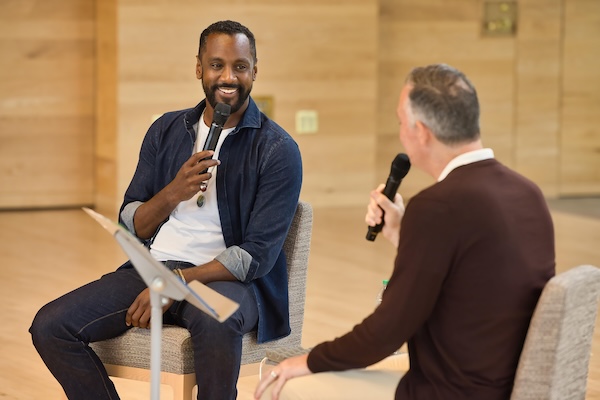
Carlos Simon (with BSO Artistic Administrator Eric Valliere) at the Tanglewood Learning Institute, August 2023. Photo Hillary Scott, courtesy of the BSO
More:
Looking back at Carlos Simon’s developing relationship with the Boston Symphony Orchestra:
January 21, 2021: As part of the orchestra’s efforts during the Covid shutdown, BSO violinists Victor Romanul and Wendy Putnam, violist Mary Ferrillo, and cellist Adam Esbensen perform the string quartet version of Simon’s Warmth from Other Suns (2019) as part of a prerecorded online program conducted by Thomas Wilkins.
February 25, 2021: As part of its efforts during the Covid shutdown, the BSO plays Fate Now Conquers (2019), a response to Beethoven’s Symphony No. 7, in a prerecorded online Symphony Hall performance, conducted by Andris Nelsons. This was the first of Simon’s works to be performed by the full orchestra.
July 9, 2022: The BSO plays Motherboxx Connection (2021), a reworking of the first movement of Simon’s Tales – A Folklore Symphony, in the Shed at Tanglewood.
August 7, 2022: The Tanglewood Music Center Fellows play Warmth from Other Suns during the 2022 Festival of Contemporary Music at Ozawa Hall at Tanglewood.
September 24, 2022: The BSO plays Motherboxx Connection again, as part of the regular subscription season in Symphony Hall.
February 9-12, 2023: The BSO, under Andris Nelsons’s direction, plays Four Black American Dances, a BSO commission, in Symphony Hall.
January 25, 2024: Simon is named Deborah and Philip Edmundson Composer Chair.
July 13, 2024: Members of the BSO play an expanded version of Warmth from Other Suns for string orchestra, conducted by Andris Nelsons, in the Shed at Tanglewood.
August 18, 2024: The BSO plays the first performance at Tanglewood of Fate Now Conquers (2019) in the Shed, conducted by Earl Lee.
August 26, 2024: The BSO plays Four Black American Dances as part of a BBC Proms concert at Royal Albert Hall in London, conducted by Andris Nelsons.
August 28, 2024: The BSO plays Four Black American Dances at the Kultur und Kongresszentrum, in Lucerne, Switzerland, conducted by Andris Nelsons.
September 1, 2024: The BSO plays Four Black American Dances at the Cankarjev Dom Culture and Congress Centre, Ljubljana, Slovenia, conducted by Andris Nelsons.
September 3, 2024: The BSO plays Four Black American Dances at the Cologne Philharmonie, Köln, Germany, conducted by Andris Nelsons.
September 4, 2024: The BSO plays Four Black American Dances at the Konzerthaus in Dortmund, Germany, conducted by Andris Nelsons.
September 7, 2024: The BSO plays Four Black American Dances at the Elbphilharmonie in Hamburg, Germany, conducted by Andris Nelsons.
September 8, 2024: The BSO plays Four Black American Dances at the Philharmonie in Paris, France, conducted by Andris Nelsons.
September 19, 2024: The BSO plays the premiere of another commissioned work, Festive Fanfare and Overture (2024), celebrating Andris Nelsons’s 10th anniversary as BSO Music Director, in Symphony Hall.
September 26-28, 2024: The BSO plays Wake Up! Concerto for Orchestra (2023) in three subscription concerts at Symphony Hall.
September 29, 2024: The Boston Symphony Chamber Players play a free concert curated by Simon at Union United Methodist Church in Boston. It includes three works by Jessie Nzinga Montgomery, along with a wind quintet by Damian Gieter and three of his own chamber pieces. Soprano Chabrelle Williams also sang two traditional spirituals and an excerpt from Jasmine Barnes’s Might Call You Art.
March 21 & 22, 2025: In Symphony Hall, the BSO plays Coltrane: Legacy for Orchestra, a suite of pieces associated with John Coltrane, curated by Simon, including arrangements of pieces by composers he selected and his own arrangements of Duke Ellington’s “In a Sentimental Mood” and Coltrane’s “Alabama.” Guest artists were trumpeter Terence Blanchard, pianist Ben Cook, bassist Ben Zinno, drummer George Derrah, and conductor Edwin Outwater.
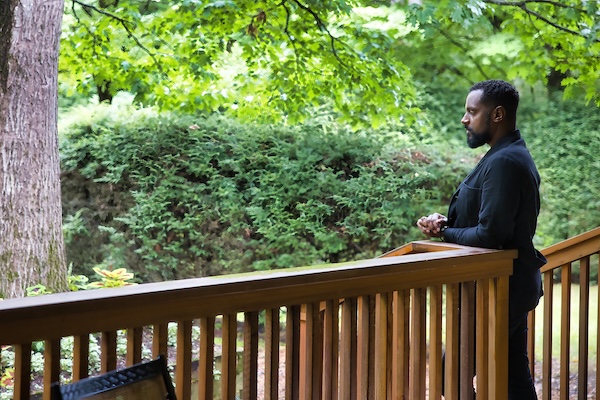
Carlos Simon at Tanglewood, August 2024. Photo: Hillary Scott, courtesy of the BSO
Looking ahead:
July 10, 2025, Ozawa Hall, Tanglewood, 8 p.m.: The Boston Symphony Chamber Players present a program partially drawn from the repertoire they played on September 29, including three of Simon’s chamber works and Jessie Nzinga Montgomery’s Strum. The program will also include Kevin Siegried’s Three Shaker Songs settings for two sopranos and the chamber version of Aaron Copland’s Appalachian Spring, conducted by Anna Handler.
July 27, 2025, Studio E of the Linde Center for Music and Learning, Tanglewood, 7 p.m.: Soprano Karen Slack (accompanied by pianist Kevin Miller) gives a vocal recital called “African Queens,” presented by the Tanglewood Learning Institute, including one of Simon’s songs, Behold, the Queen, commissioned by the BSO. The other 10 pieces, sung and spoken, come from Jessie Nzinga Montgomery, Dave Ragland, Damian Geter, Jasmine Annelle Barnes, Shawn Okpebholo, Will Liverman, Fred Onovwerosuoke and Joel Thompson.
August 24, 2025, the Shed at Tanglewood, 230 p.m.: James Burton, director of the Tanglewood Festival Chorus, conducts the TFC in the premiere of a work commissioned by the BSO, Words and Prayers of My Father. It receives an important spotlight as the lead work in one of the most popular concerts of the Tanglewood Season, when the BSO performs Beethoven’s 9th Symphony, this year conducted by Zubin Mehta.
January 18, 2026, Jordan Hall, 3 p.m.: Pianist Seong-Jin Cho and the Boston Symphony Chamber Players play a Simon premiere, as yet untitled. The other works on this program are Valerie Coleman’s Rubispheres and Brahms’s first Piano Quartet.
January 29 (730 p.m.) & 31 (8 p.m.), 2026, Symphony Hall: The BSO will perform Simon’s Good News Mass, with tenor soloist Zebulon Ellis, spoken-word soloist Marc Bamuthi Joseph (who is contributing his own text), the 40+-member choir called The Crossing, Simon playing organ, gospel choruses, and video by Melina Matsoukas, all conducted by Artistic Partner Thomas Wilkins. The program also includes selections from David Lang’s poor hymnal.
February 1, 2026, Thomas Tull Concert Hall at MIT, 3 p.m.: Violinist Augustin Hadelich and pianist Orion Weiss play a recital called “American Road Trip,” with works mostly drawn from Hadelich’s eponymous CD (Warner Classics, 2024). The repertoire will feature multimovement works by John Adams, Stephen Hartke, and Charles Ives (his Sonata No. 4, “Children’s Day at the Camp Meeting”). The program will also include the premiere performance of a new work by Simon, commissioned by the BSO, as yet untitled.
Date to be announced, 2025-26 season: Simon’s Double Concerto for Violin, Cello, and Orchestra, will be played by the BSO, with violinist Hilary Hahn and cellist Seth Parker Woods.
An online concert and interview:
National Symphony Orchestra Principal Pops Conductor Steven Reineke leads the NSO in a program of Simon’s works, two of which are mentioned above. The concert includes interview segments with Simon conducted by Reinecke, where the composer discusses the specific works and his work in general. The video includes Fate Now Conquers (2020), This Land (2019), Warmth from Other Suns for string orchestra (2020), Portrait of a Queen (2017) and Elegy: a Cry from the Grave (2015)
Some notable commercial recordings of Carlos Simon’s music:
Requiem for the Enslaved (2021) (Decca, 2022) was nominated for a 2023 Grammy. This recording (hearable on Spotify) features the chamber group Hub New Music, spoken-word artist Marco Pavé, trumpeter MK Zulu (Jared Bailey), and Simon at the piano.
Elegy: A Cry from the Grave has been recorded in its saxophone quartet version by the Aero Quartet (Presto, 2023).
In its string quartet version, it is hearable on YouTube, played by members of the Minnesota Orchestra.
The Minnesota Orchestra commissioned and premiered the orchestral version of Elegy. Eventually, Elegy (in this orchestral version) became the third movement of brea(d)th (2023) (Decca [digital form only], 2023), hearable on Spotify. This Minnesota Orchestra recording is conducted by Jonathan Taylor Rush, with librettist Marc Bamuthi Joseph as spoken word artist, the Minnesota Chorale, the vocal ensemble called 29:11 and Twin Cities Choral Partners.
Four Symphonic Works (National Symphony, 2024) collects four major works premiered by the National Symphony, all conducted by music director Gianandrea Noseda: The Block (2018), Tales – A Folklore Symphony (2021) (which includes Motherboxx Connection), Songs of Separation (2023), and Wake Up! Concerto for Orchestra (2023). It is hearable on Spotify.
Steve Elman’s more than four decades in New England public radio have included 10 years as a jazz host in the 1970s, five years as a classical host on WBUR in the 1980s, a short stint as senior producer of an arts magazine, 13 years as assistant general manager of WBUR, and fill-in classical host on 99.5 WCRB.
Tagged: BSO Composer Chair, Black Classical Music, Boston Symphony Orchestra, Carlos Simon