
Concert Review: Pianist Evgeny Kissin — Note-Perfect and Nonpareil
By Susan Miron
Heard live, pianist Evgeny Kissin offers the kind of rare, heart-altering listening experiences that give one hope for our woefully fractured world.
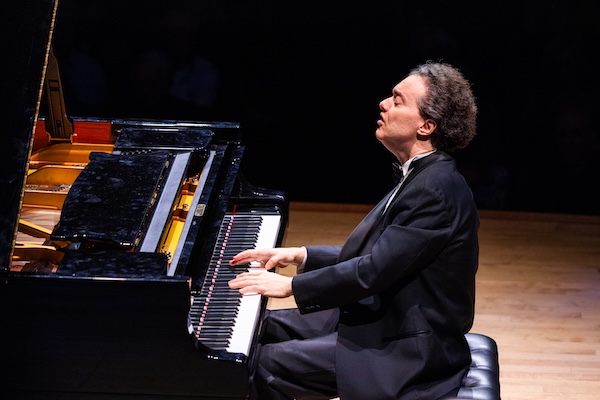
Evgeny Kissin performing at Symphony Hall. Photo: Robert Torres
I have been devotedly following the career of the once world-famous child prodigy pianist Evgeny Kissin for forty years. I’ve been lucky enough to have attended most of his 11 Celebrity Series appearances since 1991 and hope to never miss another. They are the kind of rare, heart-altering listening experiences that give one hope for our woefully fractured world.
The pianist’s friend Andrew Solomon has written, “Kissin is a virtually note-perfect performer… the latest in a line of Russian ‘supermen’ of the keyboard — a line that includes Sergei Rachmaninoff, Josef Lhévinne, Vladimir Horowitz, Emil Gilels, Sviatoslav Richter, and Lazar Berman, and whose distinguishing characteristic is a belief that the imagination and spirit of the performer should be equal to that of the composer. ”
Kissin (known to friends as Genya) opened the evening at Symphony Hall (on April 29) with a magisterial performance of J.S. Bach’s 6-movement Partita #2 in C minor, BWV 826, a favorite of pianist Martha Argerich, with whom he often plays duos. (The piece is also admired by this writer, who tried to make a harp transcription of it.) Kissin performs Bach with enormous sensitivity, drawing on a large color palette, nuanced volume, and a tasteful use of unostentatious ornamentation. His Sarabande shimmered, and the Capriccio, the last movement, was as thrillingly played as I’ve ever heard it. This dramatic opening performance was classy, informed, and refined.
The Bach was followed by three scrumptious Chopin works: Nocturne in C-sharp minor, Op. 27, No 1; Nocturne in A-flat major, Op. 32, No. 2; and Scherzo No. 4 in E Major, Op. 54. Kissin put his famed virtuosity on display, supplying sensitivity, theatricality, introspection, and technical prowess. The truth is, Kissin could have played an entire evening of Chopin and my guess is that no one would have minded at all.
The second half of the evening was devoted to Shostakovich, his three-movement Piano Sonata No. 2 in B minor (1941) and two selections from Preludes and Fugues, Op. 87, No. 15 in D-flat minor and No. 24 in D minor. For the Sonata, Kissin donned glasses, looked at the score, had a page turner — this is something one rarely sees. It is hard to imagine a more compelling introduction to those who are unfamiliar with Shostakovich’s solo piano output, which includes a set of 24 Preludes and Fugues (a homage to Bach), 24 preludes, and 2 piano sonatas.
Though it was composed at the same time as he was basking in the reception of his tremendously successful Seventh Symphony, “Leningrad,” for which he was hailed as a patriotic hero, the Piano Sonata No.2 is an unusually introspective, tragic, private piece. Kissin was sensitive to the many dour moods and turns this often-lamenting composition takes — it was written as a memorial for his beloved piano teacher, Leonid Nicholayev. With the two selected Preludes and Fugues, Kissin displayed himself at his pianistic best and most emotionally involving. The audience was smitten, completely. Sadly, a few people who were not aware of Kissin’s legendary love of encores drifted out amid the tumultuous applause.
It turns out that Kissin was just warming up. He joyfully gifted his fans three unexpected encores — an arrangement of Bach/Kempff’s ravishing Siciliana (originally the second movement of the flute sonata, BWV 1031) along with Chopin’s Scherzo #2 and Waltz in C-sharp Minor. At this point, he was ready to let loose and give it his captivating all. The encores mirrored the music of the recital’s first half and provided some of the evening’s most moving, charismatic, and impressive moments. The elated audience members broke out into a frenzy after each performance; they knew they were hearing yet another Kissin concert that they’d always remember.
Susan Miron, a harpist, has been a book reviewer for over 30 years for a large variety of literary publications and newspapers. Her fields of expertise were East and Central European, Irish, and Israeli literature. Susan covers classical music for the Arts Fuse and the Boston Musical Intelligencer.
Great review of fantastic concert