
Book Column: Spotlighting Masterful Literary Translations
By Tess Lewis
One of translation’s greatest powers — its ability to take a text out of one historical period, literary tradition, language, and set of conventions and transplant it into another — is a delicate procedure.
A negligible percentage of the books published in the United State each year are literary translations, and a vanishingly small percentage of these are reviewed in print or online. This neglect is unfortunate for a number of reasons, principally because translation remains our best antidote to cultural parochialism. It expands our worlds, giving us access not only to countries and eras we’re unable to visit, but also to the inner lives of their citizens, real and imagined.
This new bimonthly[1] column will shine a spotlight on recently published translations of literary works that deserve more attention and readers.
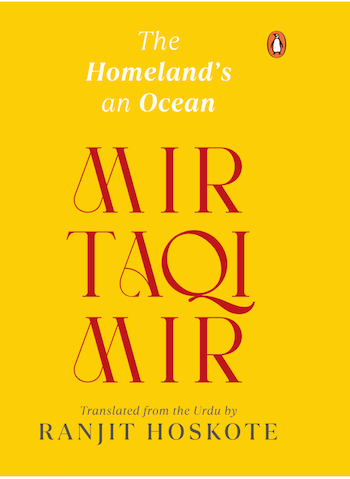
The Homeland’s an Ocean, Mir Taqi Mir. Translated with an introduction by Ranjit Hoskote, 272 pp. India Penguin Classics.
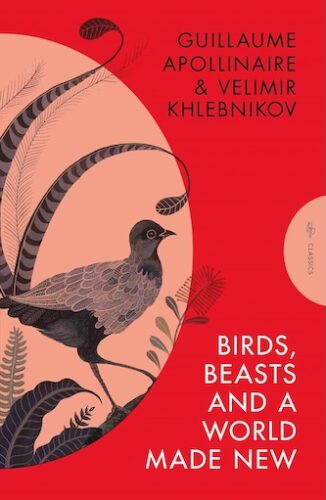
Birds, Beasts and a World Made New: Guillaume Apollinaire and Velimir Khlebnikov. Edited and translated by Robert Chandler et. al., 272 pp. Pushkin Press.
The Oceans of Cruelty: Twenty-five Tales of a Corpse Spirit. A Retelling by Douglas J Penick, 184 pp. NYRB.
One of translation’s greatest powers — its ability to take a text out of one historical period, literary tradition, language, and set of conventions and transplant it into another — is a delicate procedure. In its new environment, the transplanted work may look out of proportion, withered or too robust. The greater the remove, the trickier the operation can be, so it’s all the more satisfying when the work strikes roots and flourishes in its new linguistic soil. Two recent collections of poetry translated from Urdu and from French and Russian are impressive feats of such propagation.
In The Homeland’s an Ocean, the accomplished poet, translator, and art curator Ranjit Hoskote introduces English readers to Mir Taqi Mir (1723-1810), one of Mughal India’s greatest poets and a man of a strikingly modern sensibility. Prolific and versatile, Mir wrote almost 2,000 poems in Urdu and lyrical and narrative poems as well as three works of prose in Persian, a language widely used in India at the time. For this volume, Hoskote has selected a mere 150 asha’ar or couplets from the 13,585 that comprise Mir’s collected poems and rendered them in vigorous, colloquial English. He also provides an engaging and informative introduction to Mir, his era, and the literary and linguistic contexts in which he thrived. Under the waning Mughal empire, Delhi was repeatedly sacked by forces from Iran and Afghanistan: Mir spent more than a decade in exile. The sense of devastation and dislocation that pervades his poetry resonates all too powerfully 300 years later.
Of the heart’s desolation, what report?
This city’s been looted a hundred times over.
For Mir, the concept of a homeland is inevitably undercut at a time of shifting linguistic and geopolitical borders; it can’t escape the centrifugal forces of history.
Like the whirlpool, still centre of a giddy circling,
the homeland’s an ocean that scatters us in all directions.
Loss and mourning weigh on many of the couplets collected here, but Hoskote is careful to include verses that reflect other facets of this prismatic poet. Mir was supremely confident yet also self-aware, playful, sly, irreverent and, one imagines, very good company. He boasts that “No one who’s heard a poem of Mir’s wouldn’t say: / Say it again, it’s to die for, say it again!” But he also pokes fun at himself: “Pandemonium reigns across all my books. / Enjoy your tour through this montage of anxieties!” He can be subtly contradictory — “This is the imagination’s studio: / it shows only what you believe is true” — and boldly iconoclastic — “You want to know about Mir’s religion? He’s striped himself / with sandal paste, parked in the temple, given up on Islam long ago.”
 It’s tempting to quote couplet after couplet, but I’ll close with one that is astonishingly prescient or, perhaps, just tragically timeless: “We have no resources at all that might help us / in a world they say is awash with resources.” With this collection, Ranjit Hoskote offers us an unexpected resource to help us come to grips with both the present and the past.
In his introduction, Hoskote quotes a couplet by Ghalib, Mir’s successor and main rival to the title of Khuda-e Sukhan (God of Poetry), who did not give praise lightly: “Ghalib, what can I say about Mir’s poetry? / His collected works rival a garden in Kashmir.” While space constraints make The Homeland’s an Ocean more of a lush and varied window box than a full garden, it does offer a glimpse of what may one day be a splendid garden in anglophone soil.
The poet and translator Robert Chandler, by contrast, has taken the bold approach of transplanting two poets into one pot. In Birds, Beasts and a World Made New, he juxtaposes the work of Guillaume Apollinaire (1880-1918) and Velimir Khlebnikov (1885-1922). The two men never met but shared talents — drawing and verbal dexterity, especially in rhyming and wordplay — and many interests. Chandler’s ingenious method of comparing and contrasting their poetry in seven thematic sections with short, informative introductions is illuminating. The categories alone give a sense of the range and variety of their interests and the political forces they were responding to: birds and animals; art; war, revolution, civil war and famine; fate, history, and numbers.
This volume is a welcome invitation to discover or rediscover both poets, to a great extent because Chandler is particularly adept at fashioning rhythms and rhymes. He turns his finely tuned ear to Apollinaire’s sinuous lines and finds inspired solutions to rhymes that flow so easily in French. The grasshopper “La Sauterelle,” for example, becomes a cricket:
Voici la fine sauterelle,
La nourriture de saint Jean.
Puissent mes vers être comme elle,
Le régal des meilleures gens.
This is the slender cricket
Saint John used to eat.
May my verses be like it—
And feed the true elite.
Audaciously and to great effect, Chandler expands Khlebnikov’s eight-syllable couplet about a river mirroring the sky into a haiku. Óchi Okí / Bléschut vdalí becomes “O of the Oka / River—O, so open eye, / Bowl to hold the sky.” Fortunately for his readers, Chandler doesn’t give up even when admitting defeat. He compresses seven lines into four in “Cricket International” while noting his despair of capturing Khlebnikov’s evocations of “Russian history, a cricket’s sound-producing mechanism, a transcription of the call of a great tit and a profession of hope for a better future.”
Grasshopper-gracehoper,
Joy us with evensong.
Wing it, swing it,
Creak out your dickinsong.
His evocations — of Emily Dickinson for one — may be worlds apart from Khlebnikov, but they have a poignant harmony.
Chandler also graciously draws on the work of other translators and includes a few particularly virtuosic versions of Khlebnikov’s neologisms and linguistic pyrotechnics by Paul Schmidt, Christopher Reid, and Peter Daniels. He adds a caveat that some of the poems included here, like these two and Edwin Frank’s version of “Snake Train” (“Imagine! A winged dragon! It tore along / Beside us with the vague, furtive smirk / Of someone who enjoys a private joke // Stretched across its heart-shaped snout”) are “best thought of not as translations but as riffs…or homages.”
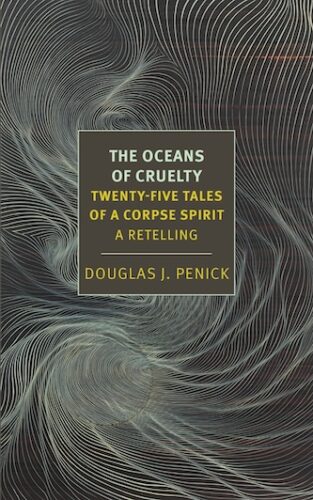
More than riff or homage, Douglas J. Penick’s The Oceans of Cruelty: Twenty-five Tales of a Corpse Spirit is a retelling of the ancient Sanskrit Vetāla Panchavimshati story cycle. Working from a half dozen existing translations, Penick has subjected these tales to multiple repottings, as it were. While it’s not a translation narrowly or even broadly defined, I’m turning my high beams on this edition because it is transporting and a joy to read as well as a reflection on the ambiguous power of storytelling to liberate or fetter.
In Penick’s version, an oil merchant dreams of Siva seducing Parvati with stories while the earth is yet unformed. When he wakes and whispers these same stories to his wife, Siva becomes enraged. The god traps the man’s living spirit in a corpse that will dangle from a tree in a cemetery until a king comes and carries him on his back, listening and responding to each of the stories. Only when a story leaves the king at a loss for words will the vetāla, or corpse-spirit, be freed. As fate would have it, the brutal but wise King Vikramāditya is tricked by an evil yogi into bringing him the corpse. Again and again, the king cuts the vetāla down from the tree and carries “the chilly cloud-like form” on his back while the spirit recounts the tales of passion, betrayal, envy, caprice, deceit, and devotion. And each time, he must answer the vetāla’s question or suffer unbearable pain. Only the final tale of insoluble incestuous complexity stumps the king’s interpretive ability, which frees the vetāla, along with his porter-king, from the prison of these disastrously over-heard tales.
Penick points out that “our inner lives are made up of innumerable webs of histories, memories, and narratives. At the same time, as we move through life, we are inside other stories, other people’s stories, alien histories, floating in an endless sea of tales, fables, gossip. … It is through stories and tales and accounts of all kinds that we move — continuously, constantly — in and beyond the limits of a single lifespan.” Here we have another of translation’s great powers at work — without it, how much thinner would the webs of our inner lives be and how much colder the sea of tales that carries us through life?
[1] In tribute to the slipperiness of language and the way words can change meaning depending on context and circumstances, this bimonthly feature will appear twice a month or every two months, depending….
Tess Lewis is a writer and translator from French and German. Her translations include works by Walter Benjamin, Ingeborg Bachmann, and Montaigne. A Guggenheim and Berlin Prize Fellow, she won the 2017 PEN Award for Translation. She is an Advisory Editor for The Hudson Review and co-curator of the Festival Neue Literature, New York City’s only German language literature festival. www.tesslewis.org
Tagged: "Birds, "The Homeland’s an Ocean", "The Oceans of Cruelty: Twenty-five Tales of a Corpse Spirit", "Vetala Panchavimshati", Beasts and a World Made New: Guillaume Apollinaire and Velimir Khlebnikov", Douglas J Penick, Mir Taqi Mir, Ranjit Hoskote, Robert Chandler