
Visual Arts Commentary: “America at 250” — Art and Commerce at the MFA
By Trevor Fairbrother
A sprawling 250th‑anniversary display sidles up to hot‑dog branding and influencer playfulness.
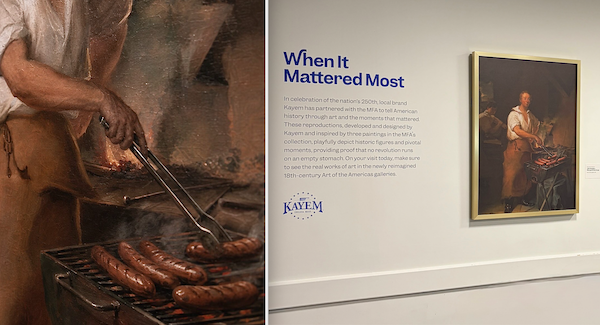
Installation of Kayem’s project in the cafeteria of the MFA, Boston. Images paired by the author. Left: detail of image by Colossus, Boston. Right: Kayem’s wall text and the spoof of 1826-27 portrait by John Neagle.
Full disclosure: I did not visit the displays discussed below. But I viewed pictures and texts online to learn how the Museum of Fine Arts, Boston, recognized the 250th Anniversary of the United States. The main event — titled America at 250 — presents over 400 items in eight thematically focused displays. It is a reinstallation of the entire ground floor of the MFA’s Art of the Americas wing. Alas, the project’s overlapping agendas can be confusing. The event is publicized in relation to the nation’s 250th birthday. While the MFA formerly had curatorial departments devoted to American (as in US) art, it now encompasses two continents in its focus on Art of the Americas (read Canada, Mexico, Chile, etc.). Moreover, even though America at 250 takes place in spaces dedicated to the 18th century, the curators have included numerous items from the 19th century to the present, intending to challenge traditional assumptions and to spark broader dialogues about the nation, its institutions, and its peoples.
The MFA’s press release offers useful descriptions of the galleries of America at 250, and this is my synopsis:
- Power and Resistance includes imposing works that expressed authority — for example, a full-length portrait of a Mexican archbishop and another of an affluent Massachusetts merchant. There are also objects that may be interpreted as acts of resistance to authority: the silver punch bowl made by Paul Revere in 1768 for Boston’s “Sons of Liberty,” a secret organization established to undermine British colonial rule; and a ceramic jar made in South Carolina by an enslaved potter who learned to read and write when literacy was illegal for slaves.
- History and Mythmaking examines the ways art helps shape national identity and transmits collective histories. The cult of George Washington is explored in depth.
- Boston’s World presents works that reflect the city’s ties to London, the Caribbean, and Native nations.
- Communities of Makers portrays “a vast, interconnected community of creators whose labor shaped the visual world of the Americas.” The makers range from Jacob Hurd, a silversmith in Boston, to unidentified Indigenous Tlaxcalan furniture makers in Oaxaca, Mexico.
- Copley’s Ambition is a gallery dedicated to John Singleton Copley, the local artist hailed by the curators as “the most important portrait painter in colonial North America.” Copley catered to the cultural and social aspirations of both Loyalists and rebels, but in 1775 he settled in London and joined the British artistic establishment.
- Families at Home looks at three cultures: Native Wampanoag; Anglo-American New England; and Black, Indigenous, and mixed-race New Spain.
- Something’s Brewing presents art and artifacts associated with four caffeinated beverages: tea, coffee, chocolate, and yerba maté. The story of the Boston Tea Party introduces the notion of tea as “a luxury commodity, a symbol of refinement, and a political hot button.”
- Asian Styles in the Americas presents luxury goods imported from China, Japan, and Southeast Asia. In addition, there are objects made in the Americas inspired by such Asian materials as porcelain and lacquer.
As I pursued America at 250, I thought often of a topic that is taboo amongst apologists for museums: the fact that art is connected to commerce and museums are tethered to market forces. The press release lyrically states that the MFA’s massive collection spins “a multifaceted story of the human experience — a story that holds unique meaning for everyone.” But don’t let those words persuade you that museums are neutral restorative places. And don’t assume that the MFA belongs to Boston and Bostonians. It is a nonprofit organization that operates on an endowment and raises outside funds to support its sundry activities. The admission price for an adult is currently $30.
Big art museums changed considerably during culture wars of the late 1980s and ’90s. They made efforts to attract new audiences that were racially and economically diverse. They embraced corporate business models and allowed art to serve as infotainment and entertainment; and they saw exhibitions, especially blockbusters, as products. In tandem, museums explored new ways to display their permanent collections: chronological narratives were often supplanted by thematic approaches intended to set up conversations involving different kinds of art. In 2025, Ethan Lasser, the MFA’s Chair of the Art of the Americas, told a Boston Globe editor that the new reinstallation would tell “a different kind of story about our nation” and strive for more complete and more inclusive narratives. Lasser recently told reporters from WCVB-TV that the museum’s collection, its visitors, and the city have all changed; consequently, the new galleries “speak to a new moment.”
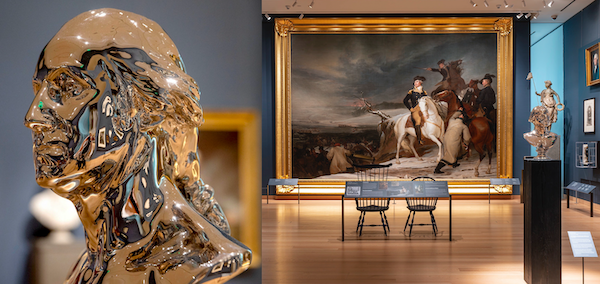
Left: sculpture by Alan Michelson. Right: the gallery History and Mythmaking, with Sully’s huge painting and the Michelson in the right foreground. Images paired by the author: detail of photo by Robin Lubbock/WBUR and photograph from Museum of Fine Arts, Boston.
Storytelling is rife in the gallery titled History and Mythmaking. Towering over everything is The Passage of the Delaware (1819), a painting by the English-born artist Thomas Sully. The picture was intended for North Carolina’s state house, but proved too large to hang there. It is a fanciful depiction of General George Washington and the Continental Army on the eve of a victory against the British. The hero rides a white stallion, accompanied by his valet, an enslaved Black man. Nearby, a recent Native American counterpoint to Sully’s presentation of Washington as the nation’s hallowed father is offered by Alan Michelson’s 2024 sculpture, Hanödaga:yas (Town Destroyer): Reflect. The Mohawk Nation nicknamed Washington “Town Destroyer” because he ordered the devastation of their communities in 1779. Michelson conceived a work of critical conceptual art by reproducing a historic bust of Washington in mirror-finished stainless steel: the portrait’s surface reflects viewers and its title invites them to remember that the subject was a villain as well as a Founding Father.
At the center of the gallery titled Families at Home is a commissioned installation by Hartman Deetz. The Mashpee Wampanoag says he is “both Native and settler” because he was born to an Irish and Italian mother and a Wampanoag father. Deetz has assembled numerous items as a personal altar on a table. In front of it he has placed a pair of sneakers from his personal collection next to a pair of 1880s Mi’kmaq moccasins owned by the MFA. On the wall above, he has inscribed an idiosyncratic matrilineal family tree. And flanking his altar are historical and contemporary Native works from the MFA’s collection, many of them crafted by women, all chosen as reflections of Deetz’s ancestry and life experiences.
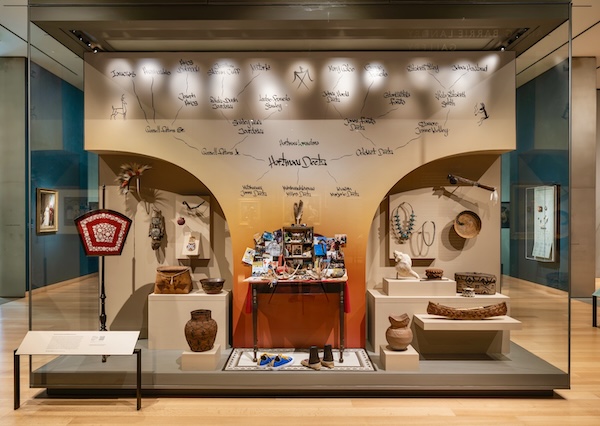
Installation by Herman Deetz in the gallery Families at Home. Photo: Museum of Fine Arts, Boston.
To introduce America at 250 on its website, the MFA quotes a line from Murray Whyte’s review in The Boston Globe: “The new 18th-century galleries underscore an enduring truth: America will never be finished.” Adopting an oratorical style, the critic lauded a curatorial approach that was willing to be “fraught, complicated, and full of truth” in ways suited to the nation’s current precarious state. He foregrounded the fact that the museum turned down $400,000 in federal funding, knowing that the current administration might take judicial action if its project did not comply with the versions of American history preferred in the White House.
Meanwhile, in another part of the MFA, there is an unabashedly commercial mini-exhibition also keyed to the 250th anniversary. It is titled When It Mattered Most. The local hot-dog maker, Kayem Foods, partnered with the museum to develop a fun-focused summer-long marketing campaign, and hired the ad agency Colossus to produce a collection of 12 framed, photo-based items. Colossus used AI to introduce images of America’s “most iconic food” into historic paintings. Three works from the collection of spoofs were installed in the museum’s basement cafeteria; they showed Sully’s The Passage of the Delaware, John Neagle’s blacksmith portrait, Pat Lyon at the Forge, and Gilbert Stuart’s George Washington, all modified by the introduction of hot dogs; a label encouraged diners to visit the original paintings in the Art of the Americas wing. Different selections from Kayem’s tongue-in-cheek collection have been exhibited at such venues as Fenway Park and Cisco Brewers and proved popular on social media. The company keeps a calendar of everything on its website, Instagram and TikTok.
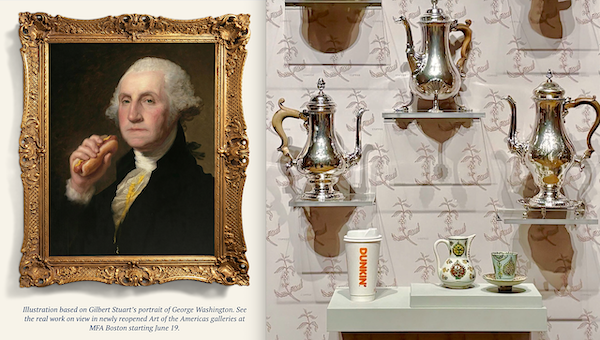
Left: item from Kayem’s website. Right: detail of vitrine in the gallery Something’s Brewing. Images paired by the author.
The MFA has not publicized When It Mattered Most on its website, but it received lots of attention when freelancer Celina Colby wrote about it in The Boston Globe: “This is the first time the MFA has collaborated with a food brand, and comes at a time when the institution is facing a $13 million projected deficit, which led to job cuts earlier this year. To see the MFA taking on the playfulness of an influencer is an unexpected turn.” Colby’s story got far more comments from readers than Whyte’s review of the reinstalled galleries. Local TV station WHDH covered the unveiling of Kayem’s project outside Faneuil Hall, and Nonie Gadsden, the MFA’s Senior Curator of American Decorative Arts and Sculpture, commented, “It’s a fun way to help a partner and to bring some attention to some of these paintings.”
The MFA’s dance with Kayem confirms that the Chelsea-based hot dog maker markets like a champ while the grande dame of Boston museums is an ingénue. There’s a vitrine in America at 250 devoted to historic artifacts associated with coffee consumption that confirms this. Alongside silverware and ceramics there’s a 2026 Dunkin’ Donuts cup that is merely identified as a loan. Clearly, it gives visitors a break from interpretative texts that righteously invoke racism, indigeneity and the country’s “contradictory promises of liberty and freedom,” and Hyperallergic gave it a friendly mention. Perhaps the curators were parroting artist Herman Deetz, who displayed his bright blue Converse sneakers next to historic beaded moccasins. One way or another, the Dunkin’ intervention relates to the MFA’s longstanding and none-too-effective efforts to expand its audience and broaden its appeal.
Trevor Fairbrother is a writer and curator. Of his contributions to The Arts Fuse, his favorite is an essay about the 1967 track “Plastic People” by The Mothers of Invention.
Tagged: "America at 250", "When It Mattered Most", Kayem Foods
Thanks for this fascinating post. I am not able to travel to Boston so this is much appreciated.
Thanks for writing. There’s a new book to accompany this project, but I’ve not seen a copy. It is titled “Art and the Americas,” and Ethan Lasser and Erica E. Hirshler edited it. The MFA also took a thematic approach when reinstalling the top floor of the same wing in 2022: “Stories Artists Tell: Art of the Americas, the 20th Century.” These reconfigurations seek to create dialogues between works traditionally deemed icons and the creations of artists who were formerly marginalized or ignored. In the lingo, the American art canon is expanded and the notion of “American” becomes fluid rather than fixed.