
Local Author Interview: Milo Todd on Excavating a Lost Queer Berlin
By Preston Gralla
Novelist Milo Todd discusses his novel The Lilac People and the challenge of reconstructing queer and trans lives under—and after—Nazism
In this ongoing Arts Fuse series of interviews with Boston-area authors, I talked with Milo Todd, whose novel The Lilac People was recently released in paperback. The novel, inspired by true events, tells the story of the thriving trans and queer community in 1932 Berlin and their fate after Hitler came to power. It focuses on a trans man named Bertie and his girlfriend Sofie, who survived the Nazis by fleeing to a farm and taking on the identities of an elderly couple.
The Lilac People was recognized as an ALA Notable Book of the Year and was a 2026 Lambda Literary Award Winner as well as a finalist for the New England Book Award. Todd is a Massachusetts Cultural Council grantee and Co-Editor-in-Chief of the LGBTQ+ literary journal, Foglifter Journal. He runs The Queer Writer newsletter.
Arts Fuse: Why did you write this book? Was there anything about life today that made you feel it was important to do?
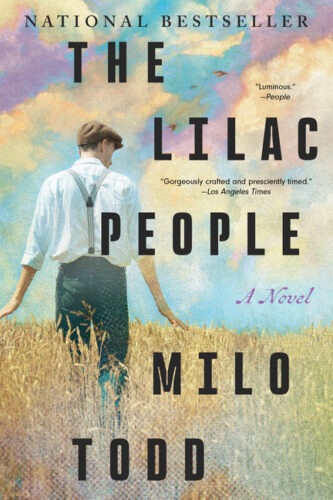 Milo Todd: The funny thing is that I started the research for this book back in late 2015 or so. I happened across a social media post that said something like, “Did you know that when the Allied forces liberated the camps, they let everyone go except the queer and trans people?” I looked it up and it turned out that was true, and it made me so angry that I just kept researching and uncovering more stuff. This all eventually turned into The Lilac People.
AF: In the book you resurrected a world that has been largely lost — the story of trans and queer people in Berlin in the 1930s. How did you do the research? How hard was it to do?
MT: This research was incredibly difficult. I always do a deep dive into any of my books because I want them as historically accurate as possible, but this one was by far the hardest and will probably forever keep that title.
Back in 2015, nobody was talking about this stuff, so I started out just looking online and in libraries for any little pieces of information I could find. Thankfully, those then led to other sources, and those sources to other sources, so soon enough things had branched and branched and branched, so I had some information to work with.
But then I hit a wall that I should’ve seen coming; there was only so much translated into English. I ended up learning German, which opened up more academic sources and such, which eventually led me to an absolute treasure trove: the Magnus Hirschfeld Society (Magnus-Hirschfeld-Gesellschaft) in Berlin. Since the early ’80s, these folks have dedicated themselves to collecting, recovering, and archiving every surviving scrap of information they can find about Dr. Magnus Hirschfeld, which translates quite easily into queer and trans life during the Weimar Republic.
Honestly, if I’d realized how much work this book was going to require, I’m not sure I’d have taken it on. But I was in so deep (and still so angry) that I just kept pushing forward. Though it’s great I ended up learning a language out of it. I haven’t spoken German in a few years now, unfortunately, so I’ve lost a fair amount of it, but I plan to get back to it whenever my life finally slows back down. I’m sure it’ll come back to me. But I’d also like to get to the point of true fluency.
AF: What was the most surprising thing you came across in your research?
MT: I was surprised by just about everything I learned, to be honest, both the good and the bad. I’d start naming things here, but then I’ll have pretty much summed up the entire book.
AF: What did you come across in your research that you would like as many people as possible to know today?
MT: While all the details are worth knowing, I just want folks to know that queer and trans people have long, vibrant histories. There’s a lot of amazing stuff out there, and the Weimar Republic is a great example of that.
AF: You did an excellent job of balancing plot, character, and research so the writing and plot felt natural, not as if you were trying to fit in every fact you found. How hard was that to do?
MT: I’m really glad to hear that, thank you. But yeah, it was a lot of work. I have a tendency in general to overdo it, just because I think the stuff is so fascinating, but then it obviously starts to read like nonfiction, which won’t do. So through trial and error, and helpful feedback from beta readers, my agent, and my editor, I cut away what wasn’t necessary.
That said, I still included backmatter, which originally was meant to simply call myself out on the few historical changes I had to make in the book in order for there to be a story. (Again, historical accuracy is really important to me.) But then since I had the opportunity, I included some facts and information, too. The backmatter was ultimately meant for my own interests and peace of mind, but readers have overwhelmingly loved it. So I’m definitely going to continue doing this with my future books. Everybody wins.
AF: After the war, you show the ways the Allies and the US targeted trans and queer people. In the ending, as Bertie enters New York Harbor he thinks of things he’s lost, and doesn’t think he’ll find them again. How do you think life in 1930s Berlin for trans and queer people compares to life for them in the U.S. today? How about life in the US for trans and queer people at the end of the war compared to today?
MT: I could go on this for hours, but essentially, not much has changed. Especially since Bertie was entering the US during the Red Scare (or, how queer history sometimes refers to it, the Pink Scare). In many ways, we’re currently there again. The big difference now, though, is that there’s much more surveillance technologically, which makes it near impossible to be left alone in any capacity. Even if you’re just sitting at home, minding your own business, it feels like the entire world is simultaneously both in your face and underfoot, eager to monitor, judge, and socially execute you down to something like, I don’t know, how you chew your food. And when your own government makes it plain that they want you to stop existing, this brings the problem to a whole new level.
By contrast, the Weimar Republic, despite all its faults, feels more progressive than anything we have today. If the modern US had a place like the Institute for Sexual Science, that would be wild. What that place did for people, especially queer and trans people, would be off the charts even by today’s standards.
AF: Have you ever yearned to live in 1930s Berlin?
MT: If I’d been born into the era, I’d probably be pretty happy with it. I’d likely be one of the folks printing the magazines, running the parties and events behind the scenes, and so on. But if this is more of a time-traveling scenario, I’d definitely want to experience the Weimar Republic for some length of time, but then would want to return to today. Despite my desire to live in a time that doesn’t have all the technological glut we have now, there are still modern comforts I’d miss, but also knowing that Hitler was looming on the horizon, no thank you. It’d also be impossible for me to keep my mouth shut about that, so then a butterfly flapping its wings and all and I’d somehow break the space-time continuum.
AF: For years there’s been a big debate in the publishing world around identity, authenticity and who can honestly and accurately tell certain stories. Do you think someone cisgender can write an authentic book in which the main character is trans? Can someone who is trans write an authentic book about someone who is cisgender?
MT: I absolutely believe that both can be done. In fact, I’ve taught on it many times, and those have been my most popular classes. (I’ve been too busy the last couple of years with with The Lilac People to return to teaching as one of my jobs, but I plan to record my most popular classes soon and make them available for purchase on milotodd.podia.com.)
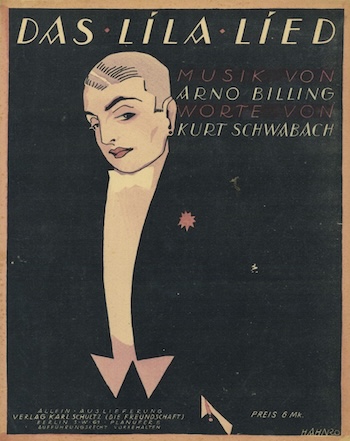
The cover of the sheet music for “Das Lila Lied” (“The Lavender Song”), written in Berlin in 1920. It became a Weimar Republic queer anthem.
My stance is any identity can write about any other identity they want. In fact, it’s encouraged. It helps us better understand one another. Also, it’s often a more accurate portrayal of life. If a person writes about NYC, but every character is magically white, that’s weird.
The key, though, is putting in your due diligence to make sure your representation of this other identity is accurate. And that can require far more work than someone realizes. It can also be uncomfortable, realizing what you didn’t know, and further realizing that what you thought you knew might not be accurate. You’ll come out of it not just a better writer, though, but a better person. Bring back humbling oneself. In fact, a lack of humbling oneself is the primary reason the overwhelming majority of authors get canceled online and dogpiled and all that.
I could talk about this for hours, but I’ll stop there.
AF: How does the way the Nazis treated trans and queer people and the way Trump and MAGA treat them parallel each other? Is what Trump has done similar to what was done in Hitler’s regime?
MT: I’ve actually done a whole, embarrassingly long recording about this because I realized I had a ton of information available I could share. It’s also on milotodd.podia.com, but is completely free. I plan to keep it up for some time longer, but I’m overdue for a “one-year-later” update.
Anyway, when I’d started the book back in 2015, the world was different. My intention for The Lilac People was to honor those who had experienced what they had, and portray it in a way that, hopefully, brought back and preserved their often faceless and nameless histories. As things began to progress in the US, I deliberately tried to keep that from bleeding into the book. I’m sure I failed in a couple places because we’re all human, but the book was never intended to be a reflection of today. While there are definitely many parallels between Nazi Germany and the modern US, any parallels in the book are technically a coincidence.
This is another topic I could talk about for a long time, but I will keep it at this: Believe it or not, the modern US is doing significantly better than Nazi Germany. I know it doesn’t feel that way, and there are definitely countless horrible and unforgivable things happening. People have died, people are suffering, it’s absolutely terrible, full stop. However, the modern US has also managed to dodge virtually every condition that would turn us into a version of honest-to-God Nazi Germany. In fact, our situation is currently almost at its end. Ironically, that’s why it’s feeling increasingly out of control in even shorter intervals of time. This is the death rattle of our particular brand of fascism we’re experiencing right now. This is part due to the foundation and details of our particular brand (that video I mentioned explains this in excruciating detail), but also because our resistance is working. So keep doing the resistance thing, folks. The worst is almost over. Hold onto that and keep going. We’re winning. And once the worst is over, get ready to rebuild. We’re going to need that energy, too.
Preston Gralla has won a Massachusetts Arts Council Fiction Fellowship and had his short stories published in a number of literary magazines, including Michigan Quarterly Review and Pangyrus. His journalism has appeared in the Los Angeles Times, Dallas Morning News, USA Today, and Boston Globe Sunday Magazine, among others, and he’s published nearly 50 books of nonfiction which have been translated into 20 languages.