July Short Fuses — Materia Critica
Complied by Arts Fuse Editor
Each month, our arts critics — music, book, theater, dance, television, film, and visual arts — fire off a few brief reviews.
Classical Music

Here are eight recent American compositions for one, two, three, four, or six players. Each is colorful, melodious, evocative, and appealing, and the composers, all living in America, come from a range of racial/ethnic backgrounds. The pieces were, in some cases, commissioned by the Pacific Symphony for its chamber concert series. (The capacious title, American Tapestry, is also recently used for a string quartet CD that Jonathan Blumhofer admires here.)
The project (just released on streaming services; also as alertly edited YouTube videos) was masterminded by pianist Orli Shaham. She plays in each track, alone or with one or more of the following: flute, clarinet, trumpet, violin, viola, cello.
Each work is in a single movement, except Avner Dorman’s four-movement Sextet, and each piece or movement is between four and eight minutes long, often with a title suggesting a musical feature (Dorman’s “Hocket” movement), a quality in human life (Jessie Montgomery’s Peace), or both (Ari Barack Fisher’s Romance, Peter Dayton’s Fantasy, Sarah Kirkland Snider’s The Currents, and Margaret Brouwer’s Parallel Isolations).
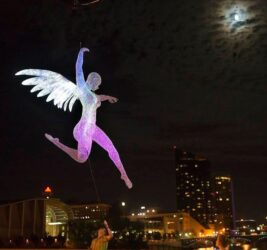
Photo from www.MichaelGard.com.
I was captivated throughout, a process greatly helped by the superb technical and expressive command of the players. The composers’ program notes sometimes mention a work that inspired the current piece: the Franck Violin Sonata, the Schumann Piano Quintet. I also thought I caught welcome allusions to Hindustani music (in Reena Ismail’s Saans), a Fauré piano quartet, or the harmonic style of Ravel, or, surprisingly, of Sondheim (the latter‘s music is sometimes Ravel-tinged).
The opener is the rhythmically exciting Wax and Wire by Viet Cuong, responding to the startling figurative sculptures of Michael Gard. Stravinsky feels like an unnamed guiding spirit here. The result is instantly communicative, as is true of each work in this remarkable anthology. The recorded sound is rich and clear.
Wonderful that this L.A.-area’s orchestra members are sharing their musical explorations with listeners everywhere! The downloadable booklet is here.
— Ralph P Locke
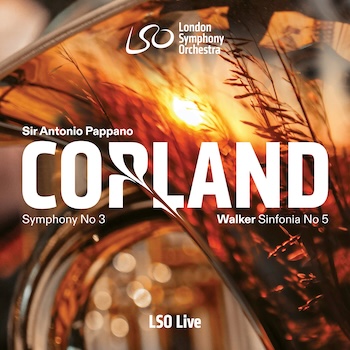
Aaron Copland’s Symphony No. 3 may not have quite captured the Cold War zeitgeist at its 1946 premiere. But the score’s optimistic quality has meant that it has aged a lot better than some of its contemporaries, and the work remains one of the composer’s most satisfying achievements.
Sir Antonio Pappano’s new recording with the London Symphony Orchestra makes a strong case for the Third’s merits: Copland’s distinctive ear for sonority, his mastery of composition, and his command of musical space all come through strongly in this performance. Though some of the contrapuntal writing in the finale feels a bit deliberate, the overall reading is pure-toned, well-directed, and characterful.
But what really makes this album work is its filler, George Walker’s Sinfonia No. 5.
If Copland’s symphony offers a populist vision of sunlit uplands, Walker’s 15-minute Sinfonia provides a necessary corrective, or at least a counterweight. Written in the aftermath of the Mother Emanuel massacre in 2015, it takes Coplandesque devices—clean textures, declamatory brass—and puts them, as it were, through an acid bath. This is music that is seething, punching, and restless. It drives, seemingly, because it has no other choice: feints at reflection are nearly all cut off or redirected. When they do arrive, they do not linger.
The results are potent and haunting, and the juxtaposition of these two American symphonists, whose lives largely overlapped, culminates in a striking dialogue about American aspirations and realities. In a semiquincentennial year devoid of anything approaching seriousness, at least officially, the pairing makes for an auspicious and welcome release.
— Jonathan Blumhofer
Books
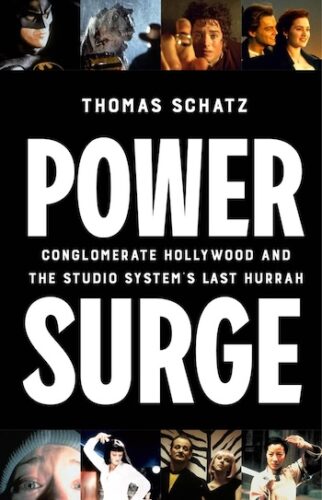
Thomas Schatz’s Hollywood Genres: Formulas, Filmmaking, and the Hollywood System (1981), I would rate, along with Siegfried Kracauer’s From Caligari To Hitler (1947) and Agee on Film (1958), as among the best books written about cinema. In it, he brilliantly analyzes the elemental formal structures of studio movies, putting them in the context of aesthetic models going back to Greek tragedy and providing a key to understanding them that I have found invaluable. His later book The Genius of the System (2010) was a thorough examination of the nuts and bolts of how that system operated – less inspiring than the previous book perhaps, but grimly insightful nonetheless.
In his new book, the oddly titled Power Surge: Conglomerate Hollywood and the Studio System’s Last Hurrah, he continues that examination into the era from 1989 to the present day, and it reveals that the latest version of Hollywood is exacerbating the worst aspects of the so-called Golden Age that were discussed in the previous book. Call it “The Demon of the System.” It presents a dispiriting, infuriating, sometimes tedious litany of debasement and exploitation (my description, not Schatz’s) in which the moguls are greedier, seedier, and more soulless (and with Harvey Weinstein, more depraved) as they usher in the period of mindlessly destructive mergers and acquisitions and ill-considered technological advances that we are mired in today.
Blame it all on Batman (1989). Directed by then Indie favorite Tim Burton, it stamped pulp product with auteur credibility, creating a franchise that would triumph and be debased and then be resurrected again by other auteurs, such as Christopher Nolan with Batman Begins (2005) and its sequels. An unexpected Star Wars-sized hit, it kicked off a series that initiated what Schatz sees as one of the main dynamics of this period: compulsive corporate profiteering versus the spirit of independent filmmaking, with the former invariably absorbing the latter.
Schatz is thorough and largely non-judgmental in describing the inner workings of this diabolical dream factory, though he could have been more forthright about the historical, political, and cultural context in which it operates. For insights into the tortured soul of the machine and the ways in which the films reflect the disorders of the real world – a process for which Schatz’s first book provides invaluable tools – I’d recommend books on similar cinematic decadence by J. Hoberman and A.S. Hamrah.
— Peter Keough
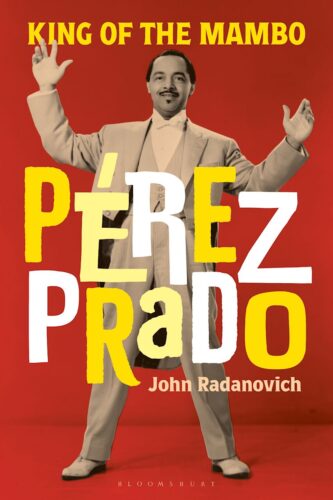
Pérez Prado: King of the Mambo promises a vivid journey into the life and times of Dámaso Pérez Prado, set against the backdrop of Afro-Cuban musical innovation in the 1950s and ’60s. In practice, however, author John Radanovich delivers far more context than character. While the book is rich in detail about the evolution of mambo and the broader musical landscape, it offers surprisingly little about Prado himself—only about 30 of its 253 pages are meaningfully devoted to its supposed subject.
Radanovich proves far more interested in the scene surrounding Prado than in the man at its center. We get extended discussions of Cuban musicians experimenting with mambo, the genre’s influence on American artists, and even a substantial detour into the dancers featured in films that drew on Prado’s music, complete with plot summaries and production details. How Prado and his music played a part in the Época de Oro are thoroughly cataloged, but these sections feel disproportionate, crowding out any sustained exploration of his personal life.
When Prado does come into focus, it is fleetingly. Interviews with his daughter María and musician Alex Acuña offer glimpses of a figure who remains largely opaque. Radanovich himself acknowledges that much of Prado’s life was deliberately kept from public view. That admission raises a structural question the book never quite answers: if Prado was so private, why not foreground that limitation from the outset rather than circling it indirectly?
Compounding these issues are several factual errors that undermine confidence in the text. For example, Charlie Palmieri is incorrectly listed as having died in 1960 instead of 1988, and Pee Wee Ellis is misidentified as a trombonist rather than a tenor saxophonist. These are not minor slips in a work that positions itself as a serious account of a musical legacy.
Ultimately, the book reads less as a biography than as an expansive, sometimes unfocused survey of mid-century Latin music and film. While the surrounding material is often engaging, the result is a frustrating imbalance: a biography that sidelines its subject in favor of the world around him.
— Brooks Geiken
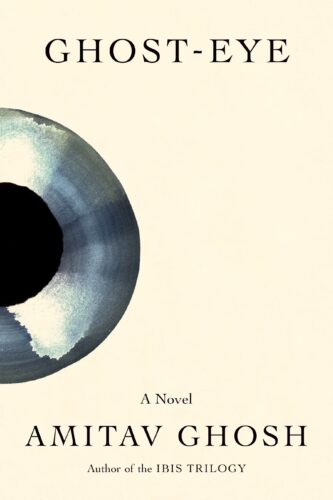
In The Great Derangement: Climate Change and the Unthinkable (2017), a trio of lucid lectures, Indian-born novelist, essayist, and public intellectual Amitav Ghosh indicts what he sees as a failure of the artistic imagination: a kind of cowardice, abetted by political complacency, in the face of planetary crisis. Dominant modes of fiction — especially psychological realism, with its faith in empathic moral uplift — prove structurally ill-equipped to confront the scale and strangeness of climate change. They screen out precisely the ruptures that define our moment. Meanwhile, scientific consensus has long made clear that current patterns of consumption are unsustainable, pointing toward a future in which the affluent world — largely responsible for the crisis — hoards dwindling resources while vast populations are left to endure an increasingly uninhabitable planet.
In Ghost-Eye, Ghosh approaches this looming catastrophe obliquely, through a genial, faintly old-fashioned scientific romance reminiscent of H. G. Wells. The narrative begins in late-1960s Calcutta, where a three-year-old girl’s sudden craving for fish in a strictly vegetarian, upper-class family prompts a prescient psychologist to suspect that she is recalling a previous life in rural India. Decades later, locating this vanished woman becomes central to a broader collective project: identifying others with similar reincarnative memories, whose residual knowledge — and flashes of future sight — might help human beings survive on a damaged, if not entirely depleted, Earth. Technology will not save us; treasure may instead lie hidden in the human mind.
Ghosh’s imagination is more empirical than mythopoetic, and the narrative’s gumshoe method — tracking clues, following leads, doing research — resists generating a deep aura of mystery. Even so, Ghost-Eye offers an engaging speculative narrative: a welcome exercise in optimism that will also delight foodies.
— Bill Marx
Popular Music
A Blooming Body (Hen House Studios) treats negative space as a primary voice. Cinder Well’s songs leave generous room around them, creating music that feels at once urgent and hushed, as if its most essential gestures remain just out of reach. Even the instruments seem to defer to silence, or something close to it. Notes linger, and the arrangements lend even the simplest interplay of melody, chords, and bassline an unexpected sense of scale.
Cinder Well’s brand of doom folk recalls the slowcore minimalism of Low alongside the shadowed atmospheres of Chelsea Wolfe and Marissa Nadler. Though Amelia Baker, who records as Cinder Well, is originally from California, her adopted home of Ireland resonates more strongly here. She plays most of the instruments on A Blooming Body, and her violin introduces an eerie edge without tipping into abrasion. Even among these touchstones, the album feels distinctly Gothic, like the score to an imagined folk-horror film.
“While the Womb Screams Silently” interweaves vocals, piano, bass, and violin with meticulous restraint, each element clearly delineated as the track gradually accrues weight over five minutes. The sparseness is such that every added layer subtly shifts the song’s momentum. Elsewhere, the gestures are even more delicate: the violin threads beneath voice and guitar on “Signals,” while “Beyond the Pale” and “The Color of Earth” introduce faintly shuffling, almost jazzy drums. “Ashes,” by contrast, builds toward a controlled peak of dissonance.
Baker’s lyrics establish mood through the accumulation of precise, telling details. The narrator of “While the Womb Screams Silently” awakens to her own objectification, rejecting the role of muse. In “Beyond the Pale,” a woman registers the collapse of a relationship while observing “a room full of strangers / pouring caffeine on empty stomachs / just craving a conversation.” A Blooming Body lingers in that charged moment when the impulse toward change becomes impossible to ignore.
— Steve Erickson
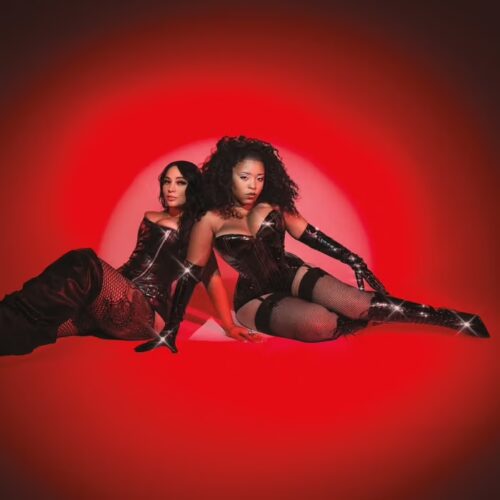
In a March 2025 essay for The Wire, Mosi Reeves identified a striking paradox: underground hip-hop, despite its claims to political progressivism, often affords less space to women than the mainstream. Even as female rappers achieve unprecedented commercial visibility, they remain subject to condescension and slut-shaming within ostensibly more “conscious” circles. With its cover presenting Sha Ray and DJ Haram as self-possessed, high-gloss figures, Critical Thot confronts this contradiction head-on.
The duo’s music is defined by volatility and refusal. Just as a track seems to settle, it veers elsewhere: trap hi-hats and booming 808s dissolve into corroded textures, metallic clatter, and sheets of noise. Percussion is equally unstable—shakers and sleigh bells intrude where kicks might be expected. “Elixir,” with its tactile unease, could score a particularly disquieting ASMR experiment. Moments flirt with conventional structure, but the dominant mood is one of frayed nerves and abrupt dislocation. Recorded across opposite coasts, the album hinges on DJ Haram’s deliberately antagonistic production, which Sha Ray meets with remarkable agility; navigating these fractured beats becomes a feat in itself.
Sha Ray’s writing is equally unyielding. Her braggadocio, sharpened by spoken-word fragments, targets sexism, double standards, and rape culture with surgical directness. She turns misogynistic language back at its users: “Thot Daughter” skewers men who harass and assault women, while “Shole Ain’t,” set against incongruous sleigh bells, mocks male entitlement—“show us your game, show us your bitch.” On “Low End Skeeza,” she condemns coercive behavior in stark terms. Across Critical Thot, Sha Ray and DJ Haram survey in sound a hostile cultural landscape—abrasive, unstable, and resistant—while asserting the force required to push against it.
— Steve Erickson
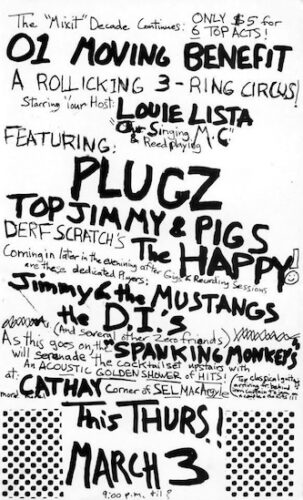
 In early-’80s Hollywood, Monday nights — “Blue Mondays” — meant the Cathay de Grande, a Chinese restaurant turned dive bar where punks and blues fans gathered for the rough, boozy sound of Top Jimmy and the Rhythm Pigs. My late friend Dan, a devotee of The Blasters, X, and Los Lobos, used to drag me there to catch the band. Even David Lee Roth was a fan, later immortalizing Top Jimmy in song on Van Halen’s 1984. The club’s dank air seemed permanently steeped in beer.
Top Jimmy — born James Paul Koncek — a former Kentucky juvie turned itinerant burrito maker — was the band’s voice, steeped in the rough-edged music of Howlin’ Wolf, Merle Haggard, and often, Bob Dylan. His rumbling baritone was matched by Carlos Gutarlos, aka Carlos Alaya, whose scorching guitar leads ignited the mix. With Gil Asias, known as Gil T, on bass, the trio formed the core of the Pigs, often joined by other fellow travelers.
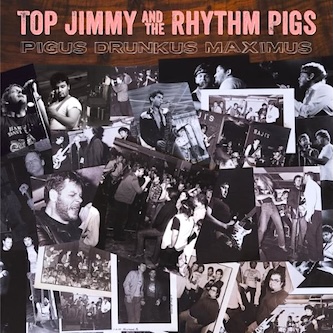
 The reissue of the band’s lone recording, Pigus Drunkus Maximus, is a small miracle, rescued in part by Variety editor Chris Morris, whose liner notes help restore the atmosphere of both the band and the scene. Produced by Steve Berlin of The Blasters, who also plays saxophone here, the album captures the band at full voltage. Top Jimmy, who died in Las Vegas in 2001, sounds wonderfully alive throughout, backed by Dig the Pig on rhythm guitar, Joey Morales on drums, and Gene Taylor of The Blasters on piano. Together they preserve the sudsy electricity of those Blue Monday nights.
The set includes Carlos Guitarlos originals such as “Dance With Your Baby,” “Hole In My Pocket,” and “Backroom Blues,” alongside Johnny Paycheck’s “11 Months And 29 Days,” Dave Clark’s “Homework,” Dylan’s “Obviously Five Believers” and “Ballad of a Thin Man,” Jimi Hendrix’s “Spanish Castle Magic,” Willie Dixon’s “Do The Do,” Lieber and Stoller’s “Framed,” and Merle Haggard’s “Workin’ Man Blues.” “Do The Do” is a particular standout, but the whole collection feels lean, sweaty, and memorably alive.
For many Cathay de Grande regulars, the night didn’t end with the last song. It meant chili cheeseburgers from Original Tommy’s, more beer, and maybe a glazed buttermilk cruller or two before spilling back into the streets of Hollywood. That world — all zines, Xeroxed flyers, and late-night devotion — is long gone, but Pigus Drunkus Maximus remains a vivid souvenir of it. You had to be there, but this record comes close enough to let you hear the room.
— Mark Hanser
Jazz
 Vibraphones are having a moment in jazz these days. Some of the finest albums of the year have featured a new generation of imaginative mallet virtuosos.
Ben Wendel’s BaRcoDe (a fancy way of formatting “barcode”) is on a different level, however. It’s as if he’s saying, “OK, Jamie Peet, you got Joel Ross to play on REFLEX. OK, Terri Lyne Carrington, you got Simon Moullier on We Insist 2025!. OK, Silvano Monasterios, you got Juan Diego Villalobos on The River. And fine, Mary Halvorson, you caught the big fish and got Patricia Brennan for About Ghosts. But I’ll get ALL OF THEM for BaRcoDe!” And just to make sure he stays the baddest cat, he goes solo with them all on tenor sax and leaves out the rhythm section.
But this is no gimmick. BaRcoDe is a gorgeous album, full of impassioned playing and brilliant compositions (all but Jobim’s “Olha Maria” are by Wendel). The four vibraphones stay distinct, thanks in part to a judicious use of EFX technology and atmospheric production, but mostly thanks to the strong individual voices of these accomplished players. It’s a powerful experience on headphones or good speakers.
Wendel’s energetic but disciplined solos, in his rich, velvety tone, weave in and out of the vibraphones. The time signatures and shifting syncopations on the uptempo numbers, like “Birds Ascend,” keep everyone (and the listener) on their toes. The ballads, like “Lonely One” (is someone whistling, or is it an EFX?), seem to float in their own stratosphere of overlapping vibraphone overtones.
Wendel’s bravery in recording in this unique context, his inspired choice of new and established players from various musical contexts, and the emotional honesty of his playing and compositions make this easily one of the best records of the year so far.
— Allen Michie
Tagged: "A Blooming Body", "American Tapestry", "BaRcoDe, "Critical Thot", "Ghost-Eye", "Pigus Drunkus Maximus", "Power Surge", "Pérez Prado: King of the Mambo", Amitav Ghosh, Antonio Pappano, Ben Wendel, Cinder Well, DJ Haram, Dámaso Pérez Prado, John Radanovich, Orli Shaham, Sha Ray, Thomas Schatz, Top Jimmy, Top Jimmy and the Rhythm Kings