Book Review: “Obstinate Daughters” — The Women Who Powered the Revolution
By Kathleen Stone
Denise Kiernan’s accessible study restores the often overlooked figures who shaped America’s founding.
Obstinate Daughters: The Rebels, Writers, and Renegade Women Who Ignited the American Revolution by Denise Kiernan. Dutton, imprint of Penguin Random House, 432 pages, $32
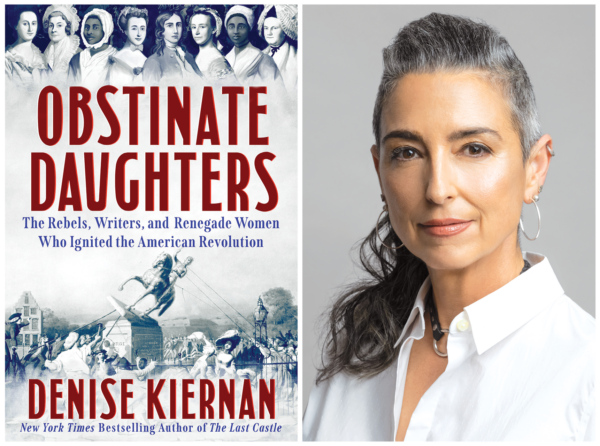
As we approach the 250th anniversary of the Declaration of Independence, new perspectives on our history are circulating. We’re learning about King George’s Proclamation of 1763, which established a western boundary beyond which colonists were not to venture; the role alcohol played in raising patriotic fervor and, sometimes, in scrambling efforts to win the war; and that, in England, the Third Duke of Richmond may have ignited the intellectual origins of our revolution. Now comes Obstinate Daughters: The Rebels, Writers, and Renegade Women Who Ignited the American Revolution, which illuminates women’s role in fomenting the revolution, and in helping to usher in a new country. Author Denise Kiernan introduces us to scores of women, some well-known, others less so, whose stories illustrate the many ways women supported the cause.
Let’s start with the Declaration of Independence. On July 2, 1776, the Continental Congress, meeting in Philadelphia, voted to approve the Declaration. The next day, the document was sent to a printer who made 200 copies for distribution throughout the colonies. Only two names appeared on that version of the Declaration – John Hancock and Charles Thomson, president and secretary, respectively, of Congress. A week later, on July 10, Mary Katharine Goddard got involved. She was the publisher of The Maryland Journal, and the Baltimore Advertiser, and also the local postmistress, the first woman in the colonies to hold such a position. Not only did she print the text of the Declaration in the newspaper, further informing the public of its promulgation but, six months later, she printed the Declaration as a broadside, this time with the names of the 56 men who had signed it. Duplicates were sent to each of the nascent states to be preserved in their archives. Publicizing the signatories’ names was a big step toward building patriotic sentiment, something that could not be assumed given the substantial number of loyalists in the colonies. Mary Katharine took the additional step of including her own name at the bottom of the document. The fact that a woman was the printer, and that she identified herself as such, was a bold, and somewhat rebellious, act.
Other women used their own words as a weapon. Mercy Otis Warren wrote and published diatribes, poetry, and plays, and her friend Abigail Adams wrote letters expressing her views on revolution, government, and slavery. Both were married to men who would help form the new government and, in Adams’ case, lead it.
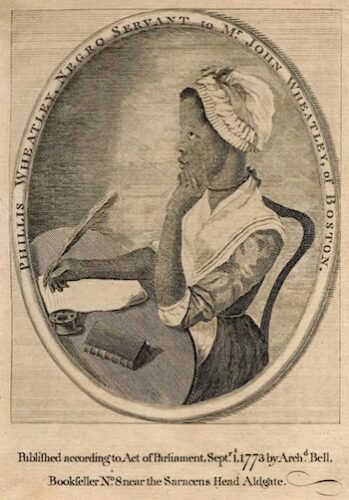
“Phillis Wheatley: Negro Servant to Mr. John Wheatley of Boston,” 1773. Attributed to Scipio Moorhead. Archibald Bell, printer. Photo: courtesy of the Boston Athenaeum.
Phillis Wheatley, who was not in a similarly advantageous marriage, also made a name for herself through her words. At age 7 or 8, she had been stolen from her family in West Africa and transported across the Atlantic on a ship known as Phillis, the name she took when Susanna Wheatley, the wife of a Boston merchant, selected her to serve in bondage as a maid and companion. Phillis was highly intelligent and quickly absorbed the lessons given her by Susanna and her teen-age daughter. By the time she was 17, Phillis was writing poetry. Her poetry, outstanding on its own, was also a platform from which she made connections worthy of those made by an ambassador.
Phillis sent a copy of one early poem to Selina Hastings, the Countess of Huntingdon, in England. When Phillis traveled to London in 1773, she met with the countess who agreed to promote a book of her poetry. On that trip Phillis also met with Benjamin Franklin.
Back in Boston, Phillis was freed from bondage when Susanna Wheatley was close to death. With words such as freedom and independence ringing through the city, Phillis echoed and amplified those themes in her poetry, inspiring the public to join in the cause of rebellion and the end of slavery.
Many enslaved Black men signed up to fight for the British, induced by the Earl of Dunmore’s promise of freedom if they did so. George Washington, on the other hand, decreed that Black men were not eligible to enlist in the Continental Army. Phillis had written a poem in praise of Washington’s being named general, which she sent to him. Later, Washington reversed himself on the issue of Black troops. Whether or not Phillis’s work persuaded him, he did write to invite her stop by his headquarters in Cambridge. “I shall be happy to see a person so favourd by the Muses,” he wrote.
Keirnan covers many other women, too many for me to review in depth. But here are a few highlights.
Laura Wolcott, whose husband was a Declaration signer, militia commander, and a judge, made musket balls. After the gilt statue of King George III in Manhattan’s Bowling Green Park was pulled down, she, along with her children and other women, melted pieces of the statue into thousands of musket balls. The ammunition made its way to Saratoga where two battles ended in victory for the Americans.
Other women stood with their husbands as they took up arms against the British. When their men were injured, or killed, the women took up weapons and continued firing.
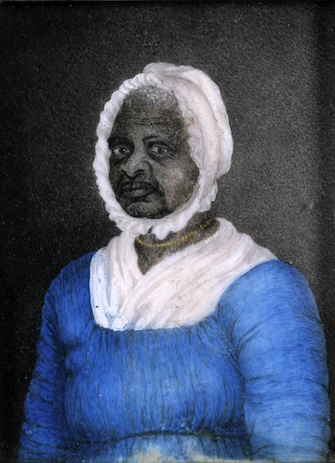
Mumbet, aka Elizabeth Freeman, aged 70. Painted by Susan Ridley Sedgwick. Watercolor on ivory, painted circa 1812. Photo: Massachusetts Historical Society, Boston
Nanye’hi, a Cherokee tribal leader, did not favor attacking white people who violated King George’s 1763 proclamation and settled in land reserved for natives. When others of the tribe disagreed and voted to attack, she vowed to find a way to warn the settlers. For Lydia Bean, the wife of a colonial soldier, that would prove to be a godsend. Lydia was captured and set to be executed when Nanye’hi interceded, taking her into her home and nursing her. Lydia, in turn, introduced Nanye’hi to weaving cloth and to raising and milking cows, skills that would later sustain the tribe when hunting was bad.
There was Elizabeth Freeman, also known as Mumbet, an enslaved woman in Massachusetts. Although illiterate, she heard the words of the Declaration of Independence and of the Massachusetts state constitution, primarily authored by John Adams, and saw no reason she should not benefit from the concepts of freedom and equality proclaimed in those documents. She asked an abolitionist-minded lawyer named Theodore Sedgwick to bring a lawsuit against her owner; a 1781 decision in her favor established the precedent that slavery was no longer to be practiced in Massachusetts. She took the name Freeman and went on to become governess to the Sedgwick children, eventually purchasing her own home.
Kiernan also includes seven short chapters highlighting her visits to some of the historic locales mentioned in the narrative. Some of these places still stand as recognizable artifacts of the past; others have become pubs, restaurants, and other commercial ventures. For Bostonians, there’s the Beantown Pub, which promotes itself as the only place in the city where you can drink a cold Sam Adams beer while viewing a cold Sam Adams. (The man was interred in the Granary Burying Ground, just across Tremont Street from where the pub is located.)
Many other women appear and reappear throughout the book. Because they are presented in the context of the war, as they should be, they are woven into many of the battles and underlying events. Kiernan’s writing style is accessible and easy-going, but the plethora of particulars can be overwhelming. Nonetheless, she makes a crucial point: women were as invested in the Revolution as men. The social and legal strictures of the time created boundaries that have made it challenging to recognize their contributions — Obstinate Daughters pays overdue homage to their heroic efforts.
Kathleen Stone is the author of They Called Us Girls: Stories of Female Ambition from Suffrage to Mad Men, an exploration of the lives and careers of women who defied narrow, gender-based expectations in the mid-20th century. Currently she is at work on a second book about women in the skilled manual trades. Her website is kathleencstone.com.
Tagged: "Obstinate Daughters", "The American Revolution", Denise Kiernan, Elizabeth Freeman, Mary Katharine Goddard, Mercy Otis Warren, Mumbet, Nanye'hi