Concert Review: The Renaissance String Quartet and the Sounds of Friendship
By Aaron Keebaugh
A compelling program of Donald Hass, Florence Price, and Brahms reveals ensemble precision and deeply felt musical dialogue.
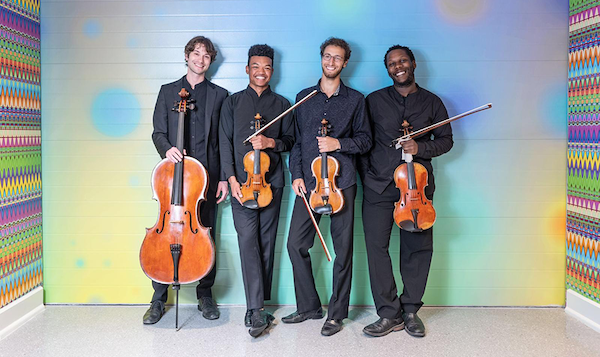
The Renaissance String Quartet. Photo: courtesy of the artist
When composer Daniel Hass wrote his String Quartet No. 1 he wasn’t thinking about how his piece would stack up against historical masterworks. But he admitted to having second thoughts when the Renaissance String Quartet, for which he serves as cellist, programmed his quartet next to those by Florence Price and Johannes Brahms last Sunday afternoon at the Isabella Stewart Gardner Museum.
“Heard along with these works puts a little pressure on it,” Hass joked when talking about his quartet ahead of the performance. But he needn’t have worried. His First String Quartet is a solid effort, full of inventive ideas and memorable gestures that sweep along in a devil-may-care eruption of sound. The result lives up to the score’s subtitle: “Love and Levity.”
The RSQ has performed this score frequently since Hass wrote it for them in 2021. Its drive and intensity no doubt reflects the close friendship shared by the four musicians. Randall Goosby’s violin echoes and enhances phrases tossed off by second violinist Jeremiah Blacklow. Violist Jameel Martin and cellist Hass maintain the kind of sturdy gravity needed to balance the ensemble’s sonority. Still, Hass’s quartet consistently places demands on the group’s embrace of cohesion. Textures shift directions on a dime. Rhythms dance, never settling into an equilibrium. The foursome handles these challenges with both machine-like precision and jam-band verve.
Hass’s String Quartet also plays with a kaleidoscope of colors across its four movements. Glassy sonorities give way to ear-searing dissonances while jazzy ballads coexist comfortably alongside hymnic passages. The musicians tear through these myriad effects with souped-up vitality. Sudden fortes shot through the lines like shock waves; even the softer lines exuded the force needed to keep the energy moving forward. If the string quartet, as some critics assert, can be seen as an animated conversation among friends, then Hass’s first contribution to the genre has the resonance of sparring, playful and good-natured.
That same blend of performing zest and intimacy made Florence Price String Quartet No. 1 feel just as immediate. This score showcases some of Price’s most emotionally urgent string writing as it reflects a deep appreciation for the past. Phrases in the first of its two movements channel as much Brahmsian heft as they do Dvořákian lyricism. The second movement, with its spiritual-like emotional longing, is the composition’s crown jewel.
The RSQ approached the work with warmth, burnishing its intimacy. A burnt mahogany tone applied just the right amount of emotional weight in each passage. The second movement was soulful yet felt eerily distant: phrases glowed like twilight. Yet the brief Scherzo, which shouted for attention between these serene moments, danced just as earnestly.
Brahms’s String Quartet No. 2 displayed even greater contrasts between solace and exuberance. He completed this score in 1873 and published it along with his First Quartet. With these works he had wrestled with history. The specter of Beethoven haunted in Brahms; he understandably was shy about tackling large-scale works — he was afraid he would not measure up. Thankfully, he got over trepidation. His Second String Quartet, with its symphonic scope, never feels derivative. Rather, Brahms honored tradition by adapting historical forms to meet his own individual artistic needs.
Here, too, the RSQ teased out every facet of the score, from the music’s whispered utterances to its driving passionate torrents. The musicians explored the mysteries of the opening Allegro, artfully shaped the long arcs of lyrical phrases in the Andante, and encouraged the nimble delicacies of the Minuetto to flit about freely. The trumpeting assurances supplied by the finale made this musical conversation feel both fun and satisfying. The performance cast a welcome spotlight on the RSQ’s greatest strength. These musicians display a kind of collective consciousness — they can practically finish each other’s thoughts.
Aaron Keebaugh has been a classical music critic in Boston since 2012. His work has been featured in the Musical Times, Corymbus, Boston Classical Review, Early Music America, and BBC Radio 3. A musicologist, he teaches at North Shore Community College in both Danvers and Lynn.