Book Review: Alma Mahler — Sorceress of the Modern
By Thomas Filbin
Judith Grohmann’s biography restores a complex cultural force too often reduced to muse and myth.
The Real Alma Mahler: Composer, Socialite, Rebel and Influencer by Judith Grohmann. Pen and Sword Books Ltd. 215pp. $39.95.
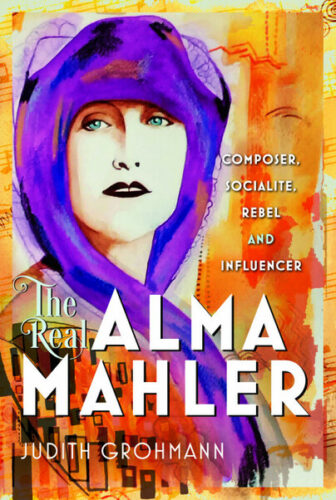
Alma Mahler led a life that, if it were made into a film, would be criticized as too outrageously exaggerated. Could a woman be married to a well-known composer, then a painter, and finally a writer? Was she a sort of Zelig, in the sense of the Woody Allen film, where a nondescript person appears in the background of everyone noteworthy and every significant event? Can one become famous just by mingling with the famous? The latter would be a hasty and unfair assessment of Alma Mahler, whose talent and awareness of life and art were so far beyond the ordinary that any attempt to minimize her would be wildly off-the-mark. Her third husband, Franz Werfel, called her a sorceress, and that makes sense: the intense fascination she inspired in men of immense talent suggests that she was far more than a muse or handmaiden, but rather, a figure who earned the respect of her famous partners. Judith Grohmann’s new biography captures the brilliance and breadth of an extraordinary person who stood at the vortex of modern art, music, and literature — she was far from a bystander.
Alma’s father, Jakob Schindler, came from a well-off Austrian manufacturing family but studied art in Vienna and became a painter whose landscapes appealed to the wealthy nobility, gaining recognition throughout the Habsburg Empire. Alma was his eldest daughter; she was favored by her father because of her temperament. She would sit in his studio for hours and appreciate the art of painting, with its forms, shadings, and color. Grohmann writes that a grasp of what drives creativity was central to Alma’s development.
As a young girl, Alma was exposed to a wide range of cultural experiences and, at eight years of age, traveled with her family to Dalmatia, Greece, and later Trieste, Dubrovnik, and Corfu. This fostered a lifelong desire to travel that also deepened her engagement with art. Her father died of appendicitis when she was 13, an event that propelled her prematurely into adulthood while also encouraging her to further expand her aesthetic sensibilities. She took up music, but resisted her teachers’ impulse to direct her toward a popular repertoire, choosing instead to explore her own preferences.
As Alma progressed into young adulthood, her “… beauty and magnetic presence made her the object of fascination, (and) her method of engagement only heightened the allure.” Her appetite for knowledge and experience became insatiable: she embraced the salons and theaters, “…always in search of conversations that could challenge and excite her.” Because of a childhood illness, she was nearly deaf in one ear; she needed to lean in during conversations, in a way that made others feel they were the center of her attention. The coffeehouses of Vienna — alive with artists, thinkers, and writers — became her informal university. In this way, the evolving modernity of the 1890s shaped her sensibility.
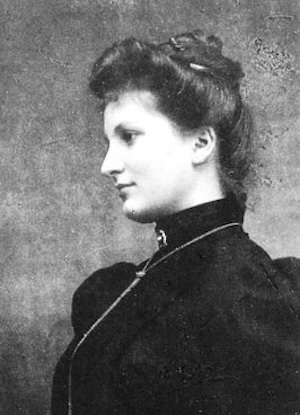
Alma crossed paths frequently with Gustav Klimt in 1898 and there was an immediate attraction. Grohmann writes, “She found his playful banter both charming and frustrating, remarking, ‘He is such a dear fellow. I was actually a little annoyed with him because he said I was spoilt by too much attention, conceited, and superficial.’” The two eventually became more entwined. When she was traveling in Italy with her mother and Carl Moll, her mother’s lover, Klimt joined them. During a brief moment alone, they kissed — it was her first such experience. She was told she was too young for such a romantic involvement, and pressured to abandon any notion of a relationship with Klimt. Other men admired her, but soon Gustav Mahler entered the equation, and, for Alma, music was a language that transcended words. Mahler would become her first husband. He was not only enthralled by her beauty, but by her perceptiveness. The composer was surprised by the depth of his attraction. Later, when asked about his first impression of Alma, he said that “…one doesn’t normally expect such a good-looking girl to take anything seriously.”
They married when she was 22, and he was 19 years older. They had two daughters, one of whom died at age five, a loss that profoundly affected Alma. Mahler died in 1911; shortly before his death Alma had begun an affair with Walter Gropius. She later became involved with the painter Oskar Kokoschka, a torrid relationship that ultimately faltered because of his possessiveness. In the midst of World War I, she reconnected with Gropius and married him; they had one daughter together, who later died of polio at age 18. She had a son in 1918 who died at age one; it is likely that the father was the writer Franz Werfel. Alma and Gropius divorced, and she later married Werfel. The war forced them from Austria to France and then eventually to the United States. In 1945, Werfel died of a heart attack, leaving Alma, once again, as the steward of an artist’s legacy. Controversies about her influence remain — particularly “The Alma Problem,” the issue of determining how powerfully she shaped — perhaps even reinvented — Mahler’s legacy. She wrote two books about him and, because of their close connection, became the primary source about his career after his death.
The remainder of Alma’s life was devoted to promoting and preserving the artistic legacies of the men she had loved. To reduce her significance to mere proximity to genius, however, is misleading. She was herself a gifted musician who composed in her youth, an astute and perceptive listener, and ultimately one of the defining cultural figures of her era. Grohmann’s well-crafted primer offers an insightful and engaging tribute to this remarkable woman.
In recent decades, Alma has been the subject of several biographies. François Giroud’s Alma Mahler: The Art of Being (1992), Oliver Hilmes’s Malevolent Muse: The Life of Alma Mahler (2015), and Cate Haste’s Passionate Spirit: The Life of Alma Mahler (2019) are testaments to the fascination the woman continues to inspire — even when that curiosity centers on her ability to recognize and shape the talent of others. She was a modernist immersed in the aesthetic currents of the early 20th century — a work of art in her own right, never reducible to a mere reflection of others.
Thomas Filbin is a freelance critic whose reviews have appeared in The New York Times Book Review, The Boston Sunday Globe, and The Hudson Review. His novella, Carousels, was published this month.