
Poetry Review: Adrian Matejka’s “Be Easy” — Identity, History, and the “Alpha Poet”
By Michael Londra
Poet Adrian Matejka distills identity, anti-racist critique, political commentary, and literary history into rapid left-right-left punches, each landing hard.
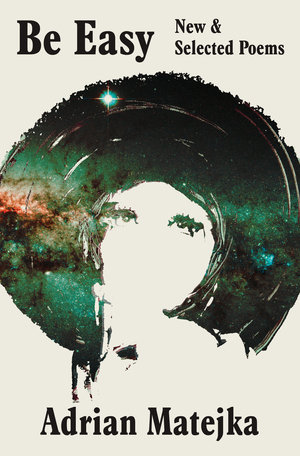
Be Easy: New & Selected Poems by Adrian Matejka, Liveright, 224 pp, $28.99
Was Shakespeare racist? Debate continues regarding Shylock, for instance. Some argue that the character is poetically written and therefore transcends any inherent bigotry. However, given The Merchant of Venice is a comedy, a case can be made Shylock’s eloquence (“Hath not a Jew eyes?”) is meant for audiences to laugh at—not empathize with. That said, even Shakespearean tragedy is problematic; Othello being the quintessential example. “The Moor” is depicted as a barely-tamed savage whose downfall is due to “gullibility.” Yet James Earl Jones—in a famous Broadway performance—elevated this role to a more complex psychological level. There is something about the pathos of tragedy, as opposed to the reassuring nature of comedy, that enables actors to transcend a playwright’s limitations. Appropriately, Jones received an Oscar nomination for his performance as Jack Johnson in the inaccurate 1970 biopic The Great White Hope. Johnson (1878-1946) was the first African American heavyweight champion — he was also a Shakespeare buff. Did he detect similarities between himself and Othello? Both were intellectuals undermined by white supremacy.
Halfway into Adrian Matejka’s Be Easy: New & Selected Poems there’s a monologue that links Johnson and the Bard. Culled from The Big Smoke, Matejka’s 2013 Pulitzer Prize-nominated biography-in-verse of Jack Johnson, “Battle Royal” channels the renowned pugilist comparing the English Renaissance bear-baiting craze to the turn-of-last-century’s boxing scene: “Back then, they’d chain a bear / in the middle of the bear garden // & let the dogs loose…A bear will always / make short work of a dog. Shakespeare // said Sackerson did it more than / twenty times to dogs & wildcats…Once baiting was against the law, some smart / somebody figured coloreds fight / just as hard.” Namechecked in The Merry Wives of Windsor, Sackerson the fighting celebrity bear is an allusion only hardcore Shakespeare nerds would grok. But this clues us into an unexpected fact—Jack Johnson’s formidable erudition—while also attesting to the belief that boxers of color were considered animals. In other words, Matejka distills identity, anti-racist critique, political commentary, and literary history into rapid left-right-left punches, each landing hard.
Curated from six prior collections (including The Big Smoke), along with twenty-one new poems, Be Easy refines these diverse influences into a unified lyric vision, such as in “Basketball feat. Issac Newton & EPMD:” “I split every bit of sunlight at College Park’s ball court—land / of sweaty Reebok tees & patriotic wristbands—escalating / to the rim…a hypotenuse of intention…The only time I dunked, the court / exploded like a party hearing ‘You Gots to Chill’ / for the first / time…while the basketball rotated / as insistently as the back-spinning apple that split Newton’s / wig.” Over and over, Matejka flings us into his “vernacular hubbub” where “Words work // the fast magic like a magician’s” (“Code-Switching Blacks”).
Everything is poetry. For example, aerospace science (reality-based and sci-fi) is especially fruitful. “STARDATE 8107.15” and “STARDATE 8205.01” draw on Star Trek’s made-up calendar to convey how TV is bound up with the Gen X poet’s earliest memories. “Unfunky UFO,” named after the Parliament song, does the same: “The first space shuttle launch got delayed until / Sunday, so we had to watch the shuttle’s return…That same / day, Garrett stole my new pencil box. That same / day Cynthia peed her jeans instead of going / to the bathroom…Both of us too upset to answer questions / about space flight.”
Classical music also gets a turn. “Gymnopédies No. 1” pays homage to fatherhood with a poem titled after a Satie composition: “That snow / week, my little girl & I trudged over / the busted branches fidgeting through / the snow like empty digits through / a hungry pocket.” Likewise, “Ode to Fela (1938-1997)” evokes Nigerian musician and activist Fela Kuti, who invented Afrobeat—West African instrumentation with jazz and funk elements—and advocated for anti-colonialism and freedom of expression. Matejka celebrates him as an “alpha male:” “Jail won’t stop him singing, / more funky than jail…Fela is Bacchus with pigment.” Kuti embodies Matejka’s ideal fusion of the political, the musical, and the sexual: “You dream / of coral snake: / lips to horn / like another / new woman…Dream / of making better: / drums stretched / to feed fire / and palm. / Call to arms / when you found / mother in driveway, / doubled over. / Mr. President, you are arming: / I condemn / democracy now.”
Filled with rock star brio, Matejka’s stanzas could be described as the work of an “alpha poet.” Only in Junot Díaz’s fiction, perhaps, will readers find such semantic swagger: “Today, I’m assimilating like margarine / into hotcakes. I’m getting down // like Danny LaRusso after the against- / the-rules leg sweep…On this day, something needs // to catalogue me: a hall monitor / doubled wide by ambition, / a goldfish with thumbs hitchhiking / toward a fishbowl full of dub” (“Seven Days of Falling”). Matejka revels in the pure hedonistic pleasure of words: “Polaroids / like a sponge bath of fingerprints” (“Domo Arigato, Mr. Mulatto [Dub Style]”); and “Let’s talk about the metronome of loss” (“Maggot Brain”); as well as “I kept rising stealthily—past my historical / anxiety, way past all my inherited hearsay” (“HIGHEST”). He is willing to look offbeat if the line is cool: “& by now even the unemployed / cat burglars appreciate sunrises / for their reliability” (“Somebody Else Sold the World”). And he is equally adept at humor: “Gotta be a frame: Luke Cage, Hero for Hire, stuck / in Texas…and I’m meaner / than Jerome Mackey and Jim Kelly in a paper bag” (“ ‘America’s First and Foremost Black Superstar’ ”). There’s even a dope rhyme or two: “They call it a crossover, but I like tats and funk. / I like overpriced throwbacks since before crunk” (“Synth Composite Basketball: No More Fundamentals”).
Among his new poems, Matejka riffs autobiographically on “ars poetica,” Latin for “the art of poetry.” In “Seeing Stars Poetica,” “Guitars Poetica,” “Handlebars Poetica,” and “16 Bars Poetica,” he adds further depth and nuance to his mixed-race origin story—initially explored in debut collection The Devil’s Garden (2003) and follow-up Mixology (2009): “& after all these years of uncertain pauses / passing as line breaks & light-skinned jokes // disguised as self-applauses, the volunteer dancers / in my head finally apologize for their faux pas…I sat slightly richer on my dad’s mohair chair at a desk / under an open window in my imagination’s guest room” (“Memoirs Poetica”).
Be Easy: New & Selected Poems is a retrospective with what I would call the “eyes of a horse.” Inspired by an equine’s panoramic vision, Matejka glances backward while galloping forward. As he continues to challenge himself, we can enjoy the earned uplift of “Record Changer.” Here the poet reminds us to resist despair. Because the future of America is up for grabs, versifiers and lovers of poetry should unite: “We collectivize…as tenaciously as chicken / legs undress themselves at a cul-de-sac party, then raise / the stripped bones to history. Out here, there / isn’t any, so history is whatever we want it to be.”
Michael Londra—poet, fiction writer, critic—recently introduced the Poets Confront AI and Surveillance Capitalism event at Poets House, available on YouTube. He also talks New York writers in the YouTube indie doc Only the Dead Know Brooklyn (dir. Barbara Glasser, 2022). His poetry was translated into Chinese by scholar-poet Yongbo Ma. Two of his Asian Review of Books contributions were named Highlights of the Year for 2024 and 2025, one of which was translated into Vietnamese. “Life in a State of Sparkle—The Writings of David Shapiro” from The Arts Fuse was selected for the Best American Poetry blog. “Time is the Fire,” the prologue to his soon-completed novel of Delmore Schwartz and Lou Reed appears in DarkWinter Literary Magazine. He can also be found or is forthcoming in Lana Turner: A Journal of Poetry & Opinion, Restless Messengers, The Fortnightly Review, spoKe, Cha: An Asian Literary Journal, and The Blue Mountain Review, among others. He added six essays and the introduction to New Studies in Delmore Schwartz, coming next year. Born in New York City, he lives in Manhattan