Book Review: Gauri Gill’s “Acts of Appearance” — Photography as a Form of Care and Ritual
By Margherita Artoni
Gauri Gill’s work is shaped by a dense visual language in which light, composition, and texture are not secondary elements but stand as active components of meaning.
Gauri Gill: Acts of Appearance. Text by Gauri Gill and Yuvraj Kadu, one of the papier-mâché artists involved in the making of the series. Edition Patrick Frey, 188 pp., paperback, $45.
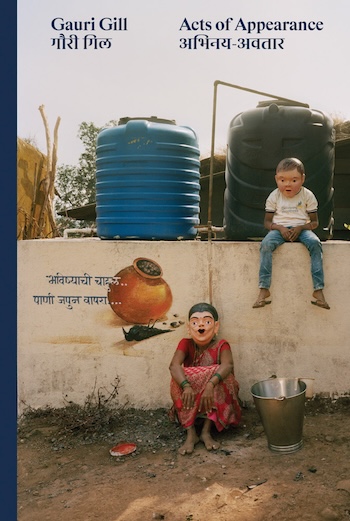
Today, Gauri Gill stands among the most compelling voices in contemporary photography. Through the lens of Bohada tradition, Gill’s Acts of Appearance rewrites the relationship between image, identity, and participation, situating it within specific Adivasi communities in rural Maharashtra, where ritual practice, domestic life, and agricultural labor remain structurally intertwined rather than separated into distinct cultural domains.
In a village in Maharashtra, a young woman moves through familiar surroundings with her face concealed by an anthropomorphic sculpture. For a moment, everyday routine shifts: the hearth, the utensils, and the working hands all seem to become part of a subtle, immaterial mise-en-scène. Acts of Appearance exists in this space, where photography moves beyond its documentary function and becomes a vehicle for narration, shared authorship grounded in participation. Here, the viewer is asked not only to look, but to intuit what lies beneath the visible surface.
The Bohada tradition, performed by master artisans, emerges from long-standing customs. Carved wood, woven fibers, metal leaf, and natural pigments operate as parts of a shared narrative system. The masks seen in Gauri Gill: Acts of Appearance were made by Bohada mask artists specifically for this project, as a departure from tradition and as a way of foregrounding the ordinary and mundane over the mythic and extraordinary. Each sculpted helmet embodies collective decisions and symbolic references: making and meaning are deeply intertwined. What results is not a fixed image but something akin to a communal act in motion, where knowledge, social transmission, and experience remain inseparable, embedded in lived ritual practice rather than abstract cultural remembrance or archival fixation.
In Untitled (59), a radiant leonine mask heightens the gesture of working on a computer, transforming an ordinary movement into something unexpectedly lyrical. In Untitled (77), the warm light from a window envelops profiles wearing a papier-mâché mask, where posture and gesture lend the scene a quiet but intense visual rhythm. In Untitled (11), a young woman, surrounded by domestic objects, becomes part of a shifting field of contours and echoes — the folds of fabric and shadows feel deliberately composed, co-authored with the subject. Across the series, forms and motifs overlap, gradually building a shared visual language produced through collaboration between Gill and her participants.
In Gill’s photographs, people are always in direct contact with their surroundings. Postures and gestures — as well as their interactions with objects — define the structural composition of each image. Even the smallest motion becomes integral to meaning. The sculptural masks, despite their nonhuman form, carry a strong expressive presence, inviting a different reading of silence, stillness, and attention.
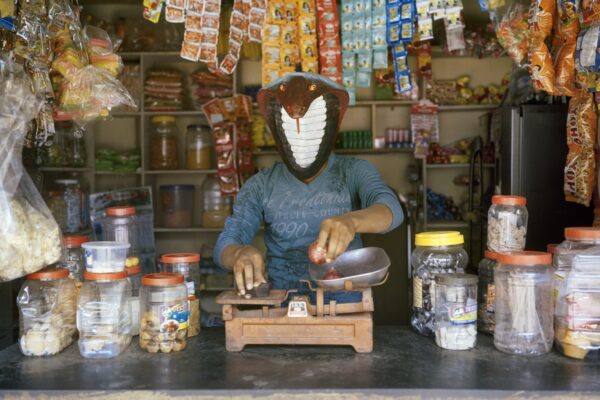
A photograph from Gauri Gill: Acts of Appearance, Edition Patrick Frey, 2nd edition, 2023.
The series also moves fluidly across time, bringing past and present into proximity, allowing ritual and everyday life to coexist without clear separation. The masks, grounded in centuries-old practices, inhabit contemporary domestic spaces, suggesting continuity rather than rupture. The photograph captures not just a moment but an intersection of custom, reflection, and experience, emphasizing continuity as lived social structure.
Gill’s work is shaped by a dense visual language in which light, composition, and texture are not secondary elements but stand as active components of meaning. The relationship between viewer and image becomes less about observation and more about attunement — a slow, deliberate noticing of how meaning emerges. This attunement is ethical rather than purely aesthetic, since the images are produced within long-term relationships of trust and collaboration that replace extractive modes of looking. It is not a politically declarative practice; it operates through relational and procedural forms of politics embedded in everyday life.
Whites, ochers, deep wood tones, and textured fabrics establish the book’s visual cadence. Nothing feels incidental; even the smallest detail — a metallic reflection, a partially seen hand — carries a certain weight.
The book’s sequencing encourages movement between images, allowing resonances and contrasts to emerge slowly. Certain details linger longer than others: a reflection on metal, the precise angle of a hand, the interrupted line of a foot. These moments act as quiet points of entry into the work’s broader structure.
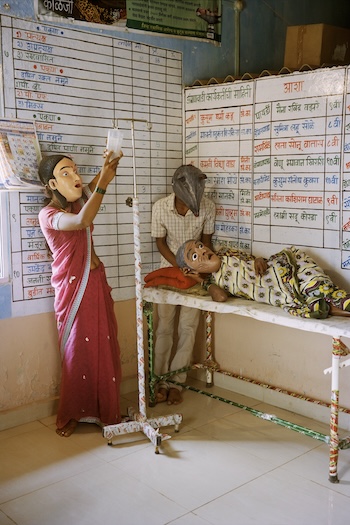
A photograph from Gauri Gill: Acts of Appearance, Edition Patrick Frey, 2nd edition, 2023.
Gill’s practice also resonates with established theoretical frameworks around performance, identity, and power. Rather than illustrating these ideas directly, the work allows them to surface organically. Her vision resonates with concepts explored by Foucault, Goffman, and Barthes. Her aesthetic approach aligns with that of artists such as Cindy Sherman, Zanele Muholi, Ralph Eugene Meatyard, Graciela Iturbide, Rineke Dijkstra, and Dawoud Bey, but differs fundamentally in its embeddedness within a living ritual community where authorship is distributed and participatory rather than individual and representational — a distinction that shifts the work from reference to participation.
Ethics runs through Acts of Appearance at every level, a sense that representation should not be extractive but shared, shaped through participation, not only passive observation. Each image functions as a gesture of reciprocity, part of a larger process of meaning-making rooted in co-presence.
At times, the relief-like quality of the images seems to suspend time itself, visually fusing, for a moment, ritual and contemporary life. Photography becomes an act of encounter, revealing the everyday as a form of narrative performance. The tension between what is visible and what remains hidden opens up a broader political and expressive field, where interpretation and heritage remain closely intertwined. The relationship between viewer and subject becomes dialogical, while each image holds its own quiet autonomy, with political meaning emerging indirectly through the reconfiguration of authorship, visibility, and participation rather than through explicit commentary.
A further anthropological reading would spotlight the mask as a cultural and social mediator. In performance-based traditions, the mask does not conceal identity; it makes power (or its potential) visible, articulating vital ties between individuals, communities, and the sacred. Within codified systems of meaning, the masked face becomes a shared vehicle of symbolic systems, genealogy, and collective reference, reshaping the relationship between individual and group. In Acts of Appearance, papier-mâché masks and sculptural forms act as points of co-creation: each gesture is mediated through its figurative sign. The mask also acquires a quasi-noumenal dimension, suggesting meanings that extend beyond the conventional, transforming the prosaic into a layered field of possible interpretations.
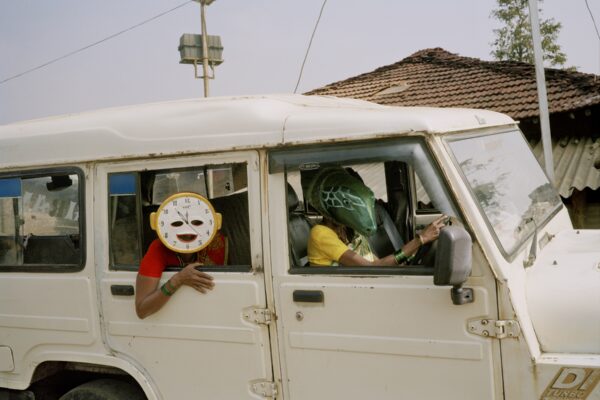
A photograph from Gauri Gill: Acts of Appearance, Edition Patrick Frey, 2nd edition, 2023.
Engaging with Acts of Appearance means entering a reflective, conceptual terrain. Gill’s photography encourages attentiveness, urging viewers to look beyond surface appearance and toward deeper human resonance. At a time when images risk becoming testimony or decoration, her work insists on photography as a space of care, vision, connection —a bridge between local tradition and global discourse where “memory” is replaced by lived continuity and shared practice of presence.
Each photograph becomes a demand to pay attention: the serious viewer must grapple with complexity, resonance, and narrative fragments. Gill turns visibility into a shared instrument of reflection, showing how photography can be at once precise and open, grounded and expansive — an instrument for sustaining a dialogue between lived experience and broader cultural memory.
Editor’s Note: This is an edited version of the initial posted review.
Margherita Artoni is a contemporary art critic and curator working between Italy and the United States. She began her career collaborating with Flash Art and currently writes for Segno, Juliet, Artribune, Exibart, Inside Art, ArteIN, part of cult(ure), The Arts Fuse, and Whitehot Magazine.
She has directed galleries in Turin — including NEOCHROME and EDGE Art Space — and in New York at TEAM Gallery. Her curatorial work has included exhibition programs with international artists such as Rashid Johnson, Theaster Gates, Ali Banisadr, Angel Otero, Tim Rollins & K.O.S., Laura Owens, and Mika Tajima.