Poetry Review: “Other Paths for Shahrazad” — Poetic Voices That Bleed and Live
By Jim Kates
Jennifer Jean’s bilingual collection reveals how contemporary Arab women poets redefine storytelling, identity, and survival.
Other Paths for Shahrazad: An Arabic/English Anthology of Contemporary Poetry by Arab Women Edited by Jennifer Jean. Tupelo Press, 203 pages, $29.95.
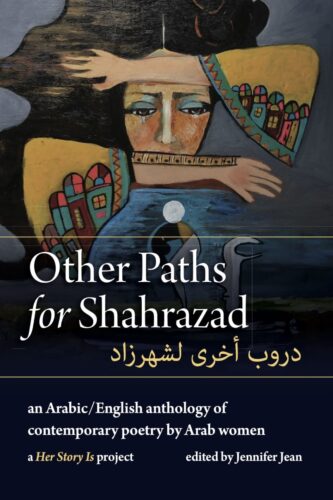
The best anthologies are introductions. You don’t know what you’re getting into. If you’re like most of us in this country, you are very much in need of an introduction to Arabic culture in general, Arabic literature more specifically, and Arabic women’s literature, most urgently.
Other Paths for Shahrazad was conceived by the Her Story Is collective, which is dedicated to “expanding linguistic, artistic, and cultural boundaries in response to global conflict and its aftermath,” according to editor Jennifer Jean’s preface. The volume was assembled as a conversation “between 78 poems by 40 women poets from 11 Arab nations in the first quarter of the 21st century.” Jean calls it “a house where these women can be heard.” Of course, all literature is a conversation, one writer with another, all writers with their readers, but not many collections set this up explicitly.
Other Paths for Shahrazad takes its title from a legendary storyteller of Persian and Arabian provenance. But we might find the true ancestor of these poems in Enheduanna, the Akkadian priestess-princess, the first writer in known history to set her name to a poem, 4,000 years ago. (See “Words after Enheduanna,” by the Syrian Canadian poet Jackleen Hanna Salam.) In any case, the line is long and the tradition is broad.
What is most notable about Other Paths for Shahrazad is not its different voices and individual poems, but the process the editor and translators challenge us to participate in — to accept these poems as invitations to walk these other paths ourselves. “Reader,” Jean urges, “if you find poems here that you love — share them. As well, if you are a translator, consider retranslating these poems and seeking publication when possible.”
One of the few drawbacks of the informality of this approach is that the poets are not indexed. That means it is not easy to return to a particular voice once you have heard it. You have to keep your own notes. That might mean you have to keep leafing back among other poems you may not have paid as much attention to before. It’s a smart strategy, but frustrating if you want to get to know the work of one particular, favored poet at a time.
The women of these poems are eager and insistent to speak for themselves. An index of first lines would be a litany of first-person singular pronouns. The range goes from the intimate, such as in “The Loss,” by Nesrin Ekram Khoury, from Syria, translated by Abeer Abdulkareem and Martha Collins:
At the end of the 28th day
She cries again
Watering her loss as if it were a flower
Keeping its thorns deep in her heart
While blood flows nearby
To the political, in the “Manifesto of Voice and Scalpel,” by Dima Mahmod, from Egypt, translated by Mohamed Hassan and Jennifer Jean:
Teach them how a woman melts the voice of evolution in a heart,
And how a woman becomes the heart of the revolution in a voice.
What is consistent is the emphasis on a perspective framed by gender and gender roles. Omaina Abd Shafy, from Egypt, translated by Mohamed Hassan and Jennifer Jean, recounts:
The doctor asked politely, “Why do you put up with pain?”
And, for a moment, I considered denial.
Because I know myself, know I don’t tolerate any agony.
But I decided to shut up.
I also know pain is a woman’s forever friend.
What we call daily living, men call awful endurance!
Most often, these categories are not separate, but interwoven and, often enough, inter-wounded. There are also notes of community, triumph, and celebration, as in “The Musician and the Sparrow” by Khawla Jasim Anahi, from Iraq, translated by Abeer Abdulkareem and Dzvinia Orlowsky:
— Let’s agree, my friend:
You teach me to sing
And I’ll gift you with freedom
— How about you just play?
And I’ll be the one to teach you freedom
Prison is of your own making
Those with wings fly even in cages
The poems talk back and forth to one another throughout Other Paths from Shahrazad, creating the community they want to extend to their readers.
What may get lost here are the differences among the national environments the women come from or live in. Is it the same being an Arabic-speaking woman in Egypt as it is in Syria? Or are we to accept this single “Arabic” culture as more than a linguistic unity? These are questions that can be answered only after we have read more of these poets, when we begin to sort them out along their individual paths. Meanwhile, it is inevitable to return to common references across national boundaries. (The Lebanese singer Fairuz, to whom I was first introduced decades ago by a Syrian friend, is mentioned in one poem from Egypt, and another from Saudi Arabia.)
This brings us back to the beginning: Other Paths for Shahrazad is an introduction to a journey, not a terminal.
Let me end with the same poet I began with, Jackleen Hanna Salam, translated by Amir Al-Azraki and the editor: “I stab silence a thousand times again and again. / I revive it and do not kill it completely. / Within its folds lie my inner thoughts, / some frozen while others bleed onto paper.”
The poems in this collection bleed — and live.
J. Kates is a poet, feature journalist, and reviewer, literary translator, and the president and co-director of Zephyr Press, a nonprofit press that focuses on contemporary works in translation from Russia, Eastern Europe, and Asia. His latest book of poetry is Places of Permanent Shade (Accents Publishing) and his newest translation is Sixty Years Selected Poems: 1957-2017, the works of the Russian poet Mikhail Yeryomin.
Tagged: "Other Paths from Shahrazad", Arab Women, Arabic/English Anthology of Contemporary Poetry, Jennifer Jean