Book Review: Rene Karabash’s “She Who Remains” — A Balkan Tale of Gender, Law, and Survival
By David Mehegan
However well or ill this smoldering novel works, it is undeniably compelling, with an ending neither tragic nor happy.
She Who Remains by Rene Karabash. Translated, from the Bulgarian, by Izidora Angel. Sandorf Passage. Paper. 146 pp. $18.95.
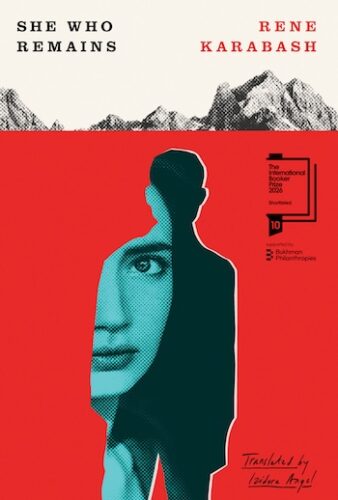 Published in Bulgaria in 2018, this unsettling short novel has been translated into several European languages and now appears in English by Sandorf Passage, a Maine-based nonprofit imprint of Sandorf, of Zagreb, Croatia. Sandorf specializes in fiction from Balkan countries. She Who Remains sold well in Europe before translation. Last month, it was named one of six fiction finalists for the International Booker Prize for works translated into English.
The publisher calls it “a landmark Bulgarian queer novel.” I’m not sure what a queer novel is — are there straight novels? Perhaps “landmark” because fiction about gay people breaks a taboo in Bulgaria? To be sure, the story includes teenage female lovers and there is one indirect scene of intimacy, but sex per se is not the main focus of interest. The central theme is the grip of strange and cruel atavism on modern people. Some fall victim to it and some escape.
How is it “unsettling”? Because at times it is difficult to figure out what is going on, what is dreamlike and what is real. The narrative has a Faulknerian intensity, and its structural technique, while it serves the author’s desired atmosphere, does not reward hurried reading. I found myself repeatedly having to slow down, go back, to make sense of the action.
The protagonist is 17-year-old Bekija, who lives with her parents and younger brother, Sále, in a mountain village in northern Albania. Her father, Murash, a keeper of pigeons — it’s not clear how he supports the family—is a hypermasculine bully and fanatical devotee of a primitive rural legal code, the Kanun of Lekë Dukagjini, which appears to rule the region. Lekë Dukagjini was a 15th-century Albanian prince who codified the Kanun at a time when there was no effective government in the region.
The novel, set in the present, begins with two startling revelations in reverse order. First, a neighborhood man appears before Murash in his pomegranate grove, says, “My brother sends his regards,” and kills him with a gunshot. Second, Bekija invokes the right, sanctioned by the Kanun, to become a “sworn virgin,” a legal gender transformation entailing a vow of chastity, allowing a woman to claim all the rights and responsibilities of a man as long as she lives like one. The link between these events drives the story.
The Kanun is something like the Italian vendetta of rural Sicily and Corsica, regulating and formalizing rigid rules of honor and their inevitable consequence: blood feuds. While feuding has long been outlawed in Balkan countries, in the villages of this novel, surrounded by the Accursed Mountains (their actual name), the Kanun’s grip lingers like voodoo in rural Haiti or caste in parts of rural India. When Bekija, in whose voice the story is told, tells us, “out of all of us, the pigeons, me, my mother, and my brother, my father loved the Kanun most of all,” we foresee the nightmare that kills Murash and nearly his whole family.
In the first of bizarre events, Bekija’s mother had been pregnant with twins, a boy and a girl (it seems they had had access to modern intrauterine scans), but near to the time of birth, the male fetus is found mysteriously missing. Only the girl is born, and Murash, who of course, had wanted a son (girl babies seem to be bad news in this culture), is so outraged that he only begins to acknowledge his daughter when she becomes a sort of tomboy, craving her father’s approval. Indeed, she proves to be more outwardly masculine than Sále, born a year later, and becomes her father’s favorite. At one point she shoots a deer.
As an adolescent, Bekija meets and falls in love with beautiful Dahna, the visiting granddaughter of a neighbor. Unaware of this attraction, her father agrees to an arranged marriage between Bekija and Nemanja, a neighbor’s son. Neither his wife nor daughter have been consulted about the plan, nor did they have any say in it. Besides Bekija’s horrified feelings, there is a potentially fatal problem. Under the Kanun, after the wedding, the bride goes to her husband’s home with a bullet in the pocket of her wedding dress. If she is found not to be a virgin, the groom must immediately kill her with the bullet. (No, we’re not in Kansas anymore.)
For Bekija, and not only because of Dhana, the betrothal is a death sentence. So she avoids the marriage by invoking the Kanun’s provision for the sworn virgin and changes her name to Matija. Unfortunately for Murash, the breach of marriage contract also violates the Kanun. As a consequence, not only must a member of the jilted groom’s family kill a male member of the erstwhile bride’s family, but after he does so, the family must serve the killer a meal. Nemanja’s brother does the deed, and the brothers later appear for the meal. Bekija’s mother soon dies, apparently from grief and shock. From this point, the family feud must go on, male for male. It is interrupted when Sále rejects his fate and flees to Bulgaria. As a sworn virgin, Mekija/Matija is apparently safe.
Except for a series of quoted letters, the narrative mostly lacks punctuation (as in the quote from Bekija above) or conventional paragraphing, although there are many breaks and short lines, sometimes single words alone on lines. This is because, we learn eventually, Bekija is mysteriously illiterate and years later, at age 33, is telling the story to a journalist who comes to the village with a tape recorder, to interview what is thought to be the last living sworn virgin. In effect, we are not reading, but hearing. Bekija’s inability to read plays a central role (perhaps a bit too conveniently) in the resolution of the plot. The last shock is the explanation of what happened to the disappeared male twin.
The novel has a lurid, Grand Guignol atmosphere, shifting from narration to poetic incantation and back again. It is often not clear what is said and what is only thought. There are no quiet moments or conversations. The text is salted with obscure lyrics of songs, such as
“the eye of the water snake is a hook, my love
The eye of the water snake is an ear”
and proverbial expressions repeated over and over, such as,
“the lie is a worm”
and
“all desperately desired things materialize one way or another, inescapably”
However well or ill this smoldering novel works, it is undeniably compelling, with an ending neither tragic nor happy, but consistent in tone with all that has come before. If it is made into a movie and you go to see it, hang on to your seat.
David Mehegan, the former book editor of the Boston Globe, can be reached at [email protected].
Tagged: "She Who Remains", Balkan fiction, Izidora Angel, Rene Karabash