
Poetry Review: The Sound of Sighs Restored — A.M. Juster’s New “Canzoniere”
By Jim Kates
What may look at first like exercises in verbal acrobatics — closely rhymed sonnets, delicate madrigals, intricate sestinas — are simultaneously expressions of confessional, personal anguish.
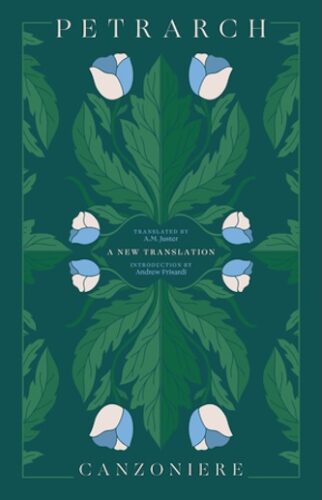
Petrarch: Canzoniere – A New Translation, translated by A.M. Juster, introduction by Andrew Frisardi. W.W. Norton, Liveright, 368 pages, $27
 Among Italian poets of the Renaissance, Petrarch’s immediate predecessor Dante has been done to death and resurrection in English translation, while other poets of significance and lyrical intensity have too often been slighted since Elizabethan times. But, for several centuries after his death in 1374, Petrarch’s influence was certainly far wider than Dante’s in European poetry, and that influence endures today, especially in contemporary sonnet traditions. In the spirit of Alfred North Whitehead’s dictum that all philosophy is a series of footnotes to Plato, it can also be said that all Western poetry is a series of conversations with Petrarch.
What may look at first like exercises in verbal acrobatics — closely rhymed sonnets, delicate madrigals, intricate sestinas — are simultaneously expressions of confessional, personal anguish.
My lucky breaks, a life that has been happy,
the incandescent days, the tranquil nights,
the gentle sighing, and the pleasant way
that frequently resounds in verse and rhymes,
transformed abruptly into grief and weeping
to make me hate my life and yearn for death.
Until now, my go-to reference for Petrarch’s Canzionere has been Mark Musa’s well-annotated bilingual edition. A.M. Juster’s elegant new presentation of these poems does not include the original texts, but it is significant that he does keep the Italian title, Canzionere, a word that means “songbook.” Petrarch himself felt bound in deep and significant ways to his Latin antecedents and surroundings, yet he chose a supple and contemporary Italian for his own poetry — which was largely written in France — establishing a specifically Italian identity that has driven the more general European significance of the poet.
The Canzoniere, a collection of 366 separate poems (one for each day of the year, perhaps specifically including a leap-day) is both a continuation of received forms and tropes from Classical and medieval traditions and a reshaping of those into a unified spiritual narrative defined by time and plot. The assemblage is far more than a compilation. Petrarch worked and reworked the sonnets, sestinas, canzone, and madrigals several times over 40 years to create the story he wanted to tell. Andrew Frisardi’s introduction to Juster’s translation encourages the reader to pay attention to the narrative, as we do in reading Dante, rather than simply picking and choosing among the individual poems. The overarching story is one of love, loss, and religious transformation.
As the story goes, the Florentine born Francesco Petrarca fell in love with a young woman named Laura (of whom we know nothing but what the poet writes) in Avignon, where he was living around the Papal court, on April 6, 1327. That date, actual or contrived by the poet, is the anniversary of the Crucifixion, and that event takes on increasing significance after the Plague of 1348, Laura’s real or fictional death, and Petrarch’s final turn to a more consecrated love:
Through you I could be living joyously,
O Mary, if at prayer,
sweet, pious Virgin, where
sin grew and grace now grows abundantly.
As knees of my imagination bend,
I plead with you to guide
me and provide wrong routes a better end.
Cogent and fluid as this narrative is, not all of the 366 poems are equally compelling (we might be grateful that Shakespeare stopped his sonnet collection at 150). A modern reader, plowing straight through the volume, can be forgiven for becoming occasionally impatient. Juster’s consistently high skill in his translations goes a long way toward holding our interest.
In these degenerate days, when we relegate formal verse to the margins of what we choose to call poetry, Juster’s commitment to Petrarch’s virtuosity in rhyme and meter is a challenge he rises to comfortably. He justifies his approach to deft and flexible English in his brief translator’s note.
Comparisons in translation can be useful, or invidious. Here are three translations of number 106 in the Canzoniere, a madrigal (Nova angeletta), one unrhymed and two with a looser suggestion of rhyming. The versions illuminate the lightness of Petrarch’s touch, show different possible interpretations, and highlight Juster’s own choice.
First, A. S. Kline’s unrhymed:
A new young angel carried by her wings
descended from the sky to the green bank,
there where I passed, alone, to my destiny,
When she saw I was without companion,
or guard, she stretched a noose, woven of silk,
the grass, with which the way was turfed.
Then I was captured: and later it did not displease me,
so sweet a light issued from her eyes.
My own loosely rhymed:
A novice angel winged her way on down
from heaven to the open riverbank
where I, by chance, was walking all alone,
and, seeing me without a friend or guard,
she set a springnet, woven out of silk,
hidden in the greenery of my road.
Then I was snared, but not unwillingly,
so sweet the glow her eyes bestowed on me.
And finally, Juster’s full formal:
On nimble wings a new small angel glided
down from Heaven to the bracing shore
where all alone, with just my fate, I’d pass.
Because she saw me friendless and unguided,
she made a silky loop for me and bore
it to a verdant path upon the grass,
then I was caught, and did not agonize,
for such sweet light was pouring from her eyes.
I leave the reader to admire Juster’s achievement, and to follow its full extent in this new songbook of Petrarch’s. “To you who hear within these bits of rhyme the sound of sighs” — Petrarch’s songbook provides a libretto of love from the 14th century to the present.
J. Kates is a poet, feature journalist, and reviewer, literary translator, and the president and co-director of Zephyr Press, a nonprofit press that focuses on contemporary works in translation from Russia, Eastern Europe, and Asia. His latest book of poetry is Places of Permanent Shade (Accents Publishing) and his newest translation is Sixty Years Selected Poems: 1957-2017, the works of the Russian poet Mikhail Yeryomin.