Film Review: Dancing at the Edge of War — The Haunting Allegory of “Sirāt”
By Tim Jackson
Sirāt is a heart-stopping, surreal reflection of our contemporary moment.
Sirāt, directed by Óliver Laxe. Screening at the Coolidge Corner Theatre on March 5.
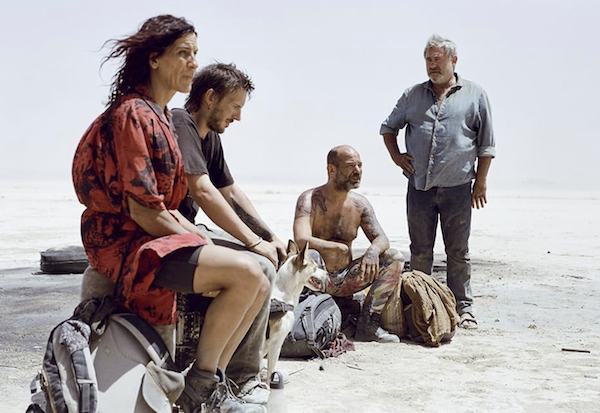
A scene from Sirāt. Photo: Neon
Produced by Pedro Almodóvar and his brother Agustín, Sirāt opens on an undisclosed stretch of the Moroccan desert. We see workers with rough hands stack and then align towering walls of speakers. Switches are flicked; a synthesizer hums to life. The camera surveys empty hills, cliffs, and distant mountain ranges. An electronic bass drum begins to pulse — slow, insistent — and suddenly the frame fills with hundreds of young bodies, all gyrating to this single, relentless rhythm. The effect is hypnotic. The wordless frenzy lulls even the viewers into a trance. On the rave’s edge, Luis (Sergi Lòpez), his son Esteban (Bruno Núñez Arjona), and their dog, Pipa, move through the crowd, showing a photo of Luis’s missing daughter.
The music continues through the night, as lasers slice the sky, creating an extended, mesmerizing sequence. A motley group of ravers, played by untrained actors discovered by director Óliver Laxe at festivals and concerts — known only by their first names — emerge as the film’s focus. The arresting presence of this visually striking ragtag group of amateurs — Stefania Gadda, Joshua Liam Henderson, Richard “Bigui” Bellamy, Tonin Janvier, and Jade Oukid — serves as a powerful anchor for the narrative.
Seemingly without warning, and for reasons never fully explained, a unit of soldiers descends on the throng. Their abrupt arrival is followed by the declaration of a “state of emergency.” An order is proclaimed over loudspeakers: all EU citizens are to board vehicles and evacuate immediately. The rave collapses into confusion: the music dies and the crowd fractures into a frenzied caravan of mismatched vehicles, snaking onto the exit road. The small band of ravers escapes the line in their two battered vans, determined to find the next gathering — there is another rave somewhere, they believe, either through rumor or faith.
Luis hesitates, then follows the questers, urged on by his son, who hopes that at the next rave he will find the missing girl. The group of ravers warns Luis that his car can’t handle the terrain. The journey will be long and dangerous. Heightening the risk: radio broadcasts announce that the country is at war, though we are not told which other country it is fighting or for what purpose. United by danger and uncertainty, mutual friendships form. Tonin entertains the boy with a puppet show starring the actual stump of his missing leg. In real life, this one-legged actor is a French festival performer. “Bigui” is missing an arm. Jade becomes a kind of punk mother figure to what turns into a bizarre surrogate family. The boy, Estaban, is the first to develop some real friendships. “They’re awesome,” he says to Luis. The group begins to share food, stories, and rave music while navigating the narrow mountain passes toward the open desert.
The journey turns increasingly hallucinatory as the desert heat begins to wear the travelers down. As they come across bombed-out military equipment, a growing sense of dread builds. Where are they? Where are they headed? To escape the mounting panic, they drop psilocybin, turn on speakers, and dance madly on the open sand. The search for Luis’s missing daughter or for any rave begins to look like a delusion. And then things go wrong — very, very wrong.
According to Mohamed Ghali Guissi, a psychologist at Al Akhawayn University, these raves are known for their intoxicating sense of freedom, occasions where young people feel they are not being judged and are comfortable expressing themselves with the aid of drugs. Substances such as MDMA deepen the liberating connection between the music and the people. Laxe uses that sense of release to provide a stark contrast to the coming travails.
The film has been compared to the 1953 French thriller Wages of Fear. But Sirāt is more than an adventure; it is symbolic and metaphorical. Sirāt (or al-Sirāt) refers to a bridge — “thinner than a razor, sharper than a sword” — that must be crossed on the Day of Judgment. A journey through hostile landscapes is often a moral wager for the innocent or nonaligned — a razor-thin balance between survival and oblivion. The caravan may represent a kind of global existential predicament — displaced people whose lives are shaped by circumstance, rather than choice. Refugees, migrants, victims of ethnic or tribal conflict, these groups face daily an uncertain fate. They are often treated as if they were invisible, or worse, expendable.
How can art, theater, and poetry responsibly deal with the brutal realities faced by displaced and marginalized people? At the very minimum, suffering demands recognition, witness, and response. The most difficult parts of this film are shockingly visceral — at times, viewers are left gasping. Sirāt‘s final shot brings the narrative’s grisly central metaphor into stark focus: the current churn of political and military violence is not a worrisome abstraction — as it is to the privileged — but a lethal reality that must be endured by traumatized millions. Laxe underlines humankind’s agony: Sirāt is a heart-stopping, surreal allegory of our contemporary moment.
Tim Jackson was an assistant professor of Digital Film and Video for 20 years. His music career in Boston began in the 1970s and includes some 20 groups, recordings, national and international tours, and contributions to film soundtracks. He studied theater and English as an undergraduate, and has also worked helter-skelter as an actor and member of SAG and AFTRA since the 1980s. He has directed four feature documentaries: Chaos and Order: Making American Theater, which is about the American Repertory Theater; Radical Jesters, which profiles the practices of 11 interventionist artists and agit-prop performance groups; When Things Go Wrong: The Robin Lane Story, and Marblehead Morning: Daring & Stahl: 50 Years in Harmony. He has made two short films as well: Joan Walsh Anglund: Life in Story and Poem and The American Gurner. He is a member of the Boston Society of Film Critics. You can read more of his work on his substack.