
Doc Talk: The 2026 Oscar Nominated Shorts — Documentaries Look at a World of Pain
By Peter Keough
For a piercing reflection of the times, turn to the Oscars’ Best Documentary categories, in particular, the Best Documentary Shorts.
2026 Oscar Nominated Shorts: Documentary. At the Coolidge Corner Theatre, Brookline, beginning February 27.
With films like One Battle After Another, Bugonia, and The Secret Agent among this year’s Best Picture nominees, the Oscars have done a so-so job reflecting our current, dismal political realities. For a more acute reflection of the times, one must go to the Best Documentary categories, in particular the Best Documentary Shorts.
In almost all of these nominees, the world seen is one of hypocrisy, injustice, unholy war, and tortured and murdered children.
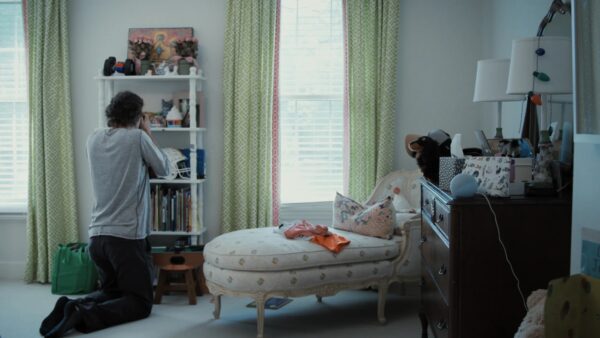
A scene from All The Empty Rooms. Photo: Netflix
One that hits particularly close to home (though apparently not close enough to bring about any change) is Joshua Seftel’s eloquent All the Empty Rooms. In it, he accompanies CBS News correspondent Steve Hartman and photographer Lou Bopp as they visit the bedrooms of children slain in school shootings. Hartman had been the network’s go-to guy for feel-good spins on the latest massacre. But then he started becoming numb, and perceived that the nation was becoming numb, and decided that another approach was needed. It was time, he thought, to confront the void of grief and wasted potential that the killings left behind, the vacancy embodied by the empty bedrooms of the victims. They visit four families, all of whom have left the rooms as they were when the children left for school and never returned. In one case, even the dirty laundry has been left untouched, so the scent of the child who was lost is retained. It is a ritual that offers some solace and overwhelms with its pathos.
But there is no anger. Who is to blame for this needless suffering? Seftel’s film says nothing about this. Nor, perhaps, does it need to. “The point … is not to have to say much,” says Hartman. “I wish … all Americans could stand in those bedrooms for a few minutes. It would be a different America.” The film ends with the names of the four children profiled, and over two hundred others who have died since the Columbine High School shooting in 1999.
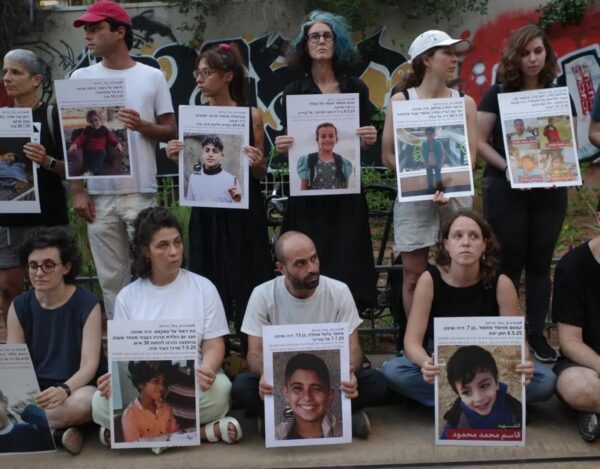
A scene from Children No More: “Were and Are Gone”. Photo: Medalia Productions
In Hilla Medalia’s restrained, slow-building Children No More: “Were and Are Gone” Tel Aviv activists perform a similar ritual for Palestinian children killed by the Israeli armed forces in Gaza. They track down the names and circumstances of the week’s victims, find photos of them, and create posters that demonstrators hold in a candle-lit silent vigil. They are instructed not to respond to any hostility: the hope is that, by showing people the faces, names, and details of the dead, they will reconsider the violence that is being done in their name. “We want people to recognize that something dark is going on,” an organizer explains, “and it goes against the principles of humanity and of Judaism.” To help avoid violent confrontations they have coordinated with the ongoing demonstrations by the families of the hostages from the October 7, 2023 Hamas massacre of Israelis that started the conflict. Emboldened, they decided to put on a demonstration on their own.
It did not go well. As they stood mute with their signs and candles, instead of awakening the consciences of passersby, they stirred a defensive rage erupting into insults and threats. Fearing violence, the organizers ordered the demonstration to disband.
Around 20,000 children have been killed in Gaza by Israeli forces since the outbreak of hostilities, with over a hundred killed after the ceasefire that was declared last October.
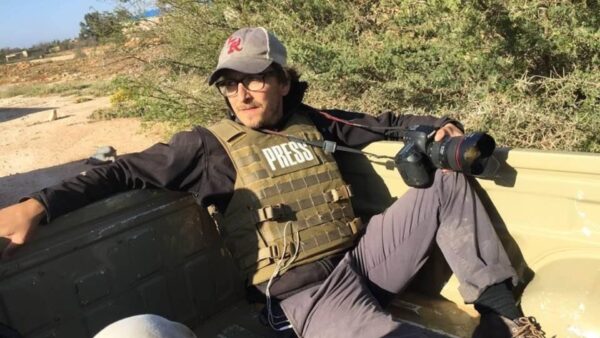
A scene from Armed Only with a Camera: The Life and Death of Brent Renaud. Photo: HBO
In Craig and Brent Renaud’s elegiacal Armed Only with a Camera: The Life and Death of Brent Renaud, the photojournalist of the title, embedded with the Arkansas National Guard during the Iraq War, visits the mother of a little boy killed by US bombs. She shows him the child’s trousers, torn and bloodstained, and weeps. “They say they don’t kill civilians. Look at the blood! Look!”
Renaud’s mission in life was to look at the things people didn’t want to see and what governments didn’t want to be seen. He has shot images of violence and misery in war zones and disaster areas in Iraq, Afghanistan, Central America, Haiti, Somalia, and finally in Ukraine, where on March 13, 2022 he was murdered by the invading Russian soldiers. Renaud’s distraught brother Craig, his constant collaborator over the years, photographs Brent’s mangled body in its casket. Why are you doing this? he is asked. “Because I know this is what Brent would be doing,” he says.
The film cuts from images of Renaud’s career to the aftermath of his shooting and the memorial services. It notes how his death added to a growing demographic of the slaughtered — journalists. He was the first foreign reporter killed in Ukraine and, in its epilogue, the film notes, “Since Brent’s death more than one hundred journalists have been killed every year. Journalism has become one of the world’s most dangerous professions.”
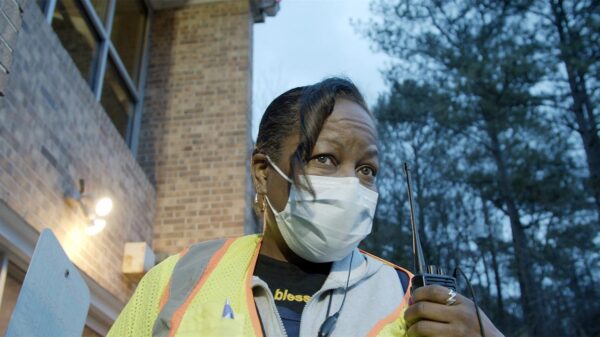
A scene from The Devil Is Busy. Photo: DocNYC
Ironically, many of those who are indifferent to the slaughter of children in US schools and around the world would not hesitate to kill those involved in the legal abortions of six-week-old fetuses. They would target people like Tracii, the head of security at woman’s health clinic in Atlanta, subject of Christalyn Hampton and Geeta Gandbhir’s tense and pointed The Devil Is Busy. Located in the deep South, it’s one of the few such facilities that has survived the post-Roe, antichoice Draconian legislation. Clients drive seven hours and more for appointments. A devout, middle-aged Black woman, Tracii starts her day at 6 a.m. checking all the rooms for someone who might have snuck in with a gun and ill-intent. While doing so she says prayers for herself, her co-workers, the clients, and even the anti-abortion activists already gathering outside.
“That sounds like Doug Jason,” she says about one inescapably loud demonstrator. She’s especially disgusted by Jason because he has the temerity to conflate his antichoice propaganda with the Black Lives Matter movement, claiming that abortion is genocide against Black babies. Tracii has confronted Jason before about his own hypocrisy, pointing out that he had served a prison sentence for trying to burn down a Black church.
“Don’t let the devil get in your spirit,” she counsels the women hustled from the parking lot into the building who are subjected to this abuse. “He’s a man, he’s a human just like you are. And at the end of the day God gets the final say.”
Other members of the staff are engaged in their duties. The call center operator must give the bad news to a client who is just over six weeks pregnant — too late for an abortion according to the Georgia law (most women are not aware they are pregnant this early). She suggests other clinics in Florida with less stringent guidelines. Says the sonogram technician, “I never thought I would have more rights 25 years ago than my daughter has now.”
“My biggest fear,” says the clinic doctor, “is what will they attack next? Contraception? Plan B? What other things will they go after that will further limit our reproductive autonomy?”
“The devil is busy out there,” concludes Tracii at the end of the day, as she secures the clinic and says a prayer thanking God for keeping them safe. For now.
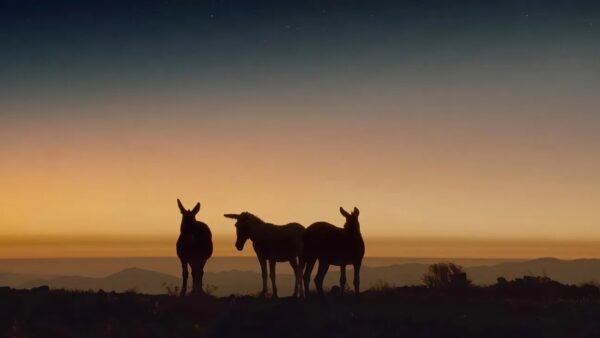
A scene from Perfectly a Strangeness. Photo: Nicolas Canniccioni/Premium Films/Courtesy Everett Collection
No children were hurt during the making of Alison McAlpine’s Perfectly a Strangeness. Nor any animals either, though it features three donkeys roaming through what had been described in the Cannes Film Festival summary as “an abandoned astronomical observatory” set “in the dazzling incandescence of an unknown desert.” In fact, though, it is a very much functioning facility, the La Silla Observatory in Chile’s remote Atacama Desert, which had been the starting point for Patricio Guzmán’s masterpiece Nostalgia for the Light (2010).
In a way it is a relief that, unlike Guzmán, McAlpine does not reflect on how, in addition to being an ideal location for observing the universe, the desert also was the site of the notorious Chacabuco concentration camp, which housed some of the thousands imprisoned and murdered during the Pinochet regime. Instead, McAlpine follows her hooved subjects as they tour the uncanny-looking facilities, empty of humans, but still maintaining its arcane operations, oblivious of the visitors. It is like an episode of the TV series Life After People, suggesting, perhaps, that the only solution to man’s inhumanity is a world without humans.
Peter Keough writes about film and other topics and has contributed to numerous publications. He had been the film editor of the Boston Phoenix from 1989 to its demise in 2013 and has edited three books on film, including Kathryn Bigelow: Interviews (University Press of Mississippi, 2013) and For Kids of All Ages: The National Society of Film Critics on Children’s Movies (Rowman & Littlefield, 2019).
Tagged: "All the Empty Rooms", "Armed Only with a Camera: The Life and Death of Brent Renaud", "Perfectly a Strangeness", Alison McAlpine, Children No More: "Were and Are Gone", Christalyn Hampton, Craig and Brent Renaud, Geeta Gandbhir, Hilla Medalia
“We have become a child-killing nation. The kindest way to put this is to say that we have become a society of people who cannot prevent our own children from being killed in their classrooms or in other gathering places and who do not much mind the killing of other people’s children by weapons of war that we have made and assigned to that purpose. Sooner or later, we will have to ask how we can so disvalue the lives of other people’s children without, by the same willingness, disvaluing the lives of our own.” — Wendell Berry, Against Killing Children, 2024.