
Concert Review: Joy and Virtuosity Meet in “In the Fiddler’s House” at Symphony Hall
By Robert Israel
Overall, the In the Fiddler’s House concert captured the infectious joy of this wondrous musical genre.
In the Fiddler’s House, Itzhak Perlman with Brave Old World and Klezmer Conservatory Band, Hankus Netsky, music director. Presented by Vivo Performing Arts, Symphony Hall, Boston, on February 15.
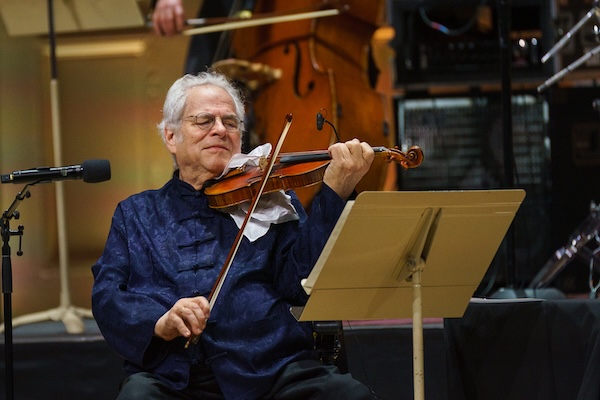
The titular violinist performing in the Vivo Performing Arts presentation of Itzhak Perlman: In the Fiddler’s House. Photo: Robert Torres
Hankus Netsky — the lanky bandleader, New England Conservatory professor, Burt Bacharach body double, pianist, and saxophonist — welcomed the near-capacity audience at Symphony Hall by informing us that we were seated in a “simcha (happy occasion) palace.” It is the first time I’ve heard Symphony Hall described this way, and the claim mostly held true, with a 12-member band that performed selections culled from a vast canon of Jewish music that they had lumped under the general heading of klezmer music.
Seated in the center of the stage was violinist and octogenarian Itzhak Perlman. Now sporting a totally white mane, Perlman is ageless. He has lost none of his creative force. He did not perform a tune many have come to identify with him — John Williams’s Schindler’s List theme. (I heard him perform it in 1997 at Symphony Hall, accompanied by the Boston Symphony Orchestra.) But he more than made up for the missing selection — it simply wouldn’t have fit into the theme of the night — with a virtuosic delivery of other tunes.
Instead, the audience was treated to what Netsky told us was music for a Jewish wedding. The players kicked into a rousing rendition of Mekhuteneste Mayne (Wedding Medley) that began slow and finished fast. The intent of the tune is to make the bride shed a few tears before she can claim her share of joy.
Most of the music had a similar resonance. The audience clapped along, hummed, and, at one point, joined arms, snaking their way through the aisles of the Hall as the band wailed away. But one selection — the liturgical Sholem Aleichem, dating from the 16th century — did not work. This tune is sung in the Jewish home upon returning from synagogue before one is seated for the Shabbat meal; it is solemn, prayerful, and mystical. “He will instruct his angels in your behalf,” the song informs us, “to guard you in all your ways, your going and your coming, from now and for all time.” I have derived inspiration from this song over many decades, but it felt completely out of place during this concert.
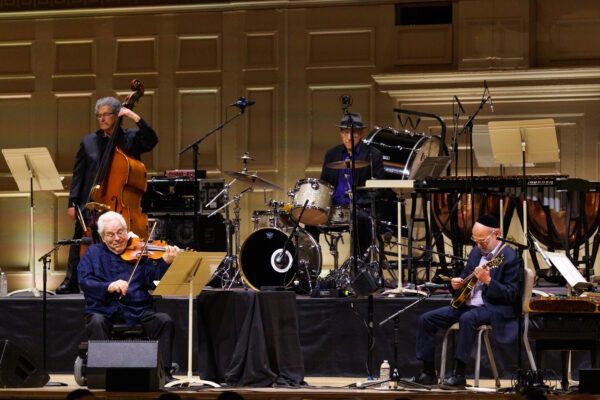
A look at the band performing in the Vivo Performing Arts presentation of Itzhak Perlman: In the Fiddler’s House. Photo: Robert Torres
It should also be noted that all of the performers were virtuosos, and that is not true to klezmer’s roots. The late Leo Rosten, in his indispensable The Joys of Yiddish, defines klezmorim (musicians) as unschooled players who created a musical genre using trumpets, bugles, flutes, clarinets, violins, and drums — anything they could get their hands on. They roamed Jewish settlements in Russia and Eastern Europe over a century ago in search of gigs. Rosten writes that they “rarely knew how to read music.” He adds, “What Jews could afford music lessons, and who in the shtetl (Jewish enclaves) would teach them?” Put another way: if, by a miracle, klezmorim time-traveled from then to now and were told they would be paid — at Boston’s resplendent Symphony Hall of all places! — they might exclaim: “What, are you mishugge (crazy)?”
Of course, given the loss of so many klezmer musicians in the Holocaust, the fact that we have this wondrous music at all is another miracle. The concert’s title paid homage to the megahit Broadway musical Fiddler on the Roof, which premiered in 1964, ran for over 3,000 performances, and was adapted from Yiddish writer/humorist Sholom Aleichem’s short stories.
There were many treats during the concert. Notable was Boston-based singer Judy Bressler, singing in flawless Yiddish and playing her tambourine, as well as the opportunity to marvel at the pious virtuosity of Andy Statman, who presented his own original composition and played clarinet and mandolin.
Missing from the Symphony Hall concert was a sample of how American culture popularized klezmer music, thanks to influencers George and Ira Gershwin, Irving Berlin, Benny Goodman, and the Andrews Sisters, among others. I was hoping to hear a rousing version of Bay Mir Bistu Sheyn — now ensconced in the Great American Songbook — but it was not included.
But my critical comments are minor. Overall, the Fiddler’s House concert captured the infectious joy of this wondrous musical genre.
Robert Israel, an Arts Fuse contributor since 2013, can be reached at [email protected]
Tagged: Andy Statman, Brave Old World, Hankus Netsky, Itzhak Perlman, Judy Bressler, klezmer
1 Comment
Leave a Comment
Sadly, you can hear the same exact pieces on their album and at their concert 30 yrs prior. But Andy Statman came through with his own composition. I wish there was more spontaneity, they way klezmer was and can be.