
Dance Review: Trisha Brown Dance Company — Elegance, Wit, and Enduring Innovation
By Debra Cash
The question was how well these mid-20th-century works would hold up and how, with the passing of time, those dances would look to both familiar and fresh eyes.
Trisha Brown Dance Company, presented by Vivo Performing Arts at Boston Arts Academy, February 13-14.
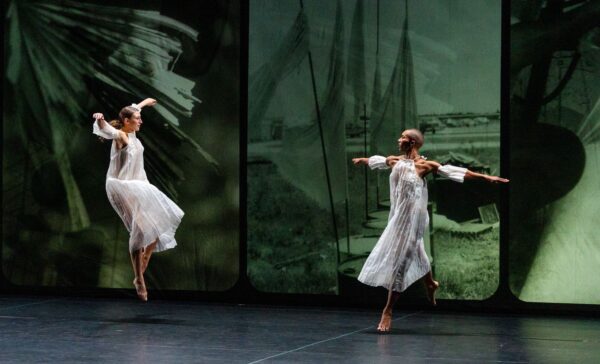
Ashley Merker (l) and Catherine Kirk in Trisha Brown Dance Company’s Glacial Decoy. Photo: Robert Torres for Vivo
She climbed horizontally up the walls of the Whitney Museum, signaled across SoHo rooftops, and told a meandering story while pursuing an errant hitchhiker’s thumb. But by the late 1970s and early 1980s, postmodern choreographer Trisha Brown had left the task-based and site-specific dances and vernacular movement of her early rebellions for the complexities of the proscenium.
Brown, who died in 2017, built all of her choreographies out of a sense of her own luxuriant movement impulses, a language that was thrown out and reeled in over and over.
This past weekend, Vivo (the recently rebranded Boston presenter formerly known as the Celebrity Series) brought three selections of Brown’s repertory back to town, performed by the company caretaking her legacy. The question was how well these mid-20th-century works would hold up and how, with the passing of time, those dances would look to both familiar and fresh eyes.
Glacial Decoy (1979), which opened the program, was Brown’s first collaboration with her friend, artist Robert Rauschenberg, who had met her in the early 1960s while he was Merce Cunningham’s stage manager, lighting designer, and sometimes set designer, and they were both taking Robert Dunn’s composition classes. (Rauschenberg would go on to chair the Trisha Brown Company’s board of directors.) Brown and Rauschenberg each had a taste for the overlooked, the detritus of daily life, finding beauty in eccentric juxtapositions. Rauschenberg is quoted as having said, “I think a painting is more like the real world if it’s made out of the real world.” Their deceptively thrown-together, lackadaisical styles mask astonishing aesthetic rigor.
As Glacial Decoy opens, a series of black-and-white Rauschenberg photos scroll by in disappearing and reappearing glimpses, left to right: a bicycle seat, a dock, water jugs, a cow. (The witty final image is a railroad crossing sign marked RR — Robert Rauschenberg claiming authorship in his composition.) The dancers, in fluted, transparent white dresses with angelic detached Renaissance sleeves (Rauschenberg designed the costumes, too), look like caryatids off their pedestals and out for a stroll. They keep their parallel placements, but nuanced motion bubbles up, somehow both molten and cool. By the time the dancers in the second duet — Catherine Kirk and Ashley Merker — appeared, I thought to myself “this is how it’s done”: Brown’s noodling and precise flow, her unhinged shoulder and tipping bird swing, had been transferred miraculously to their bodies.
What doesn’t come across in Glacial Decoy is what was, in 1979, a glorious trick of stagecraft. During a unison duet, a third dancer emerges from the wings in complete synchrony, making it look as if there might be an infinite series of dancers doing the same motion just out of sight. This year, that additive aha! was barely noticeable: it has melted into common contemporary dance language.
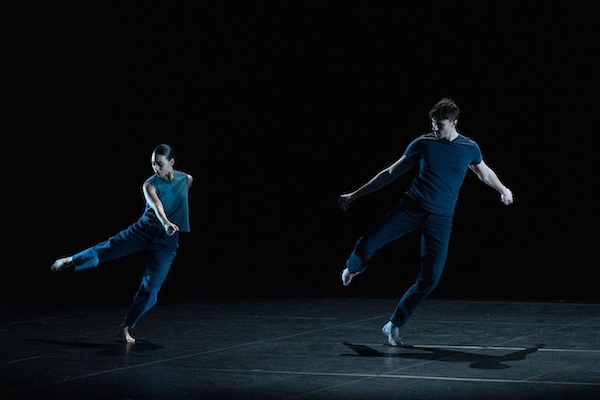
Jennifer Payan (l) and Patrick Needham in Trisha Brown Dance Company’s Rogues. Photo: Robert Torres for Vivo
Rogues (2011) was new to me: a brief duet of paired pendulums danced with delicious neutrality by Patrick Needham and Jennifer Payan. (Rogues was originally danced by two men: Brown didn’t include men in her company until 1979, when she brought in Stephen Petronio, and works that she made for her company — beyond the works created for operas and other narrative projects — remained resolutely ungendered.) Dressed in worker blues and moving against Alvin Curran’s score of twittering flute and bleating harmonica, the dancers let their elbows lead and swing their limbs freely, their torsos opening and closing to the air like swinging doors on a summer afternoon.
I was lucky enough to have caught the world premiere of Son of Gone Fishin’ at the Brooklyn Academy of Music in 1981, Brown’s first work to a full musical score, Robert Ashley’s opera Atalanta (Acts of God). At the time, she told New York Times critic Jennifer Dunning that the title was pretty random: she just wanted to create a story that would hold space for her audience’s imagining. Nonetheless, the green and blues of the costumes that bleed into the saturated colors of the cyc lighting (replacing the original backdrops by minimalist painter Donald Judd) lend the piece a lambent, lakeside sensibility.
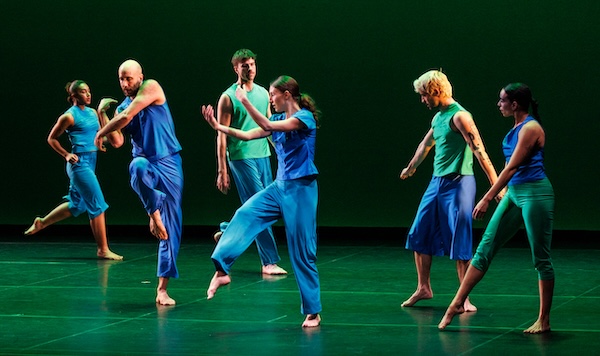
The Trisha Brown Dance Company in Son of Gone Fishin’. Photo: Robert Torres
Brown’s idiosyncratic gestural assemblage has a larger community in tow, so the focus in Son of Gone Fishin’ turns to the subsets of foreground and background, forward and reverse directionality (those wonderful backward prances!), and recurrence, so that a hand flick or one person leaning backwards against a hastily and temporarily assembled group reads like a repeated word used in different sentences. Structured as a “diabolical” palindrome, the dance has six dancers until its final minute when a new dancer pops up unexpectedly as if to say “enough already!”
For me, one night of dances by Trisha Brown could never be enough.
Debra Cash is a Founding Contributor to the Arts Fuse and a member of its Board. She wrote about the premiere of Son of Gone Fishin’ for the now defunct Saturday Review.
1 Comment
Leave a Comment

What a lovely luscious review!