
Film Festival Reviews: Persian Gulf
By Peter Keough
In secret and in exile, the power of cinema prevails at the Boston Festival of Films from Iran.
The Boston Festival of Films from Iran. At the Museum of Fine Arts Boston, through February 22.
Although operating under a regime that has recently murdered thousands protesting its legitimacy, Iranian cinema has for decades turned out some of the world’s most challenging, artful, and profound films.
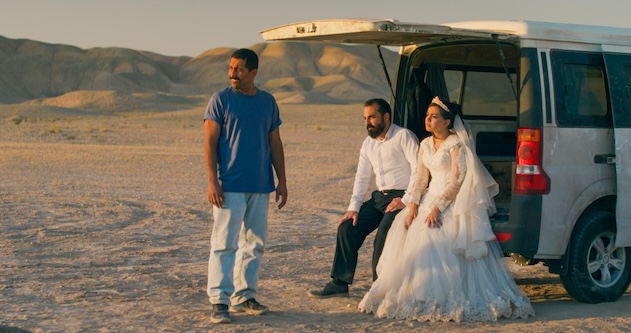
A scene from Jafar Panahi’s It Was Just an Accident. Photo: NYFF
This year’s Boston Festival of Films from Iran features masterpieces by two of the country’s most eminent auteurs. In the late Abbas Kiarostami’s Taste of Cherry (1997; screens February 8 at 2 p.m.) a troubled man drives through the desert with plans to commit suicide. In the outlawed Jafar Panahi’s Oscar-nominated It Was Just an Accident (2025; screens February 22 at 2 p.m.) a troubled man drives through the desert with plans to murder the suspected police torturer he has tied up and hidden in his van. The two films bookend nearly three decades of despair and rage endured by this tormented nation.
Some hope glimmers in Mohammadreza Eyni and Sara Khaki’s compelling, Oscar-nominated documentary Cutting Through Rocks (2025; screens February 1 at 2 p.m.). Off and on for seven years, the US-based Iranian filmmakers embedded themselves in a remote village where they covered the life of Sara Shahverdi. A leather-clad, motorbike-riding former midwife, she doesn’t take shit from men, learned to ride and stand up for herself from her late father, and ran for the local council and won. Once in office she brings improvements to the town’s infrastructure and stands up for the rights of women and especially young girls – some of whom are married off as young as 11 or 12 to wealthy men.
Despite her initial success and popularity, the entrenched traditional elders, seen puffing hookahs in the tea shop and grumbling their atavistic, chauvinist nastiness, begin to resist, especially as Shahverdi’s reforms affect them financially. When they attack, it is through a familiar strategy – launching baseless accusations and smears about her identity and morality.
In addition to their compelling, intimate access to this drama, the filmmakers also have an eye for eloquent metaphors, such as the two trees that Shahverdi’s father planted for her, solitary sentinels in a vacant desert space, to which she returns for comfort in both winter and spring. The film is inspiring but also dispiriting, a glimpse into a malignant society that’s not far removed from our own.
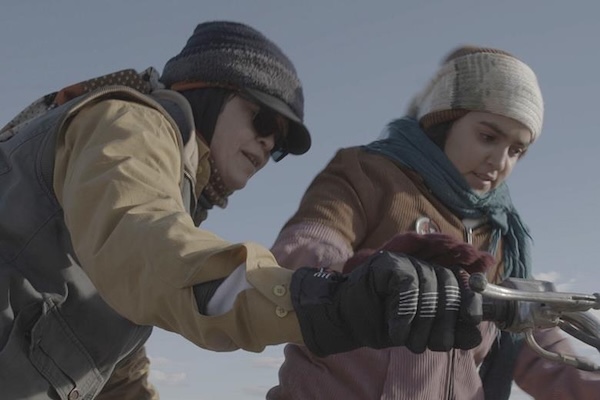
A scene from Mohammadreza Eyni and Sara Khaki’s Cutting Through Rocks. Photo: NYFF
Like Panahi’s It Was Just an Accident, Cutting Through Rocks was shot, if not secretly, at least without any official government permission. On one occasion the filmmakers were detained, questioned, and their production was shut down. MFA film programmer Katherine Irving informed me that the complications of shooting a film in Iran are increased by having women in it. Government censorship (depicting women without headscarves will get you arrested, for example) is so severe that some filmmakers will forego having any female characters at all.
Such is the case with Aliyar Rasti’s The Great Yawn of History (2024; screens February 7 at 2:30 p.m.) in which two mismatched men – middle-aged, devout loser Beytollah and young, apostate orphan Shoja – travel the remote regions of Iran in a desperate search for gold coins in a cave that Beytollah saw in a dream. A woman does make a brief appearance in the film, properly garbed, who tells Shoja that Beytollah is exploiting him and that he should work for her. He declines, and continues to follow the flawed patriarch anyway in their dubious quest. A Beckett-like buddy movie reminiscent of Turkish auteur Yılmaz Güney’s Hope (1970), Rasti’s impressive debut feature is an investigation into the unholy link between social injustice, delusion, and faith.
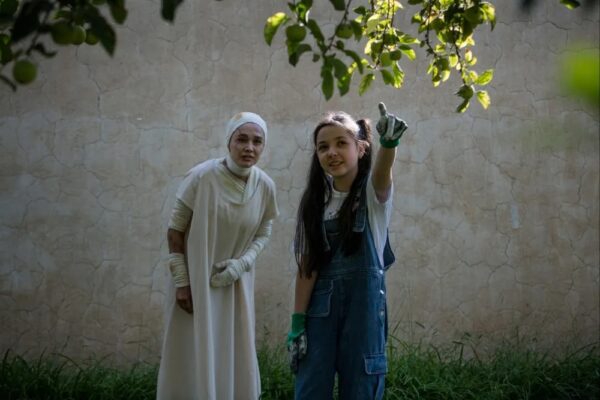
A scene from Shahram Mokri’s Black Rabbit, White Rabbit. Photo: Raoofeh Rostami
Another alternative for Iranian filmmakers seeking to avoid censorship is to shoot in another country altogether. Shahram Mokri took his production of the brilliant and enigmatic meta-movie Black Rabbit, White Rabbit (2025; screens February 6 at 7 p.m.) to nearby Tajikistan, where he was free to include women without fetishistic constraints. Ironically, one of the female characters is first seen bandaged head to toe – she is the protagonist of one of the films-within-a-film, a self-reflexive motif common to Kiarostami and Panahi but here taken to giddying, M.C. Escher–like extremes. The movie evokes Borges in its narrative structure and motifs and it rivals the opening of Robert Altman’s The Player (1992) with its bravura single-shot takes. As the film’s imagery grows increasingly surreal and magical-realistic, the story climaxes with a young woman escaping from a giant burqa, a metaphor, perhaps, for a triumph over theocratic patriarchy.
Alireza Khatami originally planned to shoot The Things You Kill (2025; screens February 5 at 7 p.m.) in his native Iran, but that quickly proved impractical. He moved it to Turkey; he satirized the whole misadventure in another 2025 film, Divine Comedy, which he shot covertly in Tehran. Things likely riled the censors, not just because of its costuming choices, but its critique of patriarchal authority, which is put across with a twist, both narrative and thematic. Ali, a young academic teaching a course on translation (a metaphor that proves significant in what follows), has suspicions when his invalid mother dies in an apparent accident. Was his abusive father responsible? Adding to his stress, this loss occurs when his own manhood is threatened: the university plans to terminate his position, and Ali has discovered that he is infertile — unable to have children.
So he tends to his arid patch of desert landscape outside of town until a mysterious stranger, the rootless and aggressive Reza, arrives from out of nowhere and signs on as Ali’s assistant gardener. Inspired by Reza, Ali sheds his namby-pamby ways and grows more assertive in confronting his father’s potential guilt. But, in doing so, is he becoming like his father himself?
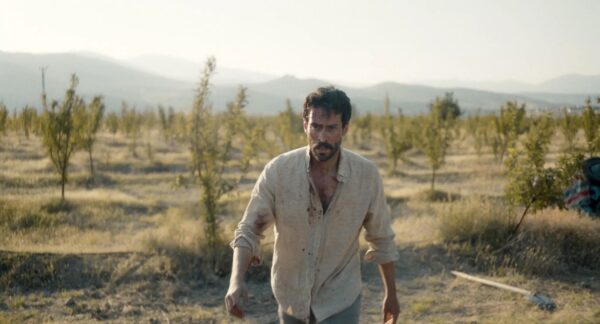
A scene from Alireza Khatami’s The Things You Kill. Photo: Cineverse
Khatami makes a bold but miscalculated choice halfway through the film – like many Iranian directors, he challenges not only social and political conventions but cinematic ones as well. The film also evokes It Was Just an Accident and Taste of Cherry with its recurring image of a vehicle driving through the desert and culminates, like the Panahi film, with the enigmatic return of the repressed.
Unfortunately, though Khatami’s female characters are not constricted by head coverings and burqas, they are still bound to male authority. Ali’s wife clings to him, despite his behavior, in hopes of bearing his child. His sisters rationalize and enable their father’s brutality. Khatami has explained that his intention in the film was not to explore the impact of patriarchal tyranny and toxic masculinity on women, but to focus instead on the lesser-known generational toll suffered by men. Admittedly, they are victims as well – but also the chief beneficiaries.
Meanwhile, the carnage continues in Iran with untold thousands butchered. But not just the scale of the violence is different now. Previous demonstrations have sprung from outrage at Iran’s oppression of women, as symbolized by the imposition of the veil, but, according to a recent article in the Guardian that cause has been shelved. Instead, a movement to install Reza Pahlavi, the deposed former Shah’s son, as leader of the nation seems to be motivating the movement. How tragic would it be if decades of blood, suffering, sacrifice, and courage ended with the return of an older, secular version of the same patriarchal tyranny.
Peter Keough writes about film and other topics and has contributed to numerous publications. He had been the film editor of the Boston Phoenix from 1989 to its demise in 2013 and has edited three books on film, including Kathryn Bigelow: Interviews (University Press of Mississippi, 2013) and For Kids of All Ages: The National Society of Film Critics on Children’s Movies (Rowman & Littlefield, 2019).
Tagged: "Black Rabbit White Rabbit", "Cutting through Rocks", "It Was Just an Accident", "The Great Yawn of History", "The Things You Kill", Alireza Khatami, Aliyar Rasti, Boston Festival of Films from Iran, Jafar Panahi