Book Review: Medicine, Morality, and the Women of “The Double Standard Sporting House”
By Clea Simon
For those ready to make the investment, The Double Standard Sporting House is a fascinating look inside a complex and compelling world.
The Double Standard Sporting House by Nancy Bernhard. She Writes Press, 328 pp., $17.99
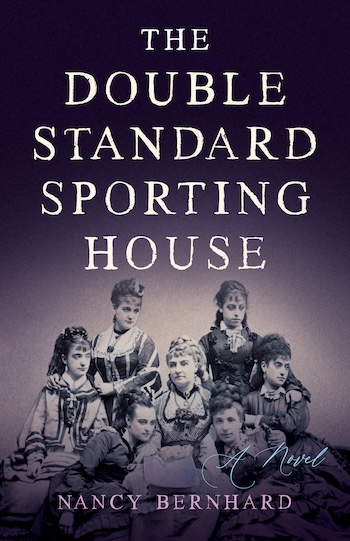 Should groundbreaking healthcare remain in the shadows if coming out endangers both the work and the patients who rely on it? That’s the question at the heart of The Double Standard Sporting House, the debut novel by Somerville resident Nancy Bernhard, which centers on a pioneering female doctor treating women, primarily sex workers, in the maelstrom of post-Civil War New York City.
Part mystery, part historical fiction, The Double Standard Sporting House focuses on the one place where everyone who matters in 1868 gathers: a high-end brothel in Manhattan. Tammany Hall functionaries (who run the city), financial giants like “Diamond Jim” Fisk, and traumatized Civil War veterans all meet in Nell “Doc” Hastings’ “house,” the Double Standard, which also houses Doc’s clinic. One of the few of its kind dedicated to treating women, her infirmary uses evidence-based science on everything from venereal diseases to pregnancy, including contraception.
Basing her practice in the brothel means that Hastings not only is of service to a very needy group. It also puts her and her practice in a delicate situation. Although her well-wishers and backers, including at least one upper-class wife and mother, urge her to go public, Hastings knows that to do so would be to risk losing the house that not only supports her work but also shelters her patients and nursing students – and gives her staff of “harlots” (her preferred term) a relatively safe place to ply their trade.
“Brothels turned out to be my best venue for the free practice of medicine,” she explains. “[T]he stick in the eye to respectability sometimes a sadness and sometimes a bonus.”
What kicks this complex and well-researched book off is the arrival of a new patient: a 16-year-old who has been brutally raped, sustaining internal injuries from the insertion of some kind of blade in her vagina. Although the young woman, Vivie, is in and out of consciousness and has been drugged with laudanum, Hastings soon extracts from her that she was abducted from her wealthy and upper-class white family by slavers who routinely sell their young female captives to various less discerning brothels. This embroils Hastings in a search for the slaver, who apparently kidnapped Vivie to fulfill a specific order for a “special virgin.” This effort further endangers Hastings’ already fraught relations with the powers that run the city.
This investigation drives the story, even as Hastings navigates a power shift in Tammany Hall. While she struggles against the “strangleholds of femininity,” the protagonist subtly manipulates the house’s clientele and eventually ventures out to find the slaver, risking not only Doc’s practice but ultimately her life.
Hastings’ attempt to solve the mystery is threaded through the everyday (or every night) events of the house, both the sexual doings and the Doc’s medical practice. Descriptions of her treatments are well founded in early medicine, if not always effective: “We used a jelly bolus with boric acid as a preventative for syphilis,” she notes, adding that with the more common treatment of mercury “the benefits hardly outweighed the risks.”
Much of Doc’s care comes down to basic advice, much of it drawn from her own history, which sneaks in through italicized asides. “You can still be a strong young woman who once lived through something terrible, and take your revenge with a full and happy life,” she tells Vivie, advice that could be read as anachronistic or timeless.
Other deliberations reveal her to be both intelligent and observant. “The differences between race and sex always reminded me of the differences between chronic disease and acute injury,” she muses. “Each could be endlessly debilitating or intermittently life-threatening in their distinct and intertwined way.”
This all makes for a fascinating look at a changing world, and it is centered on a very sympathetic and knowledgeable protagonist. The problem with Hastings’ role in the novel, however, springs from the character traits Bernhard has given her: a teacher as well as a medical practitioner, Hastings repeatedly restates her core belief that sex work is the only truly viable form of self-support for poor or unmarried women. (“Do you suppose regulators ever consider how hunger weighs in a girl’s choice of the life?” is one of her shorter reiterations.) Those repetitions, paired with her detailed takes on everyone around her, tend to bog down the text.
That said, Bernhard writes wonderfully about sex, with both a refreshing clarity and directness, although the very occasional misstep (such as the “unequivocal quake of desire [that] ransacked my groin”) interrupts the flow. Also, Hastings is an appealing heroine, caring and clear-eyed about the dangers that are facing her patients. At times, however, Doc’s circumspection about her own history carries over to her narration, making it read as overly clinical rather than personal. And, while the author writes with authority about the political battles of the time, it may not have been necessary for her to go so deep into the civic machinations. The result is an engaging, but occasionally slow read. For those ready to make the investment, The Double Standard Sporting House is a fascinating look inside a complex and compelling world.
Bernhard will celebrate the book’s release on Tuesday, Jan. 20, at 7 p.m. at Belmont Books.
Clea Simon is a Somerville resident whose latest novel is The Cat’s Eye Charm (Level Best Books).
Tagged: "The Double Standard Sporting House", NYC brothel, historical novel