
Film Review: “Dead Man’s Wire” – Getting Even Can Be Very Dark Fun
By Ed Symkus
When big business steps on a small man, watch out!
Dead Man’s Wire, written by Austin Kolodney, directed by Gus Van Sant. It is screening at the AMC Boston Common, Alamo Drafthouse Cinema, and AMC Assembly Row on January 16.
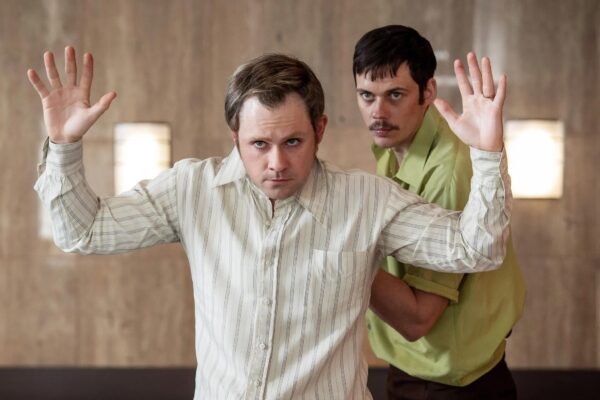
Bill Skarsgård, right, with Dacre Montgomery in Dead Man’s Wire. Photo: Row K Entertainment
There are always so many boxes to tick off after seeing a film in order to decide if it was a thumbs-up or thumbs-down experience, whether it was well worth your time or a waste of it.
Here’s how my list went with Dead Man’s Wire:
Was the acting, along with the ensemble work, praiseworthy? Check!
Did the story maintain interest? Check!
Was the writing and telling of that story clear and succinct? Check!
Was the direction inspired? Check!
Were the cinematography and sound design top-notch? Check!
Looking back on it, Dead Man’s Wire made for a rewarding visit to the cinema. But, even with all those positives, it wasn’t until a couple of revelations came along during the end credits that the deal was sealed.
Some background: For the past couple of decades, I’ve done my best to know very little about films before I watch them. I don’t do trailers. I don’t read actor or director interviews. I like being surprised. I like – pun intended – sitting in the dark. All I knew about Dead Man’s Wire was who directed it (Gus Van Sant) and the running time (105 minutes).
From the moment the protagonist, a fellow named Tony Kiritsis, was introduced in the opening moments, right up to the final frames, when his fate was disclosed, I intermittently wondered, “Who is playing this man in a manner effortlessly fluctuating from villainous to sympathetic to powerful to weak? Why, when it’s obvious that Tony was doing the wrong thing, am I rooting for him? Who is this almost-middle-aged actor pulling off this amazing feat, and why haven’t I seen him before?
Ah, but I have! Many times. He’s the Swedish actor Bill Skarsgård, and the man has an amazing range. Part of my recognition problem was that, in recent years, he’s worked under a great deal of makeup. He played Pennywise in the It franchise and Count Orlok in Nosferatu. But, hold on, he was also – sans makeup – the Marquis in John Wick: Chapter 4, Keith in Barbarian, and Boy in Boy Kills World. I didn’t realize he was the lead in Dead Man’s Wire until the end credits. So, yeah, he has range.
The other revelation was that I had been watching a (mostly) true story, one that occurred in Indianapolis in 1977. As often happens in relatively contemporary “based-on-fact” films these days, archival footage of the real people is shown in the end credits. It’s become a much-overused cinematic cliché, but, for some inexplicable reason, it plays in Dead Man’s Wire without a hitch, and the device adds a lot to the film’s emotional content.
So, without giving too much away, what is it that Tony does, what leads up to it, and what on earth is a dead man’s wire?
In the mid-1970s, Tony Kiritsis owned some land in Indianapolis, had an idea for real estate development, became involved with a loan through Meridian Mortgage, and ended up being screwed by them. After negotiation after negotiation were scuttled by Meridian, Tony came to the end of his rope, visited the Meridian offices, and demanded an audience with the company’s owner, M.L. Hall (Al Pacino). But he only managed to meet up with Hall’s son Richard (Dacre Montgomery), who was the company’s president. Tony – in tense, nervous mode – was carrying a long box that contained a pistol, a shotgun, and a contraption that would keep that shotgun aimed, very closely, at Richard’s head. It’s known as a dead man’s wire.
The film’s aforementioned strong points – acting, story, writing, directing – shape the tale of a kidnapping gone terribly wrong. Tony had demands in mind, among them financial compensation and a formal apology, none of which the Meridian owner – who Tony reaches by phone at his Florida vacation spot – is at all interested in granting.
In short order, word gets out concerning the goings-on at the loan company and the talk continues at Richard’s apartment, where Tony has brought him, still wired up. A popular, golden-throated radio personality (Colman Domingo) becomes involved, as do his listeners, along with an overly ambitious TV news crew, and a cop named Mike who knows Tony (another unrecognizable piece of acting, this one from Cary Elwes).
There’s plenty of plotting going on, but the power of the film rests on the fact that it’s an actors’ showcase, especially the complex portrait of Tony. Skarsgård’s characterization is fascinating: his Tony is angry and dangerous, yet remains calm, usually complimentary to others. He’s a likable guy who’s been placed in an impossible situation, helpless when his careful planning goes woefully wrong.
Dead Man’s Wire infuses a fast-moving narrative of ever-mounting tension and threats of violence with a darkly humorous edge. It also boasts a song-filled soundtrack for the ages, including “The Revolution Will not Be Televised” (Gil Scott-Heron), “Compared to What” (Roberta Flack), “Also Sprach Zarathustra” (Deodato), and “I’ve Seen all Good People” (Yes).
Notes that will help you enjoy the film more: Don’t Google Tony Kiritsis to find out how it ends. Don’t even watch the trailer.
Ed Symkus is a Boston native and Emerson College graduate. He went to Woodstock, has interviewed Gus Van Sant, Billy Crudup, Doris Wishman, and Wes Anderson, and has visited the Outer Hebrides, the Lofoten Islands, Anglesey, Mykonos, Nantucket, the Azores, Catalina, Kangaroo Island, Capri, and the Isle of Wight with his wife Lisa.
2 Comments
Leave a Comment

This is classic Symkus: gives a little but says a lot. I’m intrigued enough to find and watch this film.
As to your point about going in “dark” — it’s a good idea. In the recent documentary about The New Yorker, critic Richard Brody reveals that he does the same thing. I mean, really, who needs the predilections of others to shape our ideas before we have a chance to have them.
I was curious before. Now this is definitely on my “Must watch” list. Thanks, Ed!