Arts Commentary: From the Editor’s Desk — By Popular Demand, 2026
Back in February of 2024 I began to write a weekly column for the newsletter on Substack. A few readers have asked that I post these opinion pieces in the magazine.
Here is a selection of Favorite Columns of 2024
Here is a selection of Favorite Columns of 2025
Below is a selection of my top picks of 2026.
—Bill Marx, Editor-in-Chief
September 2, 2026
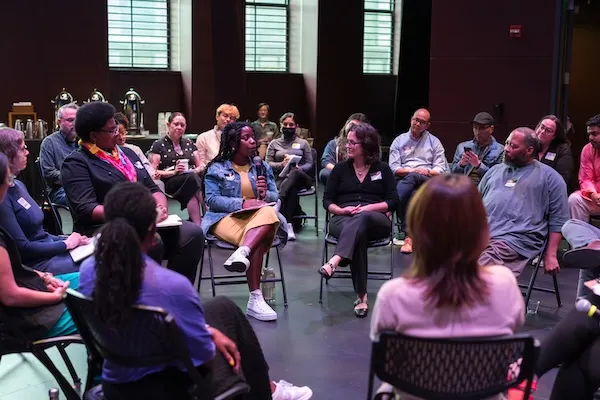
A 2024 Public Art for Public Good Convening. Photo: Christian Ruiz
An enthused shout-out—albeit with some pointed questions—for September 18’s Creative Labor: A Boston Cultural Policy Summit, co-produced by Boston Public Library and the Doris Duke Foundation. The confab will take place at the BPL and is billed as a discussion that will assert that “creative labor—the work of artists and cultural workers—is real labor, deserving of fair pay, stable conditions, and the same dignity and protections as work in any other sector. In collaboration with Arts Activate Boston, we aim to inform an equitable cultural labor policy for Boston and to make the case for creative labor as civic infrastructure.”
An afternoon session will “explore policies that impact wages, housing, healthcare costs, and/or working conditions for creatives, and give those in the room the opportunity to discuss and test out possible solutions.” To all of this I say: Hallelujah!
But as I look over the announcement and the event website, a crucial word is missing—one that should accompany any reference to creative-labor policy: unions. Isn’t strengthening these collectives—building membership and reinforcing their clout—part of what it means to “bring together coordinated activations across the U.S. to center artists in a national conversation about the future of artistic labor”?
Unions have been invited to attend and participate, but no representatives from organized labor in the local creative economy—the Boston Musicians’ Association, AFM Local 9-535, SAG-AFTRA New England Local, and UAW Local 2110, among them—are slated to appear on the panels. The morning talk will include Ali Noorani, president and CEO of the Barr Foundation, and Sam Gill, president and CEO of the Doris Duke Foundation, alongside Company One Theatre’s co-founders and leaders, Shawn LaCount and Summer L. Williams. The Greater Malden Asian American Community Coalition and Congruence Cultural Strategies are sponsoring the afternoon confab. The latter firm specializes in learning, strategic planning, facilitation, and research/evaluation—not labor organizing, collective bargaining, union representation, or labor law.
Is it really possible to talking about fighting for “fair pay, stable conditions, and the same dignity and protections as work in any other sector” without spotlighting, in some way, the experiences of union leaders and/or members? I am not sure.
Times are changing politically, partly in response to a reactionary national power grab. Cultural workers have been losing ground for decades, and they now see AI eroding their future earnings. They have grown impatient with the well-meaning lip service that wealthy and corporate interests pay to meeting workers’ demands. Economic power lies in the ability of members of an exploited class to band together for their common benefit. Those who care about fair treatment for creative labor should look for ways to shore up—and build on—union solidarity.
August 26, 2026
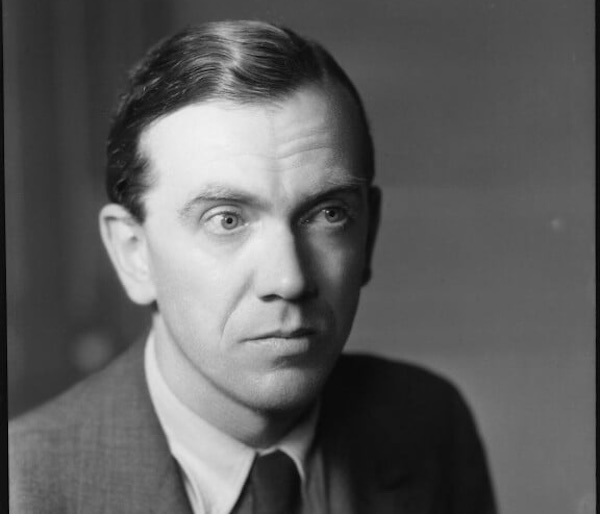
Film critic Graham Greene in 1939.
The Harvard Film Archive was closed over the summer months because of restoration activities at the Carpenter Center, but the facility has just opened, and it is starting off with a fine series — running through October 19 — entitled “The Cold Heart is More Precious Than Diamonds: The Cinema of Graham Greene.” The focus is on films based on the writer’s fiction, but his intersection with the movie world also took the form of criticism — from 1935 to 1940, he was the film critic for The Spectator and, for a short period, Night and Day, eventually publishing over 400 reviews. Greene was a fierce reviewer — incisive, unruly, and witty. For those not familiar with this aspect of his celluloid-adjacent career, it is well worth reading through the pieces collected in The Graham Greene Film Reader: Reviews, Essays, Interviews & Film Stories.
Some of Greene’s judgments hold up, such as his admiration of the films of John Ford. Others do not, particularly his puzzling disparagement of Alfred Hitchcock. For me, there is no question that Greene is wrong when he claims the Marx Brothers’ A Day at the Races is better than their A Night at the Opera. A strain of sexism runs throughout the reviews: Jean Harlow “totes her breasts like a man totes a gun.” But, as one contemporary admirer put it, Greene “can feel his subject more intimately than anyone else writing in England today. His criticism is that of a creative writer.”
That passion inevitably led Greene into the use of satire. The reviewer was tasked with ridiculing mediocrity—both its makers and those who enabled it to flourish. Greene put it this way: “This is to make a flank attack upon the reader, to persuade him to laugh at personalities, stories, ideas and methods that he has previously only taken for granted. We need to be rude, rude even to our fellow reviewers, but not in the plain downright way, which may help to kill a picture, but leaves its kind untouched. The cinema needs to be purged with laughter.”
Greene’s merciless mockery of the big studios’ sentimentality and sexual hypocrisy was prescient. In 1937, Hollywood moguls brought a libel suit against him and Night and Day, alleging that Greene’s review of Wee Willie Winkie implied that nine-year-old Shirley Temple was being sexually exploited. Greene had pointed to Temple’s “dubious coquetry” and suggested a “more secret and more adult” dimension to her appeal. The resulting settlement helped bring about the magazine’s demise. In an era before social media, it was a daring—and devastatingly mischievous—critique.
August 19, 2026

The Museum of Modern Renaissance at 115 College Avenue in Somerville. Photo: Museum of Modern Renaissance.
I want to underscore the splendidly iconoclastic value of the mission of artists Nicholas Shaplyko and Ekaterina Sorokina, the creators of the Museum of Modern Renaissance in Somerville, MA. As is evident in the photo above and in the article below, the museum is not merely a container for art; it is, itself, a work of art—a fact made urgent by the current campaign to preserve the 25-year-old project. It reflects the pair’s visionary belief that “art could be more than an object placed inside a room. It could become the room, the architecture, the atmosphere, and the life that unfolds within it.”
This conception of art as something that encloses and animates life, rather than remaining trapped within a discrete object, places their work in the tradition of William Blake, one of my favorite poets. For him, the prophetic artist labors to rebuild a damaged world; material construction is inseparable from spiritual and imaginative renewal. Shaplyko and Sorokina have not paid lip service to this notion of restoration, as many in the increasingly corporate-driven museum world have; they have acted on it, infusing their individual imaginations into every available nook and cranny of the building.
Like Blake’s illuminated books, the Museum of Modern Renaissance challenges standard cultural definitions of where art begins and ends. In the piece, the pair ask salient questions about the future of what they have created: “How does America recognize an independent artistic environment created outside conventional systems of commissioning, museum patronage, and institutional funding? How should a work be evaluated when the artists, the architecture, the archive, and the cultural life of the place have become inseparable?” Will our country set aside its ever-tightening “mind-forg’d manacles” and see this place for what it is: not simply a museum, but a living work of imagination? The fate of the Museum of Modern Renaissance may depend on the answer.
August 12, 2026
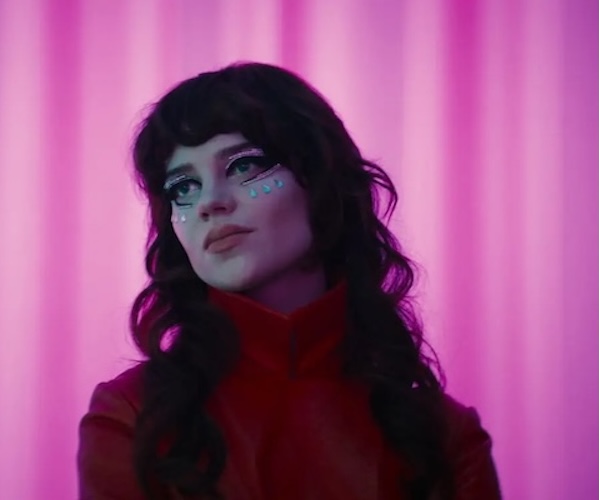
Elle (Sophie Thatcher) dreams of little lost girls, vengeful fathers, and giallo killers in Her Private Hell. Photo: Neon
Don’t let anyone tell you that arts coverage has become so anemic in our mainstream newspapers and magazines because it is too expensive to pay for. Features, reviews, and profiles about cultural doings from freelancers cost far less than what it takes to expense investigative journalism and beat reporting. I was a freelance arts writer for decades; I am now paying arts writers for this magazine. After 19 years, I can testify that reimbursing first-rate pieces on the arts will not break the bank. The truth is, The Boston Globe and other major newspapers and magazines could easily pay for more comprehensive cultural coverage. They choose not to do so, a decision that should raise alarms about how little our major media and society values arts and culture. It also goes a long way to explaining what many lament as the decline in the economic and civic infrastructure that supports sustained, in-person, professionally produced art. The signs of decay are all around us: the end of local criticism, the fragility of small venues and nonprofit companies, and lack of interest in arts education.
Every now and then, I highlight some of the recent, noteworthy films that the Boston Globe hasn’t bothered to review. (The Arts Fuse has critiqued a number of them.) Before I posted my earlier lists, I asked for a comment from the Globe arts editors. They have never responded. I will post any defense they have — if they ever send me one.
Silent Friend (foreign)
Kontinental 25 (foreign)
Last One For the Road (foreign)
Jinsei (foreign)
Mare’s Nest (indie)
CAMP (indie, woman director)
Couture (woman director, foreign)
Jackass: Best and Last (comedy/reality feature)
Romería (foreign, woman director)
Night Nurse (indie, woman director)
Summer Tour (doc, woman director — an interview, but no review)
Dead Souls (indie)
Her Private Hell (indie)
Wild Inside (woman director, doc)
Also—whether out of cost-cutting or indifference to expertise is besides the point—the Boston Globe recently dropped three knowledgeable writers from its weekly “The Ticket” feature, a selective, service-oriented guide to arts and events in Boston and nearby communities.
Over a number of years, Maura Johnston (pop), Kevin Lowenthal (jazz), and Stuart Munro (folk, world, and country) brought deep, beat-specific expertise to the roundup. They have largely been replaced by writers who appear to be interns. At the Globe, as in the Trump administration, knowing too much can get you canned.
August 5 2026
The Flamethrowers of AI
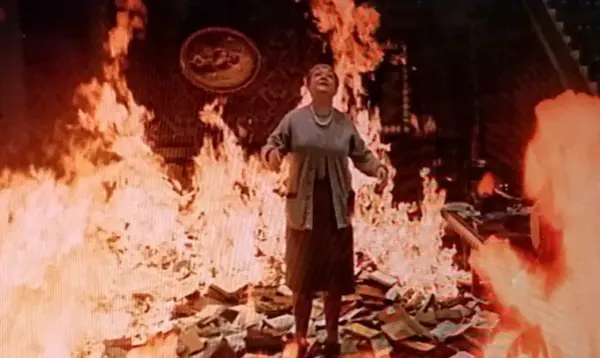
Human and “human-authored based knowledge” burning in 1966’s Fahrenheit 451.
It is impossible not to see some connections between conflagrations, physical and cultural, after recent reports that “AI companies are using intermediaries to acquire books at industrial scale anonymously. Companies specializing in bulk sourcing advertise their ability to locate hundreds of thousands of titles while promising confidentiality for AI clients, reflecting the sensitivity surrounding the practice.” AI giants explain that they are simply “racing to preserve human-authored knowledge before it is diluted by AI-generated text, often called ‘AI slop.’ Books published before the rise of generative AI in 2023 are especially valuable because they provide high-quality training data written entirely by humans.” The destruction of millions of volumes (“stripped apart, scanned into training datasets, and discarded”) is supposed to reassure investors of a lucrative future — by eradicating future AI slop, which many insist is unstoppable. The used-book business is already being negatively affected.
This summer, catastrophic fires are raging across forests in parts of Europe and the U.S., the fruits of the ongoing and ever-strengthening climate crisis. (In the U.S.: 5.15 million acres by August 3; in Europe: 434,976 hectares by July 29, about 1.07 million acres.) How many thousands of acres’ worth of books have been demolished by the flamethrowers of AI? No one can know for sure — for PR reasons, that information is being kept as a corporate secret. But it is clear that Anthropic and its paper-killing ilk are industrial-sized versions of the pyromaniac firemen in Ray Bradbury’s Fahrenheit 451. Some critics argue that AI is out to colonize human consciousness. Is it too much of a stretch to also see AI as the climate crisis for literacy? Over the centuries, books have shaped our capacity for abstract thinking. Will removing them leave nothing but scorched and barren inner landscapes?
As in Bradbury’s Fahrenheit 451, “human-authored knowledge” may be considered in decades to come as threatening authoritarian dominance, a menace to AI’s monopoly on thinking that big businesses might like minimized, perhaps even eliminated. I would like to believe that, when the novelist was working out his story’s conclusion, he had Jonathan Swift’s anthropomorphic belief in mind: “When I am reading a book, whether wise or silly, it seems to me to be alive and talking to me.” At one point in the novel, one of the “book people” says, “the most important single thing we had to pound into ourselves is that we were not important … We’re nothing more than dust jackets for the books, of no significance otherwise.” With the invasion of the blowtorches of AI and laws that criminalize librarians and booksellers, those who care for literacy must recognize their own significance and sound the alarm — to preserve and protect the voices of books.
July 29, 2026
Avalanches of AI Slop, Coming Right Up
We are at the beginning of what is likely to be a brief but volatile phase in the amour fou between AI, art, and criticism. Lines are being drawn even as the ground shifts beneath them. Confusion reigns. How much generative AI is too much in a creative work? When is AI a collaborator, and when is it effectively running the show? Will we be able to tell—and, if so, will we care? What percentage of machine assistance still allows a book or artwork to be accepted as human-made? And do critics have any clout in a debate that is going to shape the future of art? Will they even be invited to judge the mix? So far, they have been left out in the cold, partly because they don’t seem all that interested in the battle.
Meanwhile, scandals are forcing the issue. Mia Ballard was accused of using generative AI in her horror novel Shy Girl; she denied personally using it, but the controversy was enough for Hachette to pull the planned U.S. edition. The CBC reported that John Degen’s murder mystery Seldom Seen Road was among the first Canadian books to carry a small “Human Authored” label on its jacket, a sign of how quickly some — not all — publishers are moving to mark off human labor from machine mediation. Who would have guessed? “Human Authored” — the blurb.
According to Andrey Mir, in his provocative book The Technological Imperative, the crisis of discerning authenticity—human or memorex?—is not going to last long. AI is accelerating at such a supersonic pace that “everything created by humans will be refurbished … likely many times, into AI slop. Eventually, the share of original human-made content will decrease to an indistinguishable degree.” The outnumbered products of human-made material will be in competition with the tailored-to-be-consumable stuff from AI that will flood the market in biblical proportions.
Mir suggests that AI will shape culture, not the other way around. In the conflict between ease and difficulty, the comfort of access will win out every time. “At some point, choosing human over AI will involve too much friction,” he argues, “which does not suit the nature of frictionless digital consumption. Withdrawing from frictionless digital consumption is as hard as refusing to take soma in [Aldous] Huxley’s Brave New World; only iron-willed dissidents can do that.” Given that reasoning, humanity will likely find few defenders in America’s cultural-industrial complex, whose weak-kneed resistance to authoritarianism has only underscored how rarely the art world produces — or tolerates — genuine rebels.
July 22, 2026
A Locomotive in a Maze

John Hawkes. Photo: courtesy of Michael Ondaatje
John Hawkes (1925–1998) was a leading postwar American experimental writer, part of a generation that included William Gaddis, William H. Gass, John Barth, Donald Barthelme, Stanley Elkin, and Robert Coover. Their novels have largely faded from cultural consciousness, though Gass’s epic trip through the alternately ghastly/lyrical fulminations of a neo-Nazi in the heartland, 1995’s The Tunnel, has recently received welcome attention. The rap on these writers is that their focus on language came at the expense of conventional satisfactions—linear narrative, sympathetic characters, and clear moral framing. In a 1965 interview, Hawkes characterized the group’s common aesthetic: “a quality of coldness, detachment, a ruthless determination to face up to the enormities of ugliness and potential failure within ourselves and in the world around us, and to bring to this exposure a savage or saving comic spirit and the saving beauties of language … to expose, ridicule, attack, but always to create and to throw into new light our potential for violence and absurdity as well as for graceful action.”
Hawkes’s interest in dramatizing “our potential for violence and absurdity” attains prophetic force in his 1976 novel Travesty, a short, fierce dissection of diseased, self-destructive masculinity. The plot is elemental: a man who calls himself “Papa” drives like a demon at night through the South of France in a fancy sports car, delivering a smug, rambling monologue to his daughter, Chantal, and her lover, Henri. He invites them to speak, but they are usually panicked or sick once they learn that he intends to crash the car into a wall. As rain falls and the auto races through the streets, Papa describes some of the landscape as he speeds by, when he is not first articulating and then dismissing possible motives for his suicidal act: revenge for Henri’s affair with Papa’s wife, an onset of terrorist insanity, or a godlike gesture of control.
Five decades on, it is still difficult to find a more pitiless portrait of an aestheticized strain of toxic masculinity. (“I love the dark night,” says Papa, as he sketches the outside world for his passengers. “Through the thick green lens of the night I see only the brightest light.”) As literary monsters go, the narrator lacks the preternaturally charming chops of Humbert Humbert, but he presents a vivid portrait of a patriarchal ego awash in “privilege” (his word), prurient sexuality, and facile rationalizations that aid and abet amorality (“We are all secret encouragers of ignorance; at heart we are all willful barbarians.”). In Travesty, domination is caricatured as a “dead passion,” a nihilistic yearning for transcendence.
July 16, 2026
Idiot’s Delight
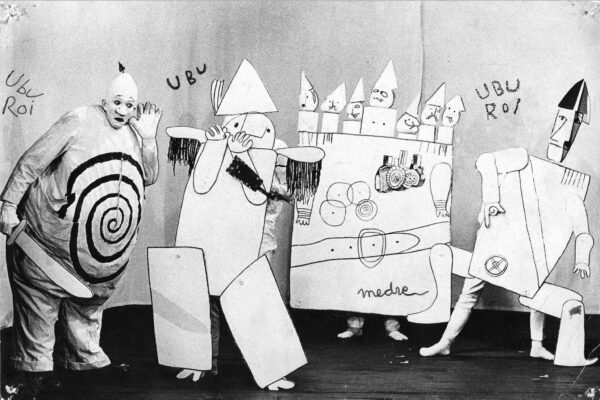
Père Ubu with soldiers. Michael Meschke’s production of Alfred Jarry’s Ubu Roi, 1964. Set design by Franciszka Themerson. Photo: Beata Bergström.
John Kelly, H.R. McMaster, Rex Tillerson, Gary Cohn, Reince Priebus, Steven Mnuchin, and Sam Nunberg are among those who have said Donald Trump is an idiot. But it is not the President alone; Trump’s virulent mindlessness has become normalized in international politics today. Where does the appeal of the unthinking come from? Leonhard Emmerling’s Idiots: The History of Homo Nullus (translated by Parnal Chirmuley) offers a fascinating history of the evolution of the idiot in the Western tradition, separating the figure from the buffoon, fool, madman, and jester.
Stretching from the Greeks and Paul in the New Testament to the punks and Andy Warhol, the book charts the historical transformations of a character who revels in nullification. For the Greeks, negation-gone-wild was a form of political critique. Cynics like Diogenes lived in a ceramic storage vessel because they were targeting social corruption. Saint Francis of Assisi renounced the delusions of the world for the sake of spiritual enlightenment. Over the centuries, the idiot remained an outsider, challenging our understanding of religious value as well as medical definitions of madness. Eventually, idiocy morphed into a more complex phenomenon—when was one playing at being an idiot, and when was one the real McCoy? Then, with the modern era, a purposeful lack of intelligence became a source of cultural clout: in contemporary art, radical purposelessness became a way, for some, to subvert the conventional. These gestures of nullity were often rewarded with fame and fortune.
It was only a matter of time before a dependence on pure intuition in the name of authenticity, along with a wholesale rejection of expertise, became political power. On the public scene today, according to Emmerling, the idiot “pursues his own interests, the provincial, small-minded know-it-all to whom education means nothing, but having an opinion means everything, and who, with his smartphone in front of his nose, blurts out his news masquerading as news into the digital world incessantly.”
I am proud to report that theater may have been the first to analyze the worship of inanity. For Emmerling, Alfred Jarry’s Ubu Roi presents a dramatic prototype of our current belief in the heroics of “idiocy.” His protagonist represents the ascendancy of grotesque, self-seeking nullity; he transforms ignorance and appetite into murderous public action. Jarry and his 1896 absurdist play were prophetic because they project, through zany comedy, how stupidity can be converted into a charismatic style that transcends exposure and scandal. Trump and his enablers are the descendants of Ubu Roi, “peddling their lack of aptitude, education, and expertise as a form of authenticity and authority.” One wishes Idiots was a funnier book about idiocy’s evolution — but it is about the transformation of ignorance into evil.
July 8, 2026
The Red Scare, Recycled
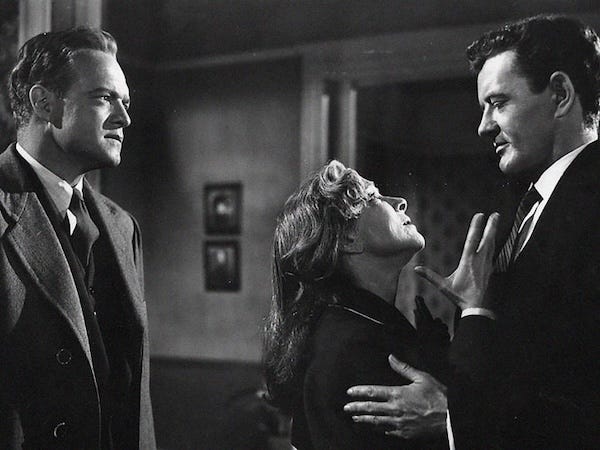
Van Heflin, Helen Hayes, and Robert Walker in a scene from the 1952 film My Son John.
With President Donald Trump recently insisting that communism is “the biggest threat to our nation there is, maybe since our founding,” and arguing that it poses a greater danger to the republic than World War I, World War II, Pearl Harbor, or 9/11—perhaps even all combined—it may be time to revisit the “scoundrel times” of the 1950s, when the Red Scare made its initial cultural impact. I have been reading Philip Roth’s 1998 novel I Married a Communist and am enjoying it; he aptly describes McCarthyism as “the first postwar flowering of the American unthinking.”
In what ways might artists respond to this invitation to enter a new era of national “unthinking”? The 1972 script Are You Now or Have You Ever Been draws on material from Eric Bentley’s Thirty Years of Treason, which compiles the actual testimony of Hollywood figures before the House Un-American Activities Committee at the height of McCarthy-era paranoia. Among those compelled to answer the era’s infamous question—“Are you now or have you ever been a member of the Communist Party?”—were Arthur Miller, Jerome Robbins, Paul Robeson, Elia Kazan, Lillian Hellman, Abe Burrows, and Lionel Stander. A production of the script is running at New York City Center Stage through September 11. Bentley left playwright Bertolt Brecht out of his onstage lineup; a dramatization of Brecht’s bamboozling of HUAC can be found here.
Docudramas can be both enraging and instructive, but this moment may call for more direct satiric confrontation. To get the ball rolling, I would propose a movie or stage adaptation updating Leo McCarey’s infamous 1952 anti-communist melodrama My Son John. In the original, salt-of-the-earth parents come to suspect that their son, a government employee, is abetting the communist cause—a premise that earned the film an Academy Award nomination for Best Screenplay. What might a contemporary version look like? Perhaps conspiratorially minded MAGA parents begin to suspect that their son or daughter is entangled—whether truly or not—with commies. Or perhaps they think one of them has been lured into the clutches of antifa? And, in keeping with McCarey’s own insistence, the story should arrive at a happy ending
July 1, 2026
Book Reviewing Sunny Side Up
Because journalistic arts criticism is under increasing threat in mainstream media, it is important that it be defined clearly. Reviews are independent judgements; verdicts that are backed up by evidence and analysis. There is a consumer guide component to reviews, but they are also about discrimination, separating the wheat from the chaff. Recommendations are always positive — reviews should be free to let the chips fall where they may. Book review publications, if only for the sake of editorial credibility, must cover the gamut: positive, negative, and mixed.
So the announcement that Porter Square Books in Cambridge, Massachusetts is now publishing Porter Square Review of Books, featuring about one review every week or so, needs to be greeted with a caveat. It is admirable that, as bookstore co-owner Josh Cook said to Sophie Culpepper at NiemanLab, the magazine’s goal is to “throw our support behind smaller presses and less well-known authors, so you’ll probably see a bit more debuts, a bit more lesser-known books.” But that sunny side approach is not good for book reviewing. PSRB is committed to cheerleading rather than criticism: the first four notices on the site are flat out raves, written by people connected with the bookstore, including its marketing department.
Book reviewing in the United States is eroding along multiple fronts. It declines not only when newspapers and magazines eliminate their review sections, but also when criticism is recast as publicity. A book culture that cannot see the value of sustaining negative judgments—or even mixed appraisals—undercuts the very conditions that make praise matter.
June 24, 2025
Can the Arts Create a Ruckus?
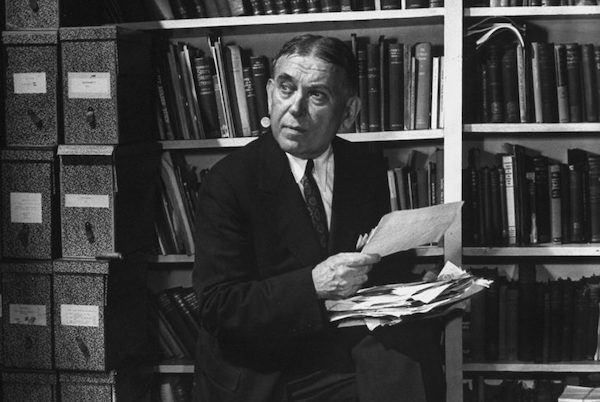
Iconoclastic critic H.L. Mencken — for him, book reviews were about risky evaluation.
Thanks to all those who contributed to the magazine’s Spring Appeal. We have met our goal, but that doesn’t mean we could not use some icing on the cake. For those who have not yet donated to the gallant cause of sustaining a future for excellence in arts journalism, please consider making as generous a gift as you can. You might also consider becoming a monthly contributor—even small, regular donations can add up in a meaningful way. You can make these gifts online or by check.
For those interested in hearing me expound on the value of arts criticism in an age awash in marketing slop, turn to the latest edition of The Short Fuse podcast, where three other Boston noteworthies and I are posed the big question: “Can the Arts Create a Ruckus?” Those also grappling with the issue are Akiba Abaka, Interim Executive Director, National Center for Afro-American Artists; Dawn Simmons, Artistic Director, SpeakEasy Stage Company; and architect Anthony J. Piermarini, Associate Professor at Wentworth Institute of Technology.
My combative response reflects my belief that the arts cannot create a ruckus without the aid of independent arts reviewing — critics who know their craft inspire the kind of dialogue that focuses on discernment, debate, and disagreement. Who knows if something is new or shocking— unless knowledgeable critics dare to draw lines? Along with the fog of influencers, there’s a new foe of critical thinking: AI rewards homogeneity, not risky evaluation.
From The Guardian: “The recent MIT study’s analysis notes that an AI system’s approach – and whether it’s more prescriptive or probing – can affect a user’s ability to maintain good judgment. Although users are often looking for a chatbot to provide speed and certainty, it’s the more nuanced, guided questioning that can improve critical thinking, the study notes.” That is what substantial arts criticism should be — nuanced, guiding, challenging — and that is what you will find in The Arts Fuse.
With heartfelt thanks to those who have supported the magazine as it enters its 20th year. Onwards …
May 27, 2026

François Ozon’s adaptation of Albert Camus’s The Stranger —not deemed worthy of a Boston Globe review.
It feels ungenerous to take aim at mainstream arts coverage just as it slides, helpless and accelerating, down a greased chute toward extinction. Still, attention should be paid, if only to take note of what is being missed and to hail an independent media that’s picking up the cultural slack. As in earlier editorials, I have come up with an incomplete list of the significant films that The Boston Globe didn’t bother to review over the preceding months. About two years ago, I asked the paper’s arts editors for why important films were being neglected: I am still waiting for an answer. It is never too late to hear from the Globe why it is not doing its job. (Pat on the back: a number of these movies have been reviewed by The Arts Fuse.)
Challenging independent and/or foreign films
The Voice of Hind Rahab (interview with director, no review)
The Rip (the film’s trailer was reviewed!)
Greenland Two: The Migration
Crime 101
Dead Man’s Wire
Magellan (foreign)
A Poet (foreign)
The Love that Remains (foreign)
Miroirs No. 3 (foreign)
The Wizard of the Kremlin (foreign)
Erupcja (foreign)
The Stranger (foreign)
The President’s Cake (foreign)
Films by women
Die My Love (mentioned as one of the films to see in the Globe’s Fall Preview — but not reviewed)
Amrum (foreign)
Documentaries
Steal This Story, Please (!)
Orwell: 2+2=5 (interview with director, no review)
May 20, 2026
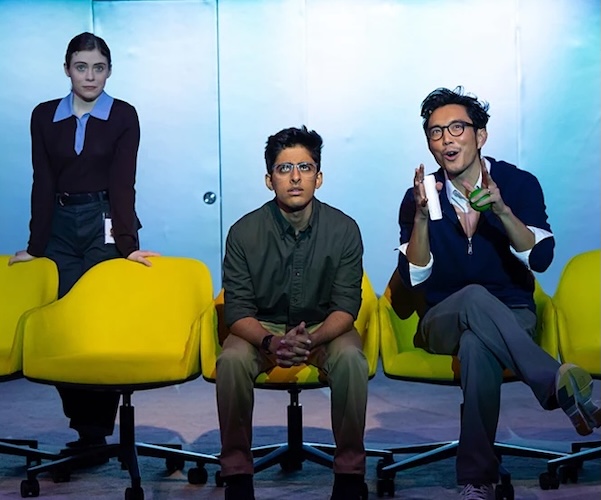
A scene from the off-Broadway production, earlier this year, of Data, a play about A.I. authoritarianism. Photos: T. Charles Erickson
In his column yesterday, Paul Krugman argues that the blitzkrieg of corruption unleashed by anti-democratic forces within the American government has reached a point of no return: “Either they succeed in destroying America as we know it, or they won’t. And until that’s resolved, they may as well engage in even more corruption and criminal acts.” As I have noted before, Boston’s performing arts organizations have largely chosen to ignore these mounting threats to democracy, ducking controversy—even the faintest whiff of protest—in the hope that all will somehow be well.
That indifference, however, may be shifting. Arts Fuse stage critic Robert Israel, surveying recently announced theater seasons, detects tentative but welcome signs that companies may have begun to acknowledge dangerous political realities. He notes what he calls “flickers of healthy sparks” (see his commentary below).
My hope lies less with current institutions than with the discontent that is stirring beneath them. Many public figures and commentators predict that, with the rise of A.I., there will soon be little need for human beings. In her recent New York Times column, “Silicon Valley Is Bracing for a Permanent Underclass,” Jasmine Sun notes that “the workforce will shift toward less automatable jobs where humans retain a comparative advantage—such as entrepreneurship, care work, the skilled trades, and entertainment like sports and the performing arts.” The efficiencies promised by A.I., particularly in marketing and technology, may lower barriers to production, making it easier to create theater that reflects the pressing concerns of communities and civic organizations—labor unions, political parties, and others.
As A.I. displaces jobs, especially among the young, it may also intensify a hunger for the tactile and communal experiences that only live performance can offer. “I regard the theater as the greatest of all art forms,” dramatist Thornton Wilder wrote, “the most immediate way in which a human being can share with another the sense of what it is to be a human being.” Freed from commercial imperatives, smaller-scale productions may begin to ponder the urgent concerns that larger institutions have been reluctant to confront—political, cultural, and social alike: the fate of democracy, the challenge of A.I., the erosion of international law, rising inequality, and the deepening climate crisis. Chances are it will be theater that asserts the value of human beings against the corporate-fueled vision of an automated future.
May 13, 2026
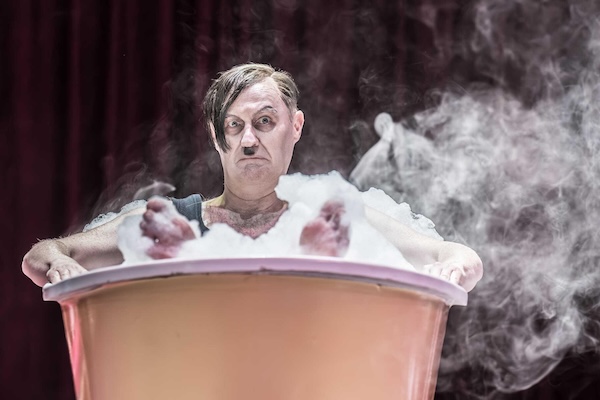
Mark Gatiss as Arturo Uri in the Royal Shakespeare Company’s production of Bertolt Brecht’s The Resistible Rise of Arturo Ui. Photo: Marc Brenner
Brutish autocrats are gaining ground in the government. An insane war grinds on with no end in sight. The economy is sputtering. Libraries and freedom of speech under attack. None of these troubles (and more) seems to trouble Boston theaters, which continue kicking up their heels inside a feel-good bubble. Around here, it’s matter of sticking to the right commercial priorities: democracy may be on the ropes and inflation climbing, but rejoice—the American Repertory Theater might snag a Tony for its socko Two Strangers (Carry a Cake Across New York). Joy! Ticket sales!
For those who believe the stage ought to grapple with the world we actually inhabit—by spelunking the grisly pits we’re digging for ourselves—this cheerfulness smacks of a cowardly evasion. Which makes it all the more bracing to encounter productions elsewhere that refuse to stage the anesthetic. Among the works that speak directly to America’s current authoritarian drift is Bertolt Brecht’s 1941 satire The Resistible Rise of Arturo Ui. The Times Literary Supplement’s rave for the Royal Shakespeare Company’s current staging confirms my sense: this sardonic parable of power-hungry thugs mounting an insurrection captures, with unnerving precision, the showbiz vulgarity of our own would-be dictator.
As critic John-Paul Stonard observes, Ui is a low-rent gangster whose murderous ascent mirrors Hitler’s: a sociopath who “builds his empire of violence through a protection racket targeting cauliflower traders in Chicago and Cicero.” Spiced with allusions to Trump, the RSC production is not just here “to entertain us with gall and grimace, or to remind us of the banality of evil … the point is to bring us back to what is happening in our world right now, and there is a stirring and infectious sense that the players know this, that they know the importance of what they are doing.” Productions like this are an invaluable reminder of the important things — artistic, political — our fearful theaters are not doing and our shamelessly docile critics are not demanding.
May 6, 2026
On the heels of my April 22 editorial on the United States supporting Israel’s acts of culturicide in Gaza, a parallel logic emerges at home. In Arizona, under the banner of “border security,” the Trump administration has overseen the destruction of a Native American heritage site—an act that reveals how readily cultural erasure is justified when folded into the language of national defense.
According to a recent report(opens in new tab) in The Intercept, on April 23 “a rare archaeological site in the Sonoran Desert was bulldozed by a Department of Homeland Security contractor involved in building the latest sections of Donald Trump’s border wall.” U.S. Customs and Border Protection confirmed the destruction, and stated that it was coordinating with tribal authorities on next steps—an acknowledgment that arrives only after irreversible damage has already been done.
The site lies on land sacred to the Tohono O’odham Nation(opens in new tab), whose members have long resisted the intrusion of border wall(opens in new tab) construction across their reservation. During Trump’s first term, the tribe successfully fought to preserve the 272-foot Las Playas Intaglio, an ancient ground design etched into the desert of the Cabeza Prieta National Wildlife Refuge. At this point, it looks as if the tribe’s luck has run out.
Professional organizations have not been silent. The Society of Architectural Historians has issued a clear statement opposing continued border wall construction in culturally sensitive areas and calling for the removal of existing sections. Yet the administration has relied on the REAL ID Act of 2005, which grants the Secretary of Homeland Security sweeping authority to waive dozens of federal, state, and local laws in the name of national security. As the Society notes, this waiver has been deployed most aggressively to insulate border wall construction from public scrutiny and legal challenge.
What emerges is not an isolated incident but a governing principle(opens in new tab): when culture is deemed to be expendable, the law is reshaped to permit its destruction. The same rationale that enables the obliteration of heritage abroad—framed as collateral to security or strategy—operates domestically with equal force. In this case, sacred archaeological memory and Indigenous sovereignty are obstacles to be cleared.
If cultural institutions, scholarly societies, and the broader public fail to respond with more urgency than they are doing so now, they risk normalizing a precedent in which heritage survives only at the discretion of executive power. This is not merely a policy dispute; it is a test of whether the United States will recognize cultural preservation as a non-negotiable value—or continue to treat it as expendable whenever it proves inconvenient.
April 29, 2026
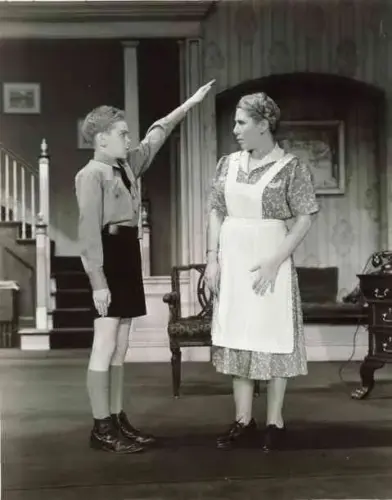
Skippy Homeier and Edith Angold in Tomorrow the World (1943).
Pointed references during Bread and Puppet’s spring touring show to Israel’s ongoing genocide in Gaza and to February’s U.S. missile strike on a girls’ elementary school in Iran—where at least 110 children were killed, roughly 54 of them girls—serve as reminders that, in the past, live theater has engaged directly with political crises (or, in these cases, catastrophes). Once upon a time, Broadway even tackled the specter of authoritarianism. Case in point: 1943’s Tomorrow the World, which ran for just under 500 performances and was later adapted into a film, its simple anti-fascist message intact. What is most interesting about the work today is how it raises the question of how a society should deal with those who have been indoctrinated.
The plot revolves around a German youth, inculcated with Nazi doctrine, who, after his parents’ deaths, is taken into the household of a Midwestern college professor whose fiancée is Jewish. In his pan of the show—aside from admiring child actor Skippy Homeier’s performance as the young Nazi—critic George Jean Nathan wrote that the drama “lies in the youngster-automaton’s persistent adherence to and practice of the Hitler dogma, the manner in which he devastates the household, and his ultimate persuasion to the fact that the American way of life may be better after all.” Nathan is right to excoriate the script’s obvious melodrama and sentimentality, though there are also some intriguing xenophobic brushstrokes. At one point, the assimilationist professor comes perilously close to choking the boy after he commits an act of violence.
The fear underlying the script is rooted in the nature of the postwar world: how would the millions who had followed Hitler be redeemed and become trusted citizens again? What would be the best way to bring them back into the democratic fold? For Nathan, the vision purveyed in Tomorrow the World—a “faith-hope-and-charity” philosophy toward Germans—would come to dominate the stage once the war had ended. Will our theater companies take up the thorny question of whether—and how—homegrown Christian nationalists can be reengaged with democratic life? Will they accept the difficult task of dramatizing the price of authoritarian complicity? Or will they stage empathetic pleas for forgiveness for those—from the libertarian broligarchy downward—who continue to dream of an end to democracy?
If our theaters shrink from attempting that reckoning, they risk forsaking their role as forums for democratic imagination, becoming instead stages on which its erosion is quietly normalized.
April 22, 2026
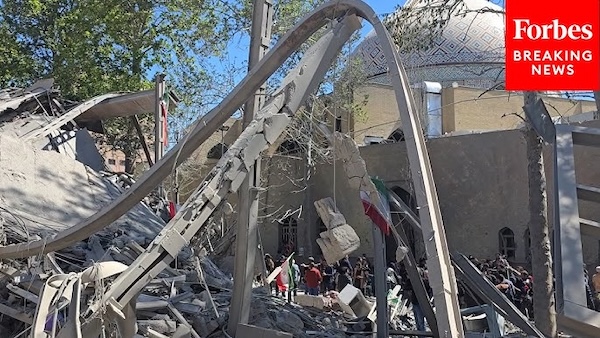
Iran’s Sharif University after it was struck by U.S.-Israeli airstrikes on the night of April 5–6.
“It is said, for example, that a man ten times regrets having spoken, for the once he regrets silence. And why? Because the act of having spoken is an external fact, which may involve one in annoyances, since it is an actuality. But the fact of having kept silent! Yet this is the most dangerous thing of all.” — Søren Kierkegaard on silence as symptomatic of an unacknowledged despair that “occasions no embarrassment but makes one’s life easy and comfortable” in The Sickness Unto Death.
We are seeing “the most dangerous thing of all” embraced by America’s major artistic institutions as well as its largest universities and philanthropic organizations. They are putting their heads down and clamming up. On April 7, President Donald Trump threatened Iran with obliteration: “… a whole civilization will die tonight, never to be brought back again,” if the country did not meet his deadline to reopen the Strait of Hormuz and sign a deal to end the conflict. There were individual outcries from academics, and PEN America issued a joint statement of protest with over 200 human rights organizations, including Amnesty International USA, Human Rights Watch, Oxfam America, and the ACLU. But our major universities and artistic institutions have yet to come out with public statements condemning Trump’s barbaric fantasy. Those sworn to uphold civilization are refusing to speak out in its defense.
A shameful pattern of silence unites America’s cultural movers and shakers. Few have objected to Israel’s systematic destruction of Gaza’s universities, or at U.S. or Israeli strikes that have targeted over 30 Iranian universities. An Israeli attack on March 12 damaged Lebanon’s Lebanese University, killing two senior faculty members. These bombings are part of a determined campaign to commit cultural genocide, to wage a merciless assault on a group’s cultural and intellectual foundations, including the destruction of its art, its history, and its collective memory. America had been financing culturicide well before Trump’s apocalyptic gesture toward Iran.
Melissa Gilliam, President of Boston University, recently told its community that the institution is dedicated to “fostering an academically rigorous environment that also prepares our students to be global citizens.” An admirable sentiment. But aren’t our universities, philanthropic organizations, and artistic institutions “global citizens”? Isn’t it their moral responsibility to speak out against the systemic demolishing of international educational centers, to object to the erasure of civilizations? Neutrality is complicity — it betrays the very values our elite institutions claim to uphold.
April 15, 2026
From The Editor’s Desk — Guest Editorial
A Call for Fair Monetization of Human-Generated Music

Grammy-nominated composer and New England Conservatory faculty member Mehmet Ali Sanlıkol.
Several months ago, as my wife and I were working on our laptops in our living room, she asked me whether she could play some music in the background. She ended up choosing a kind of slow blues. Even though I wasn’t paying close attention, in about a minute I noticed certain oddities in the music: the form was slightly off, certain riffs felt strange, and the vocal ornamentation came across as too “clean”. We became suspicious and checked whether the music was AI-generated. It was indeed fully AI-generated. Then we tried to find playlists that contained only human-generated music and had a very hard time finding one. Most streaming platforms are now flooded with fully AI-generated music! Worse, I discovered that these instantly generated recordings are subject to the same monetization rules as fully human-produced music. How is that fair?
Currently, about 50,000 fully AI-generated tracks are uploaded to streaming platforms each day. But there is no meaningful differentiation between the way human-created work and machine-generated output are monetized. For human-generated productions, countless hours and considerable money are typically expended before the creators feel comfortable enough to release the work to the public. But it only takes minutes — or even seconds — for a track to be fully generated by an AI model like SUNO. On top of that, one only needs to pay a few dollars to obtain the mechanical rights to the music SUNO generates, based solely on a set of prompts. It didn’t surprise me to learn that the majority of people uploading these fully AI-generated tracks to streaming platforms are non-musicians.
This is a complicated issue: the genie is out of the bottle, and there are already hybrid tracks combining AI and human-generated music, a trend that will only grow. Creators have long relied on copyright law to protect intellectual labor. It is deeply unfair that human musicians are subject to the same monetization rules with those who can generate a track simply by prompting a machine. We need to start a conversation immediately with lawmakers about how copyright law can address this problem. I’ve launched a petition calling for the fair monetization of human-generated music: https://www.sanlikol.com/a-petition-for-fair-monetization-of-human-generated-music/
Please consider signing the document and getting the word out about it.
— Composer and performer Mehmet Ali Sanlıkol, D.M.A. Professor of music history & musicology, New England ConservatoryDirector, Intercultural Institute at NEC.
April 7, 2026
It was only a matter of time. Author and freelance journalist Alex Preston recently admitted to using AI(opens in new tab) to help him write a book review published in The New York Times. Even though the paper has cut ties with Preston, I predict that artificial aid of this kind will become routine throughout reviewing. Arts criticism has been progressively excised from mainstream media. What’s taken its place is the review reduced to consumer-guide advice: it justifies its existence through an embrace of the language of marketing and publicity, which will soon be outsourced to bots. (There is evidence(opens in new tab) that “AI-generated ads are performing on par with those made by humans, and outperformed human ads when they avoided appearing like AI ads.”) For decades— even in lofty places — arts criticism has been dumbed-down. It has become homogenized to the point that AI has arrived to apply the final sanitizing touches.
“The highest criticism really is, the record of one’s own soul,” wrote Oscar Wilde. In order to get published, critics will jettison their personal voices — if they ever had any— and choose AI, with all the ethical issues it raises. The question is, how long will arts criticism survive in an increasingly technologically dominated media landscape?
I agree wholeheartedly(opens in new tab) with The Conversation’s Arts and Culture Editor, Jane Howard, that “each review sits in conversation with every other review of a piece of art, with every other review the critic has written.” Reviewers should be an active part of a dialogue among different voices. But exactly what should be placed in conversation? Criticism is an articulation of the value of art, a judgment that must be backed up with analysis and evidence so it can make a persuasive case. Unless the review is substantial, the “dialogue” devolves into a pillow fight rather than the kind of “mental fight” that establishes, through style, passion, and debate, the good or bad of the art under discussion. But serious writing about the arts is neither valued nor taught: a vital way in which society understands the significance of arts and culture is being silenced.
The mainstream media pays cultural reviewers little for what they are asked to do. It is understandable — though still not forgivable — that writers will take a short cut. I am not depressed about this: brilliant, non-AI arts criticism can be found in the Arts Fuse and in numerous other small but mighty media outlets. Of course, the battle to uphold an expansive definition of criticism — as an independent, provocative, and intellectually stimulating response to art — is ongoing. The truth is, it has been a long time since the real thing could be found, with any confidence, in mainstream media or on NPR.
March 25, 2026
 The “excursion” into Iran may go on for a while. Will theaters treat the world-shaping conflict — even if American soldiers are sent to fight and die — with the same blithe indifference they continue to show toward the struggle to maintain democracy? I am not encouraged. The urge to stay neutral in the face of life-and-death realities, to play it safe rather than to stake out a risky political or moral position that might upset theatergoers, has a firm chokehold on our stage artists. History will not be kind.
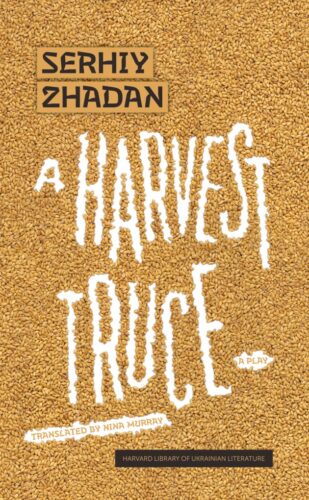
In earlier columns, I supplied recommendations for theater pieces that shed light on what’s happening in America today, from Elizabethan dramas exposing a “mad king” (Trump as Marlowe’s warmongering Tamburlaine the Great) to modern docudramas about political oppression. Here’s a new play, written by a fine Ukrainian author who is currently serving in his country’s armed forces, that would be a feather in the cap of any American company that produced it. Translator, activist, poet, and musician Serhiy Zhadan’s powerful script, A Harvest Truce, published in English translation by Harvard University’s splendid “Library of Ukrainian Literature,” is set in Eastern Ukraine, which has been in chaos since Russian incursions began in 2014.
The “harvest truce” of the title allows farmers to gather their crops, but peace is an illusion. As two antagonistic brothers, Anton and Tolik, deal with the burial of their mother, they are beset with a number of visitors who want to escape the conflict, but growing paranoia, accusations of betrayal, conflict-related trauma, and nihilistic impulses make leaving an impossibility. Zhadan’s writing accents polarizing distrust among families and neighbors with absurdist humor: these characters long to leave but, because of fear and inertia, are doomed to stay where they are. This vision of paralysis reflects a growing sense of helplessness throughout the West.
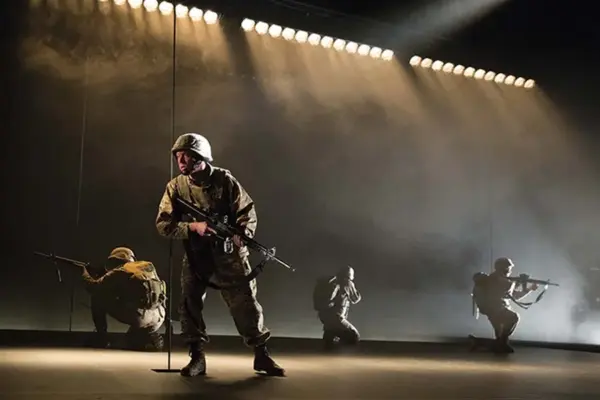
As of now, there has been only one staging of Nina Murray’s 2024 translation — a 2025 production by the Bleviss Laboratory Theatre/University of Alberta Department of Drama (see photo above). A professional premiere of A Harvest Truce would be a credit to any professional American theater company unwilling to stand aside while the world burns.
March 18, 2026
Keith Conallen and the company of Don Juan Comes Home From Iraq at the Wilma Theater in Philadelphia in 2014. Photo: Alexander Iziliaev
In a recent BINJ News editorial(opens in new tab), Jason Pramas made a sensible request of the arts: we need “more culture that questions why the U.S. (and many other nations) are at war all the time.” He admits there isn’t much financial support for such projects but argues that “the route to a strong antiwar movement lies in the production of more antiwar cultural works … and works of journalism, for that matter.” He calls on “workers in the creative professions” to overlook, for the sake of supporting peace, “the manifold threats to the livelihoods of our filmmakers and actors and artists and musicians and dancers (etc., etc.) posed by social media and so-called ‘AI’(opens in new tab) and late-stage capitalism itself.” “If you agree that war is bad for humanity,” Pramas concludes, “then find a way to embed your antiwar beliefs in the cultural works you create.”
America is now at war with Iran — for reasons that remain unclear and with no end in sight. Will our creative community have the courage to protest en masse against this insanity, or will its public response continue to reflect the fear or cowardice that has so far greeted the serious, ongoing threat to democracy? The Iran war commenced just over two weeks ago. As of now, my searches reveal no scheduled antiwar plays, concerts, or festivals tied to the conflict. Granted, it is early, but it is vital that audiences and critics demand, quickly, a culture of dissent rather than complicity. Of course, as Pramas suggests, embedding antiwar beliefs in cultural works may mean concerned artists will have to move forward without the wealthy muscle of the powers-that-be.
March 11, 2026
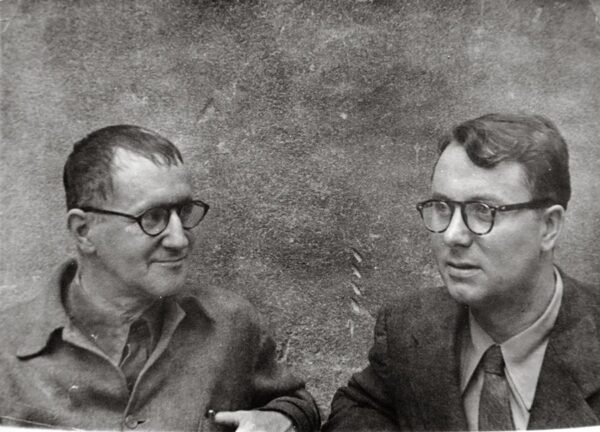
Dramatist Bertolt Brecht and critic/translator Eric Bentley in 1948. Photo: American Theater
In his 1960 essay “The Pro and Con of Political Theatre,” critic Eric Bentley points out that “the Germans have a term, Zeitstück, for a play that tries to cope with the leading problem of the day. It will, of course, be of the highest interest to see what the playwright considers that problem to be.” The use of “he” is antiquated, but Bentley’s comment on the public responsibility of serious dramatists remains salient. What, for our playwrights, is “the problem of the day”? And how are they addressing it?
Because of the Cold War, Bentley believed that the issue was war, the atomic bombing of Hiroshima and Nagasaki having raised the possibility of nuclear annihilation. America and Israel’s war with Iran also heightens the chances of a thermonuclear war; that nightmare, largely unaddressed in our theaters, remains as urgent as ever. As for our current crop of dramatists, I can’t tell you what they think is “the problem of the day,” though Company One’s lively production of the climate crisis play You Are Cordially Invited to the End of the World! may be onto something.
Bentley feared that the prospect of nuclear armageddon would spawn a literature of “terror and defeat, which is to say, of nihilism.” He was wrong in thinking that. Not much chance that American theater would swing that way. The critic ended his essay by calling for a “reorientation … [that would] entail placing the question of slavery and freedom again at the center of liberal (radical, revolutionary) activity, especially intellectual activity. For, as Camus said in Stockholm, ‘the nobility of our calling will always be rooted in two commitments … the service of truth and the service of freedom.’” For our playwrights and a number of America’s elite institutions, standing by those commitments is very much the problem of the day.
March 4, 2026

America is at war with Iran — will our performing arts do their part to protest this act of senseless aggression? Or will it be business as usual?
In the March 26, 2025, “Ideas” section of The Boston Globe, Christopher Hoffman contributed a column(opens in new tab) with the headline “Eugène Ionesco Tried to Warn Us.” The piece observes how “avant-garde playwright Eugène Ionesco’s 1959 play Rhinoceros satirized blind acquiescence to fascism and groupthink. Unfortunately, the play’s moral is more relevant than ever.”
Did local theaters take this MAGA-sized hint to schedule a production of the play? No, perhaps because this tragicomic social parable about a collective embrace of totalitarianism isn’t a musical, or because it hasn’t been a recent hit Off-Broadway. Someone, somewhere must have been listening. To its artistic and political credit, Yale Rep is staging the script(opens in new tab)—using Derek Prouse’s translation, adapted by Frank Galati and directed by Liz Diamond—from March 6–28.
The plot centers on an alcoholic, unkempt antihero named Berenger, who watches in shocked horror as inhabitants of a small provincial town gradually turn into rhinoceroses. Those committed to society’s bourgeois satisfactions and the moral order are the first to metamorphose. The rampaging rhino pack—raging, thundering, and blaring—goes on to claim the bodies and minds of citizens across the political spectrum, from left to right, including lawyers, romantics, and government officials.
The populace’s submission to thoughtlessness symbolizes “community spirit triumphing over anarchic impulses,” a metaphor for the spread of mass insanity inspired by Nazism. Berenger is immune to the transformation—too eccentric, too marginal, too bohemian? At the end, he is completely alone, left to muse on the fate of standing apart: “People who hang onto their individuality always come to a bad end.” Torn between despair and defiance, Berenger resolves to do what he can to confront a society gone mad—“to put up a fight against the lot of them.”
February 25, 2026
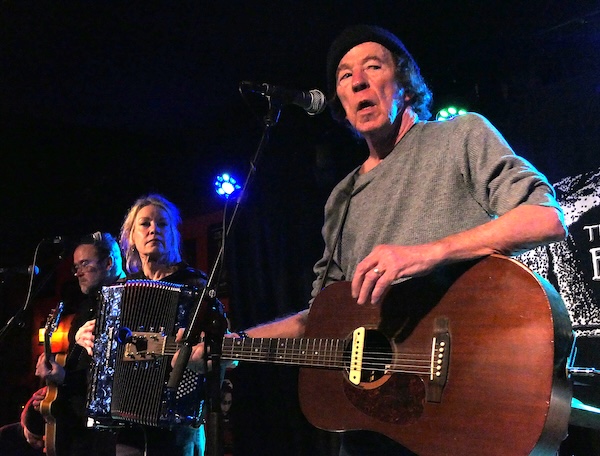
Mike Oram, Elizabeth Steen, and Dennis Brennan performing in Which Side Are You On? at the Burren. Photo: Paul Robicheau
Along with words of encouragement, I have gotten flack over my conviction, stated (often) in my weekly column and theater reviews, that the arts have a responsibility to address the political challenges posed by our unprecedented times — a Christo-fascist kleptocracy’s attempt to throttle democracy. I have been told that critical writing about the arts should be inspiring, not dispiriting. One respected voice informed me that the last paragraph in my pan of SpeakEasy Stage Company’s production of Job was “unhinged” because I insisted that “it is time our stages, which claim to care about their communities, step up and put on dramas that express alarm, resistance, and dissent.”
To my detractors, I pose a question: What is the proper role for arts criticism during this unprecedented time in American history, when xenophobic authoritarianism, empowered by the forces of government, is on the march? At the moment, a record number of books are being banned from libraries, artists censored or barred from entry, and minority cultures targeted by official decree. To my mind, carrying on with business as usual is cowardice in the face of repression. The strongest arts critics of the past would not have been silent about what is happening today — if only because of the threat it poses to artistic freedom. H. L. Mencken insisted that the essential purpose of the critic was to ensure the creative freedom of the artist, to clear the ground of rubbish, which not only included excoriating mediocrity, but the tyranny of censorship.
A critic is not deranged to claim that our artistic community is, in general, choosing to look away from an existential crisis in governance. Our stages are not meeting the moment, not building on a revered tradition of performance art whose laudable goal was to unify opposition to a virulent ideology that intends to curtail free speech and creative freedom. It is not acceptable to play it safe, waiting the wannabe despots out, magically hoping that they will be pushed aside. The alternative — their triumph — is too tragic to contemplate.
As for an admirable example of local artists who are speaking out against autocracy, take a look at Clea Simon’s excellent feature on the concert series Which Side Are You On? May a thousand flowers of artistic dissent bloom.
February 18, 2026
Why are U.S. philanthropies among the elite institutions that have been disgracefully reluctant to take bold stances against the country’s slide toward authoritarianism? There are the usual culprits: a fear of retaliation and investigations from the Feds; a desire to be seen as maintaining ideological “neutrality”; a malaise fed by uncertainty about tactics; the need to “keep their heads down” and avoid any political fallout; and internal polarization among members of the boards of directors.
It is not enough to call out such cowardice, but also to begin to search for remedies. As we struggle through an era of tyranny, violence, and inequality, the MAGA crisis offers us an opportunity—for both the giving and receiving ends of philanthropy—to rethink, reshape, and revitalize the mission of charity. As David Callahan points out in an article in Inside Philanthropy, “The strategies that liberal philanthropy has been pursuing to achieve transformative change in America—which have heavily centered on identity and rights—have hit a dead end.” It is time to examine new directions, explore philanthropy’s activist potential seriously, and reimagine its critical role in democratic renewal.
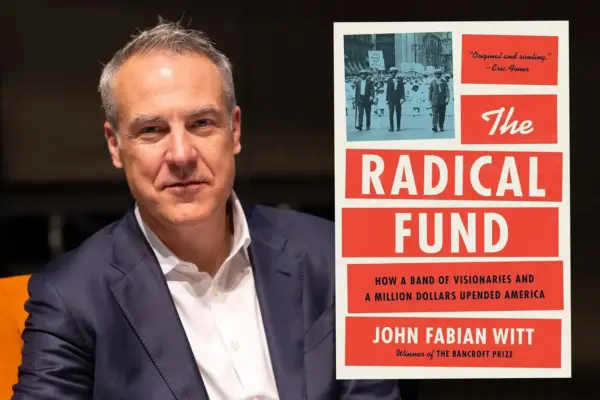
To build a better future for all, one place to start is by turning back to the past—a model of when American philanthropy directly engaged with the welfare of working-class people. John Fabian Witt’s fascinating book, The Radical Fund: How a Band of Visionaries and a Million Dollars Upended America, explores the creation, in 1922, of the American Fund for Pubic Service, which during its 19 years of existence gave away $2 million to a wide array of labor, racial equality, and civil liberties causes. Witt reports that one of the major purposes of the fund was “to identify and incubate the economic formation of the industrial union as something that would put tens of millions of Americans in a position to be able to control the direction of their economic lives and the lives of their families.”
The true test of American philanthropy’s courage is whether it empowers families to shape their economic futures—or stands by safely as that agency, and democracy itself, erodes further.
February 11, 2026
Horrific as it is, the auto-da-fé of book and arts coverage at The Washington Post has exposed a malaise that’s just as disheartening. No sizable media organizations are stepping up to pick up the slack. WBUR, WGBH, The Boston Globe — none has offered assurances (nor have other major U.S. outlets) that more book and arts reviews are coming. Don’t hold your breath. When the mainstream media bother to show even a faint interest in books and the arts, they lean into marketing rather than evaluation, fluff rather than serious coverage. Expect more inane interviews with artists by newspeople who don’t know a novel from their navel. You half expect to hear an NPR host ask a famous novelist: “Why did you decide to write a book featuring characters?”
You know things have hit rock bottom when Congress (!) is more protective of literature than our sputtering information industry. According to EveryLibrary, Congress’s final FY2026 “minibus” appropriations bills protect funding for the Institute of Museum and Library Services, the Library of Congress, and the National Archives and Records Administration — a rejection of sweeping cuts proposed by the President that would have deeply harmed libraries, museums, and archives in every state. So our libraries will stand — at least for now — while elite communication conglomerates are content to let book reviews die.
Not on my watch. Viva La Book Review supports book critics by funding reviews in local media around the country. Besides donating to The Arts Fuse and other magazines producing high-quality book and arts reviews, now is the time to gather with other lit-lovers who are passionate about maintaining book culture — readers who believe in independent evaluation rather than servile boosterism. Bezos will only win if we let him. Let thousands of book reviews bloom, let thousands of critics contend.
— Editor Bill Marx
February 4, 2026
As Stanford University academic and theater artist Samer Al-Saber wrote(opens in new tab) in 2018, Palestinian stories are the “last taboo” in American theatre, and that fear has only grown more powerful with Israel’s ongoing genocide in Gaza.
In a recent article(opens in new tab) in American Theatre, two playwrights, Ismail Khalidi and Naomi Wallace, interviewed theatermakers in the West Bank and Gaza. What we learn is predictably sobering: reports of violence, intimidation, and destruction intertwined with cries of defiance. As Mustafa Sheta, producer and general manager of Jenin’s Freedom Theatre, asserts in the piece, “I do not see our work as a luxury but as an act of survival. When everything around us is being erased, theatre becomes a way to insist that imagination and collective memory still matter.” His belief in the role of theater is a reminder to our milquetoast companies that they should be doing more than marketing themselves as “bold” or “kind.”
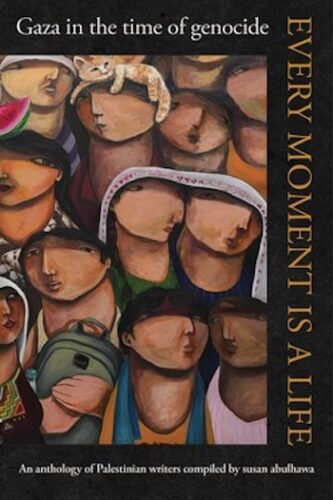
Our media, like our theaters, is uninterested in life as it is lived in Gaza. Those of us who are concerned about what existence is like for those who have (at least so far) survived the conflagration should turn to Every Moment Is A Life(opens in new tab), an innovative Arabic-English bilingual anthology that features heartbreaking remembrances and stories from 18 young Palestinian writers in Gaza. Edited by Palestinian-American scientist, writer, and activist Susan Abulhawa(opens in new tab) and Palestinian novelist and translator Huzama Habayeb(opens in new tab), these short pieces offer visceral, detailed, and poignant descriptions of loss, love, and resilience amid apocalyptic devastation.
In 2024, Abulhawa ventured into Gaza twice, inviting people from displacement camps to share their experiences of living “zero to the bone,” of what it takes to maintain human dignity at a null point. No electricity, scarce food, no water, homes utterly demolished—and death omnipresent. As Rizq Ahmad writes in the opening of the title story: “In this era stripped of tenderness, where aggression knows no end and the bleeding of death never stops, affection and warmth among displaced families have become a sort of luxury. As we all sink into the mire of the daily struggle to survive, we keep moving from one place to another, clinging to a life that bears no resemblance to anything truly alive.”
Ahmad’s notion of an “era stripped of tenderness” for the powerless and targeted cuts close to home in Trump-era America. All proceeds from Every Moment Is a Life will be sent to the contributors in Gaza and to the Palestine Writes Literature Festival(opens in new tab).
January 28, 2026
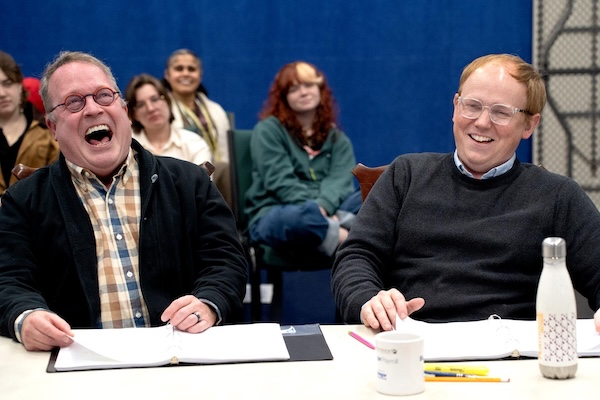
Actors Tom Ford and Patrick Harvey during a rehearshal session for the Portland Stage Company’s upcoming production of Lend Me a Tenor. Photo: Aressa Goodrich
I have long argued, too often for some people’s liking, that the Trump administration’s march toward authoritarianism has not been treated with sufficient alarm by the major players in New England’s artistic community. Perhaps this complacency – to cling to business as usual rather than to acknowledge dire threats to democracy and artistic freedom – will end after the ICE shootings in Minneapolis. Let’s hope it does.
Here’s one sign that creative organizations are beginning to connect with the threatened communities they claim to serve. I recently received an email from Arrowsmith Press with the subject line “Something Fast & Important We Can Do Before Jan 30.” There is a link(opens in new tab) to a Writers for Democratic Action Massachusetts’ “Call for Action” and the message “We need to work fast to get out the message that we will not stand for the murderous and illegal actions being taken against our neighbors, family, and friends across America.” Rather than send out yet another marketing blast, perhaps Boston’s cultural big shots might consider sending out similarly useful emails.
It will be interesting to see how Boston-area arts institutions respond to the crisis that’s coming our way, soon. ICE agents have begun working in Portland, ME — in an operation called “Catch of the Day” — and there are reports that children and people with no criminal record are being rounded up by what has become a rogue agency. What is the city’s major theater company, Portland Stage, staging during this emergency for the immigrant community? A production of Ken Ludwig’s farce Lend Me a Tenor. Portland Stage’s publicity tells us “we all need a good laugh.” I guess it all depends on who is included in that “all.” Residents hounded by ICE probably aren’t in the mood for yuks.
ICE may be coming, in force, to Boston. Will our leading artistic organizations be as depressingly oblivious to reality when the city’s streets are filled with illegal, perhaps even violent, police actions taken against our “neighbors, family, and friends”? Or will someone scrape up the courage to improvise alternatives — perhaps town halls that supply ways that Bostonians can organize against Trump’s wave of terror, or evenings dedicated to music, poetry, and drama that celebrate the value of the area’s immigrant communities? The choices our arts institutions make will be morally and civically revelatory.
January 21, 2026
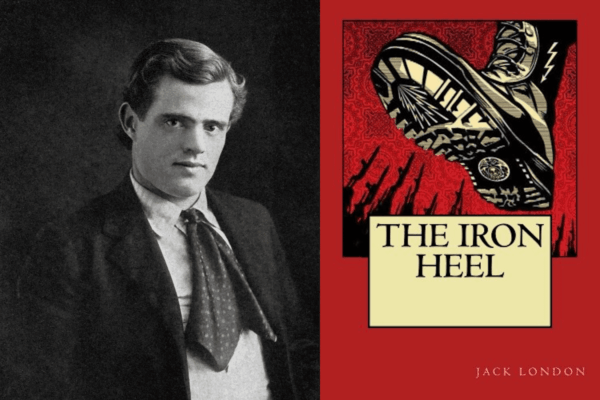
In its email touting the 150th birthday of Jack London on January 12, the Library of America kicked off its homage by quoting the Wall Street Journal’s description of the writer as “illegitimate, handsome, wildly romantic, casting himself as the rebel and revolutionary.” London was also an unorthodox socialist, but the Library of America isn’t very interested in celebrating that aspect of his imaginative vision. The promo limits itself to mentioning the classic adventures The Call of the Wild and White Fang, along with London’s autobiographical novel John Barleycorn and The Road, an ode to turn-of-the-century hobos.
Given today’s violent, anti-democratic climate, highlighted by the Trump regime’s illegal and sadistic use of physical abuse in Minneapolis, LoA’s disregard for London’s political relevance is demoralizing. He adored the “scientific romances” of H.G. Wells, saluting him as a “sociological seer” for his imperialist satires, War of the Worlds among them. London experimented with a similarly dystopian brand of sci-fi that has proved surprisingly prescient. London’s 1908 novel The Iron Heel (which has never gone out of print) chronicles a fascist takeover of America, a bloody upheaval that will be unchallenged for 300 years. (The text is a memoir of rebellion defeated, love and loss, and despotism triumphant — a manuscript discovered hundreds of years later and published with scholarly notes in the twenty-seventh century.)
The authoritarian power grab is propelled by an unscrupulous oligarchy that has successfully curtailed freedom of speech and assembly, jailed dissenting opponents and critics, and taken over news and information industries. It maintains its power through a professional army of paid mercenaries who are assisted by a secret police force. Besides its considerations of religious fanaticism, imperialism, and terrorism, the rip-roaring narrative contains an international component as well — a small band of corporations have bonded together to assert global economic hegemony. To paraphrase Ezra Pound, literature is prophecy that stays prophetic.
London’s apocalyptic meltdown is crude, yes, but its elements of dark adventure are enormously cinematic. If only director Paul Thomas Anderson had decided to adapt (and update) London’s antifascist fantasia — the first modern novel to issue an alarm about dictatorship in America — rather than Thomas Pynchon’s Vineland. As one of the capitalists says, “We will grind you revolutionists down under our heel…the world is ours…and ours it will remain.” London’s class critique influenced Sinclair Lewis’ It Can’t Happen Here, George Orwell’s 1984, and Philip Roth’s The Plot Against America. The book’s vision of gun-toting mayhem in the U.S. streets — revolutionary troops outnumbered by the military forces of the oligarchy — anticipates, in depressing ways, 21st-century mayhem. Those who are interested in reading The Iron Heel, along with London’s essays on socialism, “Revolution” and “How I Became a Socialist,” can find them in the LoA volume Jack London: Novels and Social Writings.
January 14, 2026
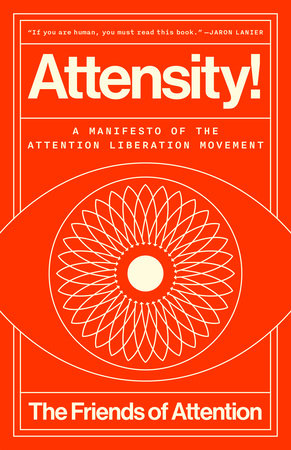
An existential battle for our eyeballs is being waged against the monetized-to-the-max machinations of our libertarian digital overlords, the pied pipers of algorithms. An intriguing part of the campaign to help our minds escape the clutches of the screen barons of Silicon Valley is being led by “an underground association of artists, performers, and interventionists” whose consciousness-freeing goals are proclaimed in the provocative manifesto ATTENSITY!: A Manifesto of the Attention Liberation Movement(opens in new tab).
The group, which hopes to grow into a social movement, plans to flip the dominance of “an instrumentalized vision of human being,” propelled by technology’s “scramble to drive freehold stakes into the very stuff of our consciousness.” Instead, we are urged to use our various forms of attention, in the in-person communities we create, “to constitute the values of this world: what we care about, what we give ourselves to, what we endow with time and thought and touch, what we stay with, what we circle back towards; these are the things that become valuable.” Attention activism is about awakening people to the fact that we, not the “human frackers,” own our own minds.
Attempts to nurture independent, communal life outside the virtual bubble-world of an overpowering techno mind-suck are crucial. Still, the all-too-elastic boundaries of “attensity” give me pause. The volume’s authors define it as “the true gift of the open. It is where we meet in that openness, and make space for what unfolds.” Aside from the work of William James, no attention is paid to the literature on attention. Aldous Huxley’s 1962 utopian novel Island (his final book) contains mynah birds calling out “Attention.” For him, it was not about free-range “openness”; it was about cultivating a disciplined, spiritualized awareness of the present moment—being fully here and now rather than letting oneself become lost in memory, fantasy, or habit. Attention was not simply a matter of sharpening psychological concentration or joining with others to share interests and understanding. It was also an ethical imperative—to see reality, oneself, and others clearly. Attention was not about creating more space, but taking up the moral struggle of drawing responsibly humane boundaries.
January 7, 2026
When it comes to reflecting on what is happening around us, Boston-area theaters have hermetically sealed — aside from advising us to “be kind,” boldly staging Broadway hits, and bringing back, by popular demand, Joy Behar’s My First Ex-Husband. Few companies have dared to confront our ongoing American meltdown; those who do should be saluted. Of course, Boston’s critics should be demanding a slowdown in theatrical business as usual, but they are content to keep their heads buried in the confetti of happy talk. The Boston Globe stage critic assumes that it is dandy that Boston theaters stick with domestic matters — no one along the ideological spectrum will be bothered if the drama is kept all in the family.
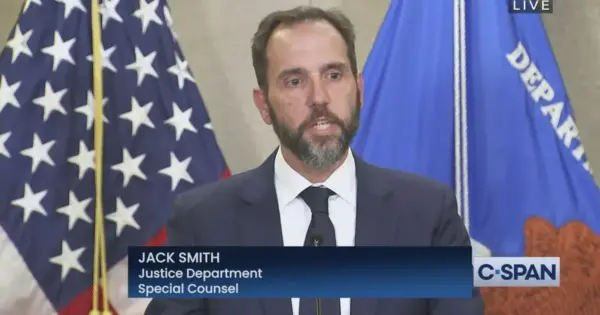
So, kudos to the Writers for Democratic Action Theater Project for yesterday’s stirring January 6: A Day Forever, a staged reading directed by Jeff Zinn at the Wellfleet Harbor Actors Theatre. Co-writers James Carroll and Rachel DeWoskin adapted material from the Congressional Record of the second impeachment trial of Donald J. Trump. More low-hanging doc-u-drama fruit for a local troupe: former Special Counsel Jack Smith’s recent testimony before the House Judiciary Committee, defending his investigations into Donald Trump’s alleged efforts to overturn the 2020 election and mishandling of classified documents. Smith asserted he had strong evidence of Trump’s culpability, that the Jan. 6 attack wouldn’t have happened without Trump.
I have my eye out for other stage efforts that tackle authoritarian chicanery or shows that acknowledge internationally uncomfortable realities. In March, Company One will be presenting, in partnership with the Boston Public Library, You Are Cordially Invited to the End of the World, a comedy about the climate emergency that a trusted authority informs me speaks, with humor and poignancy, “to the very real stakes of climate anxiety and grief without dwelling in hopelessness.” Serious theatergoers should support this as well as other productions that engage with the crises around us. Dramatist Dan O’Brien posits that a political play takes up “a problem that is ignored, denied,maligned. A political play is, by definition, unpopular.” Let us prove him wrong.
Bill Marx is the editor-in-chief of the Arts Fuse. For four decades, he has written about arts and culture for print, broadcast, and online. He has regularly reviewed theater for National Public Radio Station WBUR and the Boston Globe. He created and edited WBUR Online Arts, a cultural webzine that in 2004 won an Online Journalism Award for Specialty Journalism. In 2007 he created the Arts Fuse, an online magazine dedicated to covering arts and culture in Boston and throughout New England.