
Holiday Commentary: Making Room for the Stranger
By Martin B. Copenhaver
Sometimes the stranger is someone who is very well known to us, like a father whose strange ways include a devotion to a certain story about a childhood in Wales.
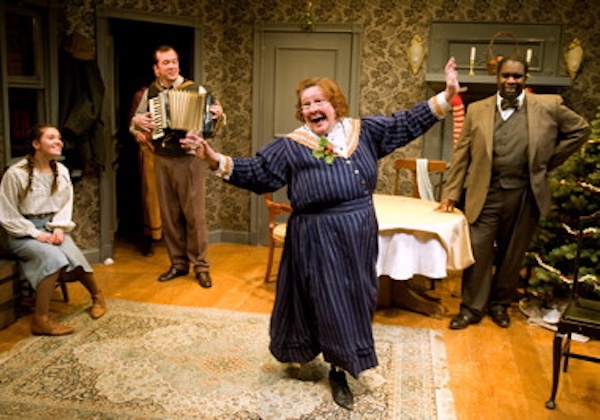
A scene from the 2010 production of A Child’s Christmas In Wales. Photo: Peter Goldberg
I have always loved the writings of Dylan Thomas. So, when our children were still young, I was excited to take my family to a play adapted from Thomas’s story A Child’s Christmas in Wales. It was a smashing success. Our children were enthralled. I was delighted to think we had created a new family holiday tradition.
For six years running we went to see the production. It felt like a Christmas liturgy that did not need to be changed from one year to the next. And I always looked forward to it. Between Christmases certain lines from the story would make their way into conversation. (“Go on to the Useless Presents!” Or, “There were always Uncles at Christmas.”) Or, at least such lines would appear in my conversation.
Then one year the theater company did not stage the play. I had to break the news to my family.
After a few understated expressions of sorrow, our daughter tentatively ventured, “You know, Dad, I think it’s really okay. To tell you the truth, I never really did like A Child’s Christmas in Wales.”
Our son immediately jumped in: “I’m so glad to hear you say that. I thought I was the only one.”
“You never liked it?” I asked.
“Sorry, Dad. Like… never.”
I turned to my wife. She just shook her head.
It turns out that no one else in my family enjoyed A Child’s Christmas in Wales. They all found it excruciatingly boring. But for years they did not tell me and they had not told one another, either.
In its fullest sense, hospitality is making room for the stranger. And most religious traditions make clear that, when you are welcoming the stranger, you are making room for the divine. Sometimes the stranger comes from another land or is simply someone unknown to us. Mother Teresa used to affirm that God often comes to us “in the distressing disguise of the poor.” These are important reminders in a time when strangers often are not welcomed but, rather, reviled or rejected for being in some way different from us. Another reminder can be laid alongside that one: Sometimes the stranger is someone who is very well known to us, perhaps someone who lives under the same roof as we do, but whose ways are strange to us. Someone like a father whose strange ways include a devotion to a certain story about a childhood in Wales.
Martin Copenhaver was a pastor in the United Church of Christ for 34 years before becoming president of Andover Newton Theological School. Despite all objections, he still professes a love for the writings of Dylan Thomas.
1 Comment
Leave a Comment

For those who want to experience the vibrant lyricism of Dylan Thomas’s prose, here is a link to Richard Burton, in 1960, reciting A Child’s Christmas in Wales.