Theater Review: Working Up a “Hedda” Steam
By Bill Marx
Two versions of Hedda Gabler — one gratifying, the other gauche.
Hedda Gabler by Henrik Ibsen. Translated from the Norwegian by Paul Walsh. Directed by James Bundy. At Yale Repertory Theatre, 1120 Chapel Street, New Haven, through December 20.
Hedda, an adaptation of Ibsen’s Hedda Gabler, written and directed by Nia DaCosta. Streaming on Amazon Prime Video

Tessa Thompson as Hedda Gabler in Hedda. Photo: Amazon Prime
In his program notes for the Yale Repertory Theatre’s fine-grained production of Hedda Gabler, dramaturg Timothy Hartel writes that Henrik Ibsen sets up a debate. The question for the audience: how much leeway should women have when it comes to challenging convention? “How much bad behavior can we accept? How much is too much?” Hartel asks. That question is authoritatively answered — at least when it comes to adapting Ibsen’s masterpiece — by director Nia DaCosta’s overwrought, full-tilt film version. In this brutalized, sliced-diced-and-quartered version of the play, everyone is behaving extremely badly — Hedda is only one self-destructive villain in a crowd of overachieving sinners and sadists.
By making Hedda a half-Black adopted daughter of General Gabler and Hedda’s old flame Løvborg a lesbian, DaCosta is trying (awfully hard) to be au courant. Nothing wrong with a politically revisionist approach if it is handled convincingly, with psychological depth and well-rethought characterization. Here, though, we are only supplied with political point scoring via cartoonish gestures — patriarchal repression is wrong! Updating is used to pile on social grievances; every decadent is a victim. Weirdly, the narrative’s incoherent sprawl resembles the kind of sloppily constructed, overheated melodrama, albeit with racier trappings, that Ibsen’s compressed black comedies were intended to kick to the curb.
Hedda is the victim of what has become the “Gatsby Party-ization” of historical dramas, an attempt to make them shockingly relevant by packing the playing field with reveling rogues. (I assume there will be a county-fair blowout in a new film version of George Eliot’s The Mill on the Floss.) A splashy, wanton shindig has now become de rigueur, chockablock with people doing really nasty, stupid, or murderous things. Most of Hedda takes place during a dissolute ’50s bash, where drugs, alcohol, and casual sex free the powerful and the powerless (not many of those around) to act out in ways that underline the thesis that this is a festering world of social rot. Of course, watching all these beautiful people doing terrible things to themselves and others is a lot of kitschy fun. Nothing much is at stake, because this is obviously a society that’s not worth saving.
Accordingly, DaCosta gives us leeway unlimited. Why not have Hedda’s husband, George — his academic career in shambles after the head of his department tries to shoot a guy he caught shtupping his wife — drop to his knees and perform cunnilingus on Hedda as she casually tosses the pages of Løvborg’s precious manuscript into the fireplace? I thought Apollinaire Theatre Company’s recent staging of Hedda Gabler was stupidly heavy-handed when it had Judge Brack feel up an unresisting Hedda. In Hedda, DaCosta goes this misstep one better: Brack throws Hedda on the ground and pummels her with his fists — even though there may be witnesses nearby! Tessa Thompson serves up yet another version of Hedda as the irrepressible vixen; the performer has dark pizzazz, but she underlines every twisted, sadomasochistic emotional turn. When the script gives Thompson a rare moment to relax, such as when Hedda explains why — at a time she was vulnerable — she decided to marry George, you glimpse the possibility for a more nuanced performance. But, for the most part, Thompson is a bedeviled hellion on the fast track to nowhere.
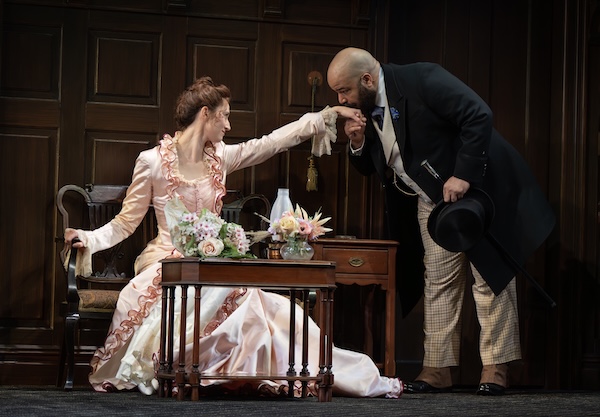
Marianna Gailus (Hedda Gabler) and Austin Durant (Judge Brack) in the Yale Rep production of Hedda Gabler. Photo: Joan Marcus
Thankfully, director James Bundy, in his satisfyingly modulated Yale Rep production, lets our imaginations do the work; he keeps the reported orgies at Miss Diana’s risqué salon and Judge Brack’s home offstage. What’s most refreshing about this Hedda Gabler is that Marianna Gailus’s compelling portrait of the off-putting protagonist cuts against the neon-lit bad-girl grain. The actress does not lean into the character’s putdowns and nastiness, or her sardonic irritation at being required to serve staid conventions. No, this Hedda speaks deadly truth when she tells Brack how deeply bored she is. Gailus delivers Hedda’s barbs with an enervated spin — it is as if the woman is too dispirited to energetically demean those around her.
And that approach usefully highlights what it takes to bring Hedda to fitful life — the opportunity to play with the lives of others, to put into action disastrous scenarios, supposedly in the service of elevating others. One of the most amazing scenes in Ibsen is staged beautifully here, when Hedda gets an opportunity to commit an act of creative/destructive power — destroying the old so that the new can be born. Gailus flickers with giggles of illicit excitement as she balls up the pages of Løvborg’s irreplaceable manuscript and slowly flings them into the fire. Here is what our antiheroine says as she is doing the evil deed in Paul Walsh’s translation: “Now I am burning your child, Thea! You with the lovely hair. Your and Eilert Løvborg’s child. I’m burning it. Burning the child. Killing your child.” It is an act of infanticide, a reminder that, for Ibsen, family life is the primal site of rebellion.
Gailus’s strong performance is enhanced by those in the rest of the Yale Rep cast. George’s Aunt Juliane is often minimized as a good-naturedly servile soul; Felicity Jones’s Latta injects welcome backbone into the character, though it would be nice if Latta also suggested that, on occasion, the slighted Juliane is needling Hedda — she knows Hedda isn’t anxious to admit she is expecting. Max Gordon Moore’s George Tesman eludes falling into comic-pedant caricature, while Stephanie Machado, as the exploited Thea, displays some tonic flashes of anger. (Hedda‘s Thea stalks off to write her own book after she learns Løvborg lost the manuscript they had worked on together — it is a gratifying change.) As Judge Brack, Austin Durant delivers a sturdy portrait of subtly oily male gamesmanship. Brack is on the hunt for another woman in his collection of mistresses, but he is not a transparent brute. He is systemic patriarchy personified — maintaining surface respectability, arranging his sensual enjoyments out of sight, making sure he is in a position to protect himself and those he is interested in controlling. Hedda is not the only one in this society who is deathly afraid of scandal.
While he was composing Hedda Gabler, Ibsen wrote in his notes that “Life is not tragic — life is ridiculous — and that cannot be borne.” Is that the play’s message for us now? It can be interpreted as a tragicomic farce about the absurd constraints of gender roles. What caught my eye in this fine production — and got me thinking — was the striking visual of two women dressed in mourning in the final scene. Hedda is dressed in black in recognition of the death of George’s Aunt Rina, but it also foreshadows her own demise. The other woman in black is Aunt Juliane, whom Hedda and Judge Brack condescend to as a plebeian do-gooder. She cared for Aunt Rina when she was ill and now, with an empty room available, Juliane informs Hedda that she will take in “a poor creature who needs care and attention, unfortunately.” Hedda is aghast — “But a total stranger —” To which Juliane replies, “With sick people you’re soon friends. And I really do need someone to live for.” Later in that scene, George says his aunt might take in the socially ostracized Thea, who had a romantic relationship with the disgraced Løvborg and has left her husband and children for good. Might Juliane, not Hedda, be the strongest feminist rebel in this drama?
Yes, Ibsen brings Juliane back into the final act of the play as a means to poke Hedda into publicly confessing that she is pregnant. But she is also there to serve as a patronized but admirable alternative to Hedda’s unbridled, charismatic egotism. Is it any surprise that Juliane is completely omitted from the film Hedda? For all of its progressive preening, the storyline is obsessed with the glittery machinations of selfishness. Ibsen was too great a dramatist to leave the theatrical ground entirely to the self-destructive, pistol-packing Hedda, as fascinatingly enigmatic as she is. Life may be ridiculous rather than tragic, but we are all in it together. One thing to do while passing the time is to care for others, even strangers.
Bill Marx is the editor-in-chief of The Arts Fuse. For over four decades, he has written about arts and culture for print, broadcast, and online. He has regularly reviewed theater for National Public Radio Station WBUR and The Boston Globe. He created and edited WBUR Online Arts, a cultural webzine that in 2004 won an Online Journalism Award for Specialty Journalism. In 2007 he created The Arts Fuse, an online magazine dedicated to covering arts and culture in Boston and throughout New England.
Tagged: Austin Durant, Hedda Gabler, Henrik Ibsen, James Bundy, James Udom, Marianna Gailus, Max Gordon Moore, Stephanie Machado