Concert Review: Yo-Yo Ma and the Communion of Bach
By Aaron Keebaugh
With youthful vigor, Yo-Yo Ma performed the complete Bach Cello Suites, intermixing the music with stories of personal success, wishes for future generations, and gratitude for all those who make the Commonwealth function.
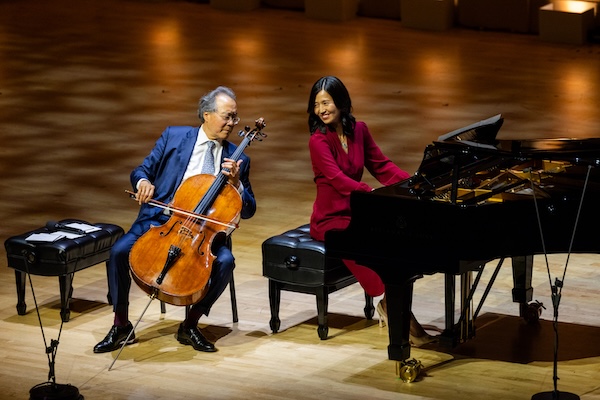
Boston Mayor Michelle Wu joined Ma onstage for the encore, accompanying him at the piano in Bach/Gounod’s “Ave Maria.” Photo: Robert Torres
These pieces have been called by their admirers a dance between humankind and God, the very definition of musical profundity. But for celebrated cellist Yo-Yo Ma, Bach’s Cello Suites reflect the indispensable values of community in a time of intense political division.
His program, titled “We The People: Celebrating Our Shared Humanity,” weaves themes of social consciousness around Bach’s familiar suites by inviting listeners to contemplate their hopes for the future.
It’s a passion project for Ma, one of a number in which he has brought together real-world concerns and musical performance. But “We The People” is tailored to inspire an era of democratic decline. Rather than sink into pessimism, Ma stands firm and resilient. With youthful vigor, he performed the complete suites, intermixing the music with stories of personal success, wishes for future generations, and gratitude for all those who make the Commonwealth function. And this Celebrity Series presentation articulated at least one deep truth — Bach’s music provides a sturdy foundation for such deep reflection on egalitarian concerns.
The performance began before a note was even struck. The hallways outside Symphony Hall displayed portraits of teachers, first responders, doctors, and health and agricultural workers, the people who make Massachusetts run. To signify his gratitude, Ma’s recital was broadcast live to more than 70 locations around the state.
Ma also instructed listeners in Symphony Hall to write their hopes for the world of 2050 onto a small card placed in the program. We were then told to exchange them with other audience members and to take these cards home and plant what was inside them. The cards contained seeds for perennial flowers that would symbolize, Ma said, the eternal wellspring of hope.
Yes, the gesture is more than a little naive, but Ma’s sentiment is genuine. He chooses to face the world with an honest optimism, insisting that the problems should be lived through rather than ignored. Bach’s music underscored all these generous feelings over a three-hour performance — without intermission. This was an exercise that demanded furious concentration as much as the listeners’ thoughtful consideration.
Ma’s relationship with the Cello Suites is deep, born of lifelong study. He has been playing these works for 65 years. He has recorded the suites three times, and performed them for audiences of all kinds. In my experience, he makes each reading feel simultaneously familiar and fresh. He explores the music’s outward exuberance as well as its underlying tensions.
Last Friday’s performance, imbued with enormous feeling, felt appropriately smooth and understated. Ma neither leaned into a strict historical approach, beyond observing every repeat, nor did he tip into expressive self-indulgence. He played the G Major Prelude with unexpected grace. His silvery tone also encouraged the D Minor Prelude to sweep gently. Ma dove into the subtle and sensitive side of Bach as the cellist shed light on the implied counterpoint of the E-flat Major Prelude and the yearning intensity of the C Minor Prelude.
The Sarabandes of each suite conveyed both tenderness and solitude. The phrases of the C Major Sarabande wafted through the air like smoke rings. The D Minor came off as alluringly distant, a lonely cry into the void. Ma sweetened his tone for the D Major Sarabande and channeled the playful urgency of the Sarabande in C Minor.
In contrast, the quick dances coursed with live-wire energy. Ma lofted the Allemande from Suite No. 1 with airy delicacy. And the ensuing Minuets swaggered with a foot-stomping lift. So did the D Minor Courante and Gigue, where courtly grace mingled with rustic vitality. The two Bourrées of the Third Suite were similarly on display as contrasts in grace and tension — one dance stepped with assurance, the other tipped toward the harmonic shadows.
Other dances were searching to the point of desperation. The Gavottes of the C Minor Suite felt as light and pointillistic as a Webern score. The Courante of the D Major Suite unfolded in a torrent, as if struggling to break free from formal constraints. The concluding Gigue bounded with vim and vigor that underscored the challenge of this Herculean recital.
“This is a lot of cello even for me,” Ma said at 10 p.m. He still had two suites to go and the crowd, which sat in rapt attention for two hours, began to break up. Those who stayed until the end were treated to a surprise encore. The Bach/Gounod Ave Maria brought Ma together with Boston Mayor and pianist Michelle Wu. Ma’s line sang soulfully against Wu’s sensitive accompaniment. The evening’s verbal messages conveyed inspiring warmth and hope. But, when played this well, Bach’s music, in all its reverence, speaks for the transcendent.
Aaron Keebaugh has been a classical music critic in Boston since 2012. His work has been featured in the Musical Times, Corymbus, Boston Classical Review, Early Music America, and BBC Radio 3. A musicologist, he teaches at North Shore Community College in both Danvers and Lynn.
Tagged: Michelle Wu, “We The People: Celebrating Our Shared Humanity”