Book Review: “Corrections At Work” — – Practical Reforms for Correctional Officers, Sidestepping Abolition
By Bill Littlefield
When it comes to the aberrant conditions in today’s jails and prisons, concerns such as how corrections officers are regarded by their superiors in the system, the media, and the public are beside the point.
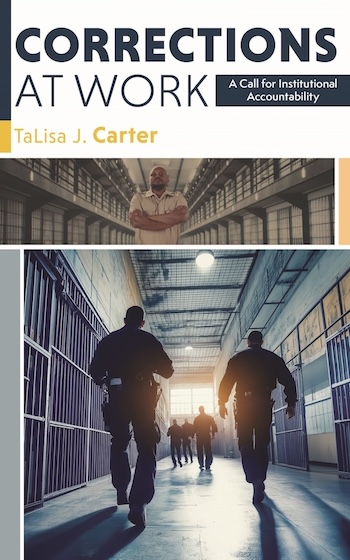
Corrections At Work: A Call For Institutional Accountability by TaLisa J. Carter. New York University Press, 231 pages. Paperback, $30
 TaLisa J. Carter is an Associate Professor in the Department of Justice, Law, and Criminology at American University. For eight months, before she attended graduate school, she was employed as a correctional officer in a jail in Georgia. Her work in the jail and her graduate training led her to develop a plan to improve the functioning of that aspect of the carceral system.
One of Carter’s goals was “to figure out a way to recruit and retain people to work in the carceral system, which is known to inflict harm on all it touches.” Although the system as constituted is harmful to everybody involved, she argues, it can be improved. There is no suggestion in Corrections At Work that we should consider whether “departments of correction” and various levels of incarceration should continue to exist in their present form. Carter is not for the abolition of prisons, only improving them.
What Carter is for is a greater emphasis on rewarding and commending correctional officers when they are doing a “good” job. That said, it is not always clear what “good” means in this context, and who should be making that determination. Should wardens and governors who’ve demonstrated contempt for incarcerated men and women be given that responsibility?
Carter doesn’t seem to make a distinction between correctional officers who work in jails and those who work in either state or federal prisons. She maintains that, in general, people doing that work are not regarded with sufficient respect. Individual officers are blamed for bad conduct when the responsibility lies with the institution. That contention is as reasonable as it is obvious. Anyone who has been in a jail or a prison quickly sees that the institution is oppressive, isolating, dehumanizing, and often brutal by design. Carter’s notion that we might alter that grim reality by tweaking the recruiting procedures, training regimen, and daily operating procedures of the men and women charged with keeping order in jails and prisons (including publicizing when jobs are well done) is tough to accept.
Some of what Carter concludes about jails and prisons and the people who work in them is indisputable. She contends that almost nobody grows up wanting to be a corrections officer. She notes the high turnover rate among such officers. She uses, as one example, the group of forty men and women with whom she went through a training program. Twenty-five percent of them were gone almost immediately after they started work, either because they’d been fired for unacceptable conduct or because they’d decided the career choice had been a mistake. Twenty-five percent sounds high, but it’s remarkable that all forty of the folks in Carter’s group made it through training, given that part of that education involved being assaulted with a taser by one of the course’s trainers. She reports that the experience was intensely painful and disorientating — but doesn’t condemn the practice. Carter reports that when she was tasered, she felt “proud, proud that I had not let any sound out at all.”
Carter acknowledges that correctional officers have been involved in smuggling drugs and weapons into prisons, assaulting incarcerated men and women, and various other felonies while on the job. She maintains that “It’s not just the apples: the barrel is rotten, too,” and that when there is “misconduct in the criminal justice system, institutions are rarely taken into consideration.” She reports that “what caused me the most grief was the way scholars approached correctional officer behavior.” She makes the point that correction officers don’t receive much attention. unless they’ve been caught breaking various rules.
The truth is, however, that almost nothing that goes on in prisons gets much attention. That’s by design. Prisons are about isolation. Three recent suicides at a medium security prison in Massachusetts failed to make the news until well after they’d occurred. In the face of that indifference, Carter insists that conditions in jails and prisons could be ameliorated through comprehensive training focused on racism and sexism, the encouragement of better relations between superior officers and the men and women they supervise through social activities such as parties and team sports, and required body cameras. Has she heard about those instances in which body cameras somehow get turned off or malfunction when they might have been most useful? She also praises a particular correctional officer who – discouraged by how gloomy the entrance to his workplace was – got the administration to paint the area in brighter colors. Here, the overused analogy of “putting lipstick on a pig” comes to mind.
Carter’s particular suggestions for reforming the system, at least as applied to correctional officers, are part of a plan she calls her “Institutional Response Model of Social Control.” She writes that she “did not formulate this theory from thin air” but “relied on two preexisting theoretical frameworks to inform the factors, relationships between concepts, and assumptions to construct this model: colorblind ideology and the theory of law and social control.” To me, this sounds simultaneously jargon-riddled and ominous.
Jails and prisons are part of an aberrant system alleged to keep those of us who aren’t incarcerated “safe.” They certainly don’t work for the future of those who have been incarcerated; the high recidivism rate is proof of that. Genuine reform will require an unwavering, and well-funded, commitment to programs within the prison that educate and train the jailed men and women for productive lives when they return home. Educating incarcerated men and women is not the responsibility of correctional officers, nor should it be. Beyond that step, there must be an effort to recognize that people born into poverty, surrounded by despair, lacking in opportunity, and erroneously regarded as incapable of learning and thriving must be valued, not ignored or incarcerated. Shamefully, American society has not accepted that humane responsibility. Until it does, concerns such as how corrections officers are regarded by their superiors in the system, the media, and the public are beside the point.
Bill Littlefield volunteers with the Emerson Prison Initiative, a program that enables incarcerated men to achieve a college degree. His most recent novel is Mercy (Black Rose Writing).
Tagged: "Corrections At Work: A Call For Institutional Accountability"