
Concert Preview: The Return of the Either/Orchestra at the Regattabar
By Jason M. Rubin
From the start, “Either/Orchestra” was a nice pun but, with Russ Gershon at the helm, the arrangements were never this or that, but rather this and that.
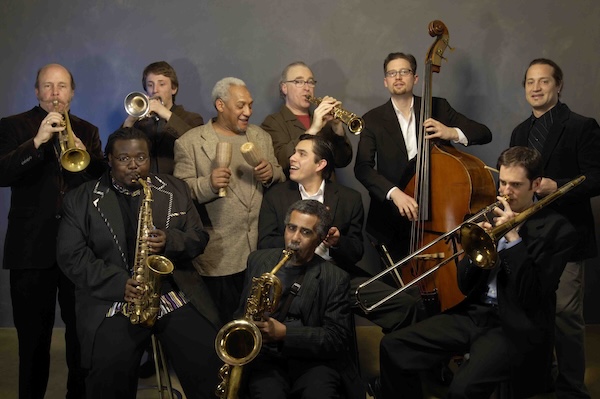
The Either/Orchestra — back after a six-year hiatus. Photo: Eric Antoniou
When the Either/Orchestra (E/O) played its first show on December 17, 1985, in the humble confines of Cambridge Public Library’s basement, few could have imagined that the quirky “small big band” — historically all white and led by Jewish saxophonist Russ Gershon — would one day become one of America’s premier proponents of Ethiopian music. After a six-year hiatus, the band is back with two shows (7:30 and 9:30 p.m.) at a more appropriate Cambridge room, the Regattabar, on the 40th anniversary of their live debut.
From the start, “Either/Orchestra” was a nice pun, but while the name might have been well-suited to the temperaments of the band members, it actually didn’t suit the music. With Gershon at the helm, the arrangements were never this or that, but rather this and that. No minimalism here. This was aptly demonstrated on the group’s second album, 1988’s Radium, which featured a medley of Thelonious Monk’s irreverent “Nutty” and Bobbie Gentry’s melodramatic pop hit “Ode to Billie Joe.”
At the time, so-called “traditional” jazz, with Wynton Marsalis its leading exponent, was in vogue. Gershon had different influences.
“I was more in tune with the postmodernists,” he said. “The bands that influenced me the most were Sun Ra’s Arkestra and the Art Ensemble of Chicago, among others. They were so eclectic, with heavy nods to Africa. I always wanted a band that was not limited by labels and that defined our direction.”
Gershon wasn’t always an avant-jazzer. He grew up in Connecticut and New York, then came to Boston in 1977 to study at Harvard. After playing in rock bands for several years — one, the Sex Execs, lost to Til Tuesday at the 1983 WBCN Rock & Roll Rumble — Gershon realized he had more to learn and enrolled at Berklee College of Music for three semesters.
With a growing book of compositions, Gershon needed a band to play them; hence the birth of the E/O. But how did this Boston-based band of talented misfits end up in Ethiopia?
“I first heard modern Ethiopian music through my friend Mark Sandman (Morphine),” said Gershon. “It really excited me. Yes, it was a bit of a left turn considering the music we had been playing, but it also fit into my wide-ranging view of the music universe. When I got to know the old-timers whose music we had been listening to, I realized how much they were influenced by American music. The world is connected so it all made sense to me.”
The E/O included arrangements of Ethiopian tunes on its 2000 album More Beautiful Than Death. These reached the ears of Francis Falceto, a French music producer responsible for the original album that Sandman had played for Gershon.
“He was interested in what we were doing, so I went to France to meet him and he invited us to play at a festival in Addis Ababa; we were one of the first Western artists to play this festival.”
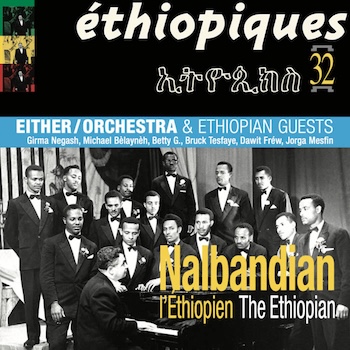
Ethiopian music colored the next few E/O albums and is the core of an upcoming new release, the band’s first since 2010: éthiopiques 32: Nalbandian the Ethiopian, which is due out in winter 2026. The title refers to Nerses Nalbandian, a music teacher and composer who arrived in Ethiopia in 1938 and shaped modern Ethiopian music by arranging traditional melodies for Western instruments.
“When we were there in 2004, Nalbandian’s children heard us play,” said Gershon. “They said, ‘You have to play our father’s music.’ So we worked out the tunes and played them over three concerts at the National Theater with Ethiopian guest singers. The concerts were recorded and the album has been finished for 10 years but we’re just now getting it out.”
At the Regattabar shows, the E/O will be playing a selection of tunes from all eras of the band, as well as from a deep pool of unreleased material (about seven hours’ worth, according to Gershon). The current lineup (and the year they joined) is as follows: Tom Halter, trumpet (1985); Dan Rosenthal, trumpet (2006); Joel Yennior, trombone (1998); Sam Spear, alto sax (2025); Russ Gershon, tenor sax (1985); Charlie Kohlhase, baritone sax (1987); Alexei Tsiganov, piano (2025); Rick McLaughlin, bass (1997); Brooke Sofferman, drums (2019); and Vicente Lebron, congas and percussion (1999).
Click here for information on the new album.
It’s worth noting that the E/O is not Gershon’s only musical outlet. The Russ Gershon Trio has a monthly residency at OGGI Gourmet in Harvard Square, playing everything from Mingus to the Monkees. Listen to This: Electric Miles Davis Music, 1968-1975, performs regularly around town. And Lookie Lookie plays bugalu, a form of music that originated among the Puerto Rican community in New York in the mid-’60s. He also teaches at Brookline Music School. As for what the future holds for the E/O, Gershon is working on booking additional dates and is writing music for the band — “but there’s lots of work to do with the other stuff,” he cautions.
Jason M. Rubin has been a professional writer for 40 years. He has written for The Arts Fuse since 2012. His books include SHORTS: A Sizable Collection of Short Fiction (2025); Villainy Ever After (2022), a collection of classic fairy tales told from the villains’ point of view; and Ancient Tales Newly Told (2019), a pairing of two historical romances, one set in 17th-century England and the other in Biblical Jerusalem and Sheba. Jason also teaches journaling workshops. He holds a BA in Journalism from the University of Massachusetts Amherst. Learn more at https://jasonmarkrubin.