
Television Review: PBS’s “The American Revolution” — It’s All in the Details
By Ed Symkus
Directors Ken Burns, Sarah Botstein, and David P. Schmidt, along with screenwriter Geoffrey C. Ward, make learning history both accessible and enjoyable.
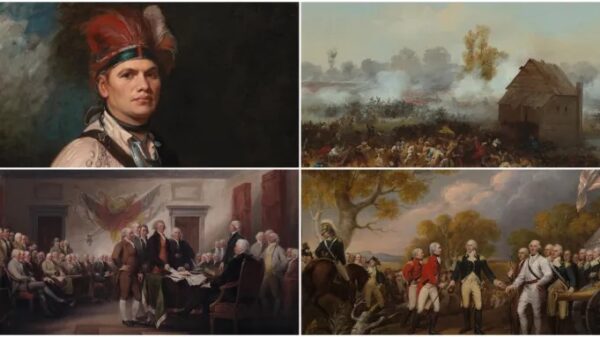
Scenes from The American Revolution. Photo: PBS
Most everyone knows how the American Revolution ended, but I’d guess not many people know how it got to that ending. Or even what the lengthy war was really all about. Or that it was lengthy at all.
I vaguely recall that a portion of my junior high school history class in a suburb south of Boston was dedicated to explaining that a bunch of Brits sailed west, put down roots in North America, and had to fight for their freedom when their former king didn’t want to grant it. There was also something about massacres in Lexington and Boston, a raucous Tea Party, Paul Revere taking a late-night ride, George Washington becoming a hero, and Benedict Arnold being some sort of double agent.
Did I learn back then that the war lasted seven-plus years, that it was about a lot more than freedom from British tyranny, or what actually caused Benedict Arnold to do what he did?
I did not. Neither was I told essential information including that John Hancock was a “practiced smuggler” and Samuel Adams was a failed brewer; the secret paramilitary organization The Sons of Liberty had a counterpart group called The Daughters of Liberty; Paul Revere’s celebrated ride took place shortly after midnight, and his warning was, “The regulars are coming!”, not “The British are coming!”; and the teeth created for George Washington by the dentist John Greenwood were not made of wood, but of human teeth, horses’ teeth, and ivory from a hippopotamus.
Ah, if only I had teachers like documentarian Ken Burns who, along with his two co-directors Sarah Botstein and David P. Schmidt, and screenwriter-historian Geoffrey C. Ward — who has collaborated with Burns for four decades — brings many levels of new light to the 18th-century conflict.
Running 12 hours over six consecutive nights (Nov. 16-21) on PBS, The American Revolution takes a deep dive into the causes and effects of what became an extended international event.
We get an inventive mix of narration (the calm, assuring intonations of Peter Coyote), talking heads (a variety of British and American historians and writers), and off-camera voices reading portions of letters and speeches from soldiers, politicians, and various eyewitnesses from back in the day, giving accounts of battles and their aftermaths.
Schmidt keeps the narration fascinating, with deft, often offbeat contributions to the script. Coyote, at one point, tells us about a group of cavalry and mounted infantry called the British Legion: “Their commander was a 25-year-old English officer — Banistre Tarleton — handsome, rakish, ruthless, and determined to make himself a celebrated soldier. ‘Tarleton,’ wrote the British chronicler Horace Walpole, ‘boasts of having butchered more men and lain with more women than anybody in the army’.”
Within the segments featuring on-camera historians, one mentions that “Democracy is not the inspiration that creates the revolution. The revolution creates the conditions for people to aspire to have a democracy.” Another says, “This wasn’t just a war between Americans and British. It was also a civil war among Americans.” At that point, the film delves into a study of clashes between the patriots (rebels) and the loyalists (those still true to the king).
One of the strongest ingredients here is the inclusion of the often recognizable voices of A-list actors for the off-camera readings of letters and speeches. Among them are: Tom Hanks, Meryl Streep, Morgan Freeman, Laura Linney, Jeff Daniels, Josh Brolin, Ethan Hawke, among many others. One inspired decision was to have Paul Giamatti provide the voice for John Adams, a role he played in the 2008 HBO miniseries John Adams.
Aside from there being so much to absorb and learn via the series’ words, there’s the other, equally strong side of anything with Burns’s name on it: the extraordinary visuals. It will surprise no one who’s familiar with his earlier entries (Baseball, Jazz, The Civil War, so many others) that this one has plentiful examples of filmed recreations of events as well as a bounty of still images — in this case, glorious oil and watercolor paintings of battles, some archival, others done in exquisitely detailed period style by contemporary artist Greg Harlin (Note: Many of Harlin’s Revolutionary War paintings are currently on display at Cabot House in Beverly.) Of course, no Burns production would be complete without a generous amount of panning and zooming over and around those still images — aka the Burns Effect. This one does not disappoint.
Behind all of that is an intricate sound mix made up of both period and original music, those omnipresent voices, and, during battle scenes, a blend of gunfire, explosions, shouts, and screams.
This is epic filmmaking and storytelling. Yes, a 12-hour commitment sounds like something of an ordeal. But The American Revolution is no such thing. There’s great depth and detail, but there isn’t a lick of fat. It’s gripping, exciting, engrossing, and sometimes distressing.
Since binge-watching it, I’ve been impressing (or maybe annoying) friends with a few factoids I took away: During the Boston Tea Party, 46 tons of tea were dumped into Boston Harbor; four months after the signing of the Declaration of Independence, a group of loyalists in New York signed a Declaration of Dependence; British soldiers often did not fare well during battles because their red coats made them good targets.
Ed Symkus is a Boston native and Emerson College graduate. He went to Woodstock, interviewed Amanda Palmer, Dan Hicks, Colin Farrell, and George Romero, and has visited the Outer Hebrides, the Lofoten Islands, Anglesey, Mykonos, Nantucket, the Azores, Catalina, Kangaroo Island, Capri, and the Isle of Wight with his wife Lisa.
Tagged: "The American Revolution", David P. Schmidt, Geoffrey C. Ward, Ken Burns, Peter Coyote
6 Comments
Leave a Comment
A beautifully done production, but Burns largely (though not entirely) follows the typical narrative. In 1774, 4,600 farmers and tradesmen ousted all judges from the Worcester County Courthouse. It was the first permanent exile of the British gov’t in the colonies.
Burns gave it a general reference of five seconds.
Makes me wonder what other crucial events are being omitted.
I have, yet, to see it, but I can easily guess what the omissions were:
1. what was done to traitors and the status of a traitor.
2. why the Constitution came AFTER the Declaration of Independence: does it make sense to found a new country without any national laws? Maybe the one-third of colonists on the eve of the Revolutionary War were UNDECIDED as to whose side they would support for THIS reason; no damn laws on a federal level
It would take far episodes to go into the kind of detail you’re seeking to cover those kinds of things.
It’s too bad he took excellent research and muddles it with mid truth. He blandly misrepresents the Establishment Clause in his summary. I applaud the retelling of history but condemn the left wing assertions that, debatable we’re not truly represented from both sides. He is NOT a “documentarian” but a propagandist.
This one will be hovering at the edge of my thoughts for a long time, much like his “The Civil War” did decades ago. When it came out, most people dismissed interest in Civil War history as a low-brow obsession. Not after that. And I’m sure many dismiss intense interest in the American Revolution similarly. The term, founding fathers, alone signals that something usually unfounded or ignorant is coming.
Not so this series. Yes, any history that shows legendary icons behaving badly – meaning behaving as people at the time behaved – will be attacked as “woke” or as leftist propaganda. But there was no such thing as what the United States became, nor was it envisioned as the cause of anything akin to democracy by the majority engaged in the war. Terms like Liberty were broad concepts. The concept of universal equality remains an aspiration to this day.
It’s not what we thought, Not generally. Not even close. This is what the documentary series conveys brilliantly.
I’ve only started watching but was struck by two things:
1. The art was amazing, emotional, moving and a history lesson in itself. I would have like more attention to the artists rather than the quick showing like flipping through a photo album even if phased in and out
2. The Six Nations tribes as the longest democracy of centuries. Before explorers pounced and claimed ownership of land and people. I hope there is more of their story as I feel we are reliving it in Ukraine, Gaza and so many other places in the world.
On this Thanksgiving, I pray Love thy neighbor as thyself” and more.