
Theater Review: Manual Cinema’s “The 4th Witch” — A Hallucinatory Vision of War and Witchcraft
By Robert Israel
Shakespeare’s Macbeth serves as a springboard for a memorable new vision by these inventive multimedia theater artists.
The 4th Witch, presented by Manual Cinema. Concept and direction by Drew Dir. Devised by Dir, Sarah Forance, and Julia Miller. Presented at the Robert J. Orchard Stage, Emerson Paramount Center, 559 Washington St., Boston, through November 9.

A scene from Manual Cinema’s The 4th Witch. Artist Credit: Drew Dir
The night I attended The Fourth Witch, Manual Cinema’s freewheeling take on Shakespeare’s Macbeth, Washington Street was under the spell of a distant hurricane spinning out to sea. I looked for the ghosts of Boston’s long ago Combat Zone, but did not see any. Instead, on this wet, windy night (October 30th), I counted many theatergoers wearing pointy black hats.
The stormy weather set just the right mood for the “hurly-burly” onstage. No, this would not be 11th-century Scotland, where Shakespeare set his inky-black drama that inspired this production. But all bets are off when this visiting troupe of nimble and inventive players encamps from Chicago.
On their website, the company members describe themselves as a troupe that “combines handmade shadow puppetry, cinematic techniques, and innovative sound and music to create immersive stories for stage and screen.” They succeed in doing just that, and more.
The 4th Witch transports us to an imaginative landscape in war-torn France, where magic mushrooms foraged from the forest possess strange powers to transform and distort. Spirits haunt this hallucinatory place. Darkness almost prevails, but light finally streams in.
But first, a bit of back story: Cineastes like Manual Cinema have long been drawn to portraying Macbeth on the screen. American Joel Coen finishes last with his 2021 The Tragedy of Macbeth starring Denzel Washington and Frances McDormand. Before Coen there was Japanese Akira Kurosawa’s Throne of Blood, before him Orson Welles’s Macbeth from the ’40s, and let’s not forget film director Roman Polanski’s violent take on the tale during the ’70s. Manual Cinema pays homage to all these productions. But these visual prestidigitators weave their own feminist-inflected fable out of the Bard’s study in warrior breakdown.
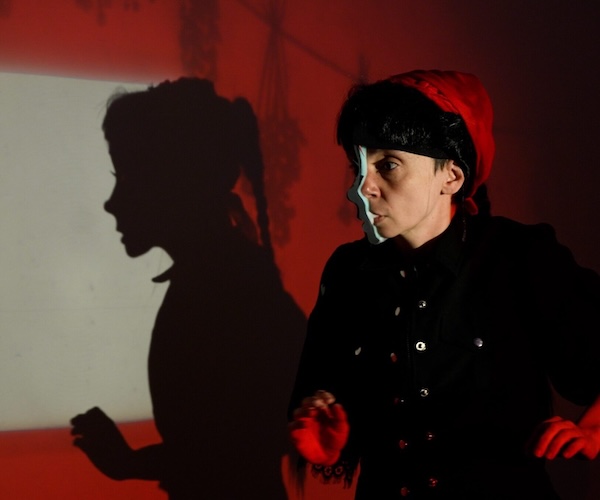
Sarah Forance performing in The 4th Witch. Photo: Katie Doyle
Without disclosing too much, Manual Cinema sets their production in a French hamlet, circa World War I, where a young girl is shown helping to prepare the evening’s meager repast. A bomb destroys their house. Seeking safety in the cellar, she survives. Soon, a soldier, Macbeth, arrives with his medal of valor and a crow on his shoulder; he chases the hapless girl into Birnam Wood, where she meets a mysterious old woman. Soon, she sets forth on a path of vengeance.
Attending a show by Manual Cinema is like being seated at an open kitchen where we get to watch as the chef, sous chef, and sundry kitchen help scurry about, each with his/her tasks to prepare a gourmet meal just for us. We see the puppeteers at work, quite seamlessly, pivoting between scenes projected above them on a wide screen. We are pulled back to the time when, as youngsters, we attended and enjoyed homemade puppet shows. I was reminded of the work of multidisciplinary Canadian dramatist Robert Lepage, who achieves this same impression of “back to childhood” through the use of sophisticated technology: complicated means to generate primal sensations in the audience. Lepage has often said he wishes he could bring a fire pit on stage to tell his stories, projecting shadows on cave walls the way our ancestors did in Lascaux, France, making figures they painted come alive in silhouette.
Kudos goes to the cast of five puppeteers — Lizi Breit, Leah Casey, Sarah Forance, Julia Miller and Jeffrey Paschal — who work like banshees. The musicians Caroline Jesalva on violin, Lia Kohl on cello and vocals, Lucy Little on violin and vocals, and Alicia Walker on piano and vocals work individually and collectively to bring a stimulatingly mordant color and pathos to the production.
Shakespeare’s tale is the springboard for these theater artists; their show is peppered with a few scenes and references to his work. That’s where the homage ends, and that’s where their memorable new vision begins.
Robert Israel, an Arts Fuse contributor since 2013, can be reached at [email protected].
Tagged: "The 4th Witch", Jeffrey Paschal, Julia Miller, Leah Casey, Lizi Breit, Macbeth, Manual Cinema
2 Comments
Leave a Comment

Of the Manual Cinema productions I have seen — this and the previous three at Arts Emerson, The 4th Witch is smoothest, the most impressively synchronized. At times, it is a jaw-dropping experience, an acrobatics of theatrical art. The far-from-sentimental storyline is compact, cohesive, and surprising — this is a silent film fable accompanied by surreal sound effects, its whirly gig of visuals Manual Cinema’s most varied and intricate yet, particularly in terms of how the storytellers play with perspective.
Film directors are not the only ones to use Shakespeare as a jumping off point. Theater artists have often put the Bard’s characters and plots through new paces — Edward Bond is one of my favorites, and the Manual Cinema’s radical rejiggering of Macbeth, with its use of marginal characters (in the original) to explore the meaning and use of violence, fits into Bond’s wheelhouse.
Finally, Bob doesn’t mention the production’s self-conscious (self-referential?) use of “echo and shadow”– these players are shadows that gambol with shadows on the screen.
I loved it, especially its reinvigoration of Macbeth as a story of the attractions of violence. And all that cooking!