Visual Arts Review: A Glitch in the System — American Artist’s Homage to Octavia Butler
By Jonathan Bonfiglio
Some critics will consider the works in this show extreme, but one of the many strengths of American Artist lies in the fact that they draw on Butler’s prescient dystopian vision, elements of which are becoming a reality.
American Artist: To Acorn at the MIT List Visual Arts Center, 20 Ames Street, Bldg. E15-109, Cambridge, through March 16, 2026.
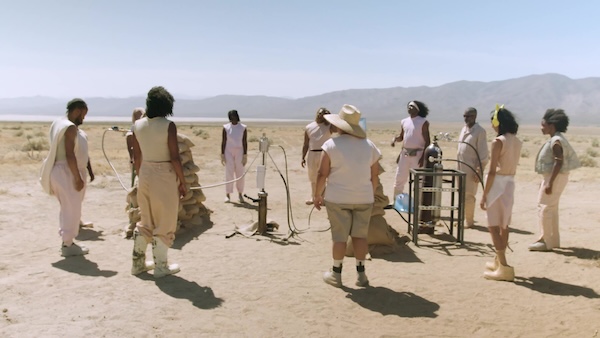
American Artist, The Monophobic Response, 2024 (still). Two-channel HD video with
sound, 18:19 min. Courtesy the artist
A small assembly of people stands in a circle in the desert. Their shadows are short; it is the heat of the day. The group members wear light tones, but the clothing offers limited protection for the various shades of darker skin that — because of the cutoff shirt sleeves and shorts — are vulnerable in that environment. There is a sense that these people are being blasted by the wind and the sun. They look uncomfortable, their body language uneasy. This is a harsh landscape and these people are exposed to the elements. It feels as if this scene could be taking place on Earth or a distant planet, real or fictional.
In the center of the circle are some objects, linked intravenously by tubing. On the outer edges sit two cylinders, each protected by a line of piled sandbags. At the heart of it all — the centerpiece of the event, the focus of everything — is something thin and seemingly inconsequential, held by a metal frame. Everything is connected by electrical wiring to a small battery and a panel of switches on the desert floor.
Whatever this is, we seem to be witnessing a laboratory event. Also, without knowing anything else about it, without context or guidance, the setup exudes the air — the accoutrements — of a trial, a test in which the outcome is uncertain. But also, without context or guidance, it also feels as though we are seeing some sort of human experiment. That is because what especially stands out — in this highly racially filtered array of data — is the skin color of the participants. It is a stark truth — and hugely socially incriminating — that what is most unusual of all in this most unusual of settings is the pigment of someone’s skin.
With context added, the drama of the scene is made clear. The cylinders hold fuel and oxygen, and the gathered disciples (?) are participating in a recreation of a 1936 rocket engine test in the desert. A further layer is added when we learn that those taking part in the event are members of a community of enthusiasts of Octavia Butler, seminal Black American writer of speculative fiction.

American Artist, The Monophobic Response, 2024 (still). Two-channel HD video with
sound, 18:19 min. Courtesy the artist
The visuals make up The Monophobic Response, a two-channel video installation from American Artist: To Acorn at the MIT List Visual Arts Center, currently celebrating its 40th anniversary. During the desert ritual, the devotees recite verses (scripture?) from Butler’s The Book of the Living, and its fictional-but-now-not-fictional religion, Earthseed, a deeply humanist series of treatises that — among other things — speaks of “taking root among the stars.”
All of this no doubt sounds speculative, notional, and complex. Well, that’s because it is, unapologetically so. American Artist — the figure and their work — has previously described themselves as wanting to be a glitch in the system. Their work is not about digestible takeaways, but invites viewers to peel back layers of uncomfortable ideas, and these can often feel abstract. It takes commitment to enter into and make sense of this artist’s elaborate, labyrinthine challenges. But it is a challenge worth taking, because their work’s innate strength is to probe issues of identity, often via a hall of perceptual mirrors. Like the books of Octavia Butler, who broke through barriers of both race and gender in her writing, abstract imaginative complication presents us with notional Venn diagrams of different possible worlds in which our reality is only one (un)happy accident among an infinity of others.
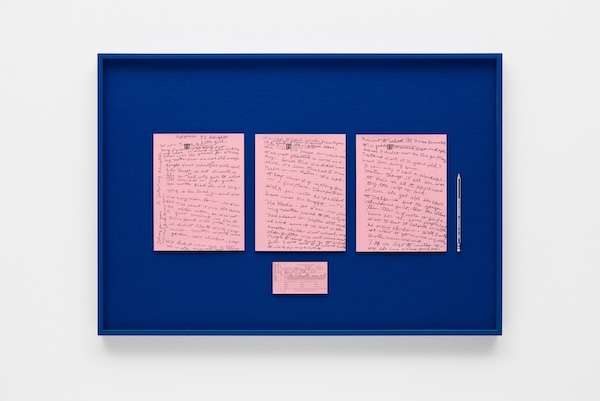
American Artist, Octavia E. Butler Papers: mssOEB 1-9062 I (Mother to Daughter), 2022. Huntington Library stationery, graphite, pencil, felt. Framed: 26½ × 38 × 1¾ in. (67 × 97 cm). Courtesy the artist and Commonwealth and Council, Los Angeles
However you look at The Monophobic Response Butler is foregrounded: she and the speculative possibilities she devoted her life to are at the heart of this piece as well as the entire American Artist: To Acorn exhibition. American Artist studied at the same high school as Butler, and undertook an ongoing study-meditation of Butler’s papers at the Huntington Library in San Marino, California. Indeed, various related pieces have appeared in the recent work of American Artist, and at the MIT List Visual Arts Center viewers can look at Octavia E. Butler Papers: mssOEB 1-9062 I (Mother to Daughter) — precise graphite tracings made by American Artist of the traces of the writer’s life. This work is an artistic facsimile of documents written by Octavia E. Butler’s mother, Margaret Butler, detailing her own mother’s efforts to raise her children in rural Louisiana during a time of poverty and segregation. These documents speak of devotion, have the feel of sacred ground.
American Artist has a long track record of undergoing extensive thought experiments through which they interrogate racial capitalism, in particular how it exploits technology and the production of “knowledge.” Perhaps most notable in all these actions was their legal name change in 2013, which in a single masterstroke lifted them to the summit of those specific Google search terms. Name recognition was hijacked while, at the same time, the artist remained hidden behind the algorithm.
Some critics will consider the work in this show extreme, but one of the many strengths of American Artist lies in the fact that they draw on Butler’s prescient dystopian vision, aspects of which are becoming a reality. And who is to say, after all, what is radical? Is it a longing to live forever, leaving the earth and its difficulties (such as Elon Musk’s desire to transport chosen immortals to Mars) or is it our segregated and increasingly unequal world?
As well as writing about art in the American continents, Jonathan Bonfiglio covers Latin America for The Times in London and regularly broadcasts for the likes of LBC (UK), ABC (Australia) and TalkRadio (UK). His new podcast “Less Time Than Ideas – Art Across the Americas” is available across streaming platforms.
Tagged: "American Artist: To Acorn", American Artist, Black science fiction, MIT List Visual Arts Center